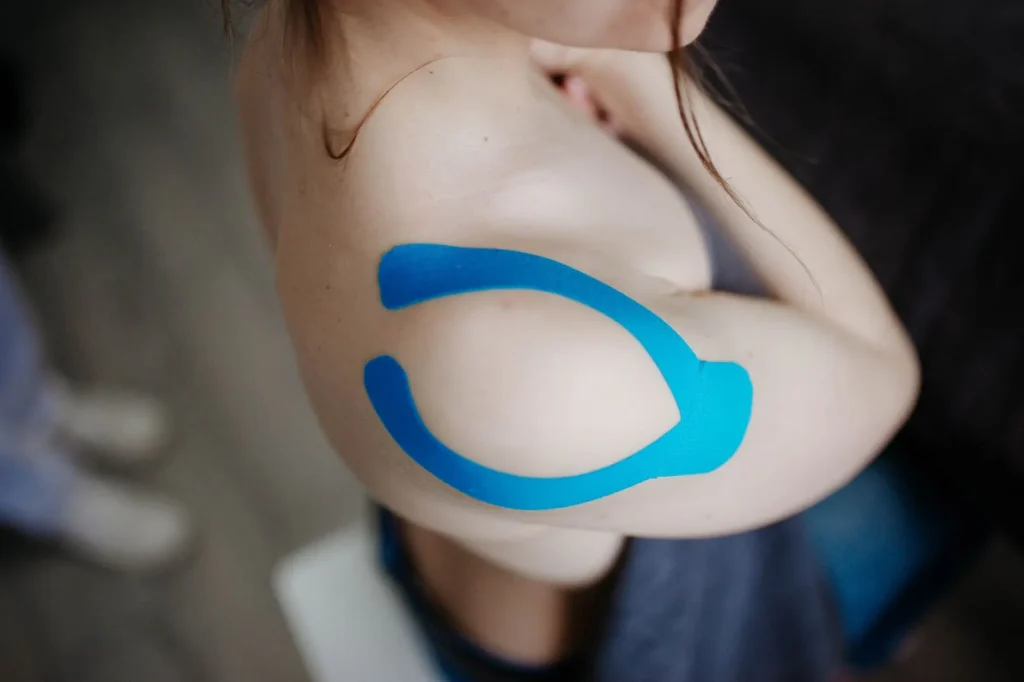
Two tapes, two philosophies, one question every athlete eventually asks: which one does my injury need? Athletic tape is the rigid white strapping that immobilizes; kinesiology tape is the colorful elastic that supports while moving. They are not competitors; they are different tools for different phases of healing, and choosing wrong wastes both.
Key Takeaway: Athletic (rigid) tape restricts movement to protect healing structures: the sprained ankle’s early weeks, the thumb that must not bend. Kinesiology tape is elastic, allows full range, and works through proprioceptive feedback and gentle tissue lifting: the swollen knee, the tired shoulder, the muscle that needs reminding. Rigid protects; kinesiology supports. Your injury’s phase picks the tape.
Athletic tape: the bodyguard
Rigid athletic tape, the white zinc-oxide strapping, is mechanical restriction applied precisely:
- Job: limit the range that damages healing ligaments, the sprained ankle’s inversion guard
- Mechanic: near-zero stretch, anchored strapping that turns tape into an external ligament
- Window: the acute and early sub-acute phases, when the tissue cannot tolerate the motion it will eventually need
- Cost: the restriction it provides is also its limitation; joints taped rigid lose their feed and their position sense with every day worn
Athletic taping is a skill: the specific anchors and stirrups for each joint are techniques, and a badly applied rigid tape is both useless and a skin problem. It is also, by design, temporary: the phase passes, and the tape comes off.
Kinesiology tape: the coach
Kinesiology tape (K-tape) is elastic, thin, and designed for days-long wear, and its mechanism is feedback more than force:
- Job: enhance proprioception, support without restricting, and gently lift the skin to improve the space beneath it
- Wear time: 3 to 5 days per application, through showers and training
- Range: full motion preserved; the tape moves with you
- The applications: swelling management (the lymphatic fan cuts), muscle facilitation or inhibition, postural reminders, and the edema work
K-tape’s honest evidence profile: solid for its sensory and edema effects, mixed for strength and performance claims. It is a support tool inside rehabilitation, not a treatment by itself, and the clinics that use it well say so.
The comparison table
| Feature | Athletic (rigid) tape | Kinesiology (elastic) tape |
|---|---|---|
| Stretch | None | High elasticity |
| Job | Restrict and protect | Support and feedback |
| Range of motion | Restricted | Full |
| Wear time | Hours to a day | 3-5 days |
| Phase | Acute healing | Recovery through return |
| Feel | Firm, immobilizing | Forgotten within minutes |
The injury phases, and which tape each needs
| Phase | Example: ankle sprain | Tape of choice |
|---|---|---|
| Acute (days 1-7) | Swelling, pain, unstable weight-bearing | Rigid taping or bracing: protection leads |
| Early recovery (weeks 1-3) | Motion returning, strength starting | Transition: less rigid taping, kinesiology for swelling and feedback |
| Rebuilding (weeks 3-8) | Balance and strength training | Kinesiology tape as a proprioceptive aid during drills |
| Return to sport | Full training, game days | Sport taping for high-risk athletes; kinesiology for the support feel |
Patients receiving Kinesio Taping services in Milton get the tape matched to the phase: the acute ankle gets protection, the swollen knee gets the fan cuts, and the returning athlete gets the feedback layer their rehab earned.
What kinesiology tape actually does, mechanism by mechanism
- Proprioceptive feedback: the skin’s constant gentle input sharpens the body’s position sense; the taped ankle knows where it is
- Skin lifting: the elastic recoil lifts the skin microscopically, decompressing the lymphatic channels beneath; the swelling fan cuts use this
- Muscle facilitation or inhibition: applied with tension and direction, the tape cues underactive muscles or calms overactive ones
- Pain modulation: the skin input competes with the pain signal, the gate-control mechanism, reducing the perception
The mechanisms are modest and real: kinesiology tape is not magic, and it is not nothing. It is a low-risk feedback tool that makes exercises better tolerated and swelling resolve faster when paired with the rest of the plan.
When taping is the wrong tool entirely
- Complete ligament ruptures: surgical and bracing conversations, not tape
- Untreated fractures: imaging first, always, for the injury that cannot weight-bear
- Chronic tendinopathy as a standalone: tape supports the program; it is not the program
- Skin disease, fragile skin, or tape allergies: the alternatives exist and get discussed
The taping techniques patients see most
- The ankle stability strips: the lateral support for the returning sprain
- The knee medially-supporting application: the patellar tracking aid
- The shoulder facilitation strips: the rotator cuff’s tired-muscle wake-up call
- The lymphatic fan: the swollen knee’s or ankle’s drainage cuts, the post-bruise classic
- The low back application: the posture-feedback strip for the desk and lifting days
The ankle sprain: the case that explains both tapes
The inversion ankle sprain is taping’s textbook case, and its phases walk through both philosophies:
- Week 1: the rigid taping or lace-up brace protects the healing lateral ligaments through the swelling’s worst week
- Weeks 2 to 3: the transition: less rigid restriction, the kinesiology’s drainage fans for the bruising, and the balance work begins
- Weeks 4 to 8: the proprioception training, tape as feedback aid, the peroneal strength rebuilding
- Return to sport: the athlete’s choice between sport taping, bracing, or the trained ankle alone, made with the testing data
The sprain that got rigid tape forever is the ankle that never relearned balance; the sprain that got K-tape alone in week one is the one that rolled again. The phase matching is the whole art.
The swelling fan: kinesiology’s most visible trick
The lymphatic fan cut, five tape tails splayed over a swollen region, is the technique that surprises patients with its effect:
- The mechanism: the tape’s elastic recoil lifts the skin slightly, decompressing the lymphatic vessels that drain the region
- The applications: post-bruise swelling, the surgical edema (with clearance), the chronic hand and ankle swelling
- The evidence: reasonable for edema support, especially paired with elevation and movement
The fan is applied with the tape stretched on the backing paper, laid with zero tension on the skin, and it works quietly for days while the swelling drains through the movement the tape makes possible.
Taping and bracing: the neighbors, not competitors
The ankle conversation often arrives at bracing versus taping, and the honest comparison:
- Lace-up and semi-rigid ankle braces: reusable, adjustable, self-applied, the practical choice for season-long protection
- Rigid taping: the custom fit per application, the cost per taping session, and the skill it requires; often preferred by athletes who feel the difference
- The combination: taping for games, brace for training, is a common and legitimate pattern
The assessment sorts the protection plan, and the tape is one layer of it.
The shoulder: kinesiology’s most grateful customer
The shoulder responds to taping better than almost any region, and the reasons are mechanical:
- The rotator cuff’s fatigue pattern: the tired muscles that stop controlling the shoulder blade late in the day; the tape’s facilitation strips cue them for hours
- The posture feedback: the shoulder-rolling desk pattern, and the tape that reminds the shoulders where they live
- The overhead athletes: the throwers and swimmers whose cuffs need the proprioceptive support through long sessions
The shoulder taping lasts 3 to 5 days, survives the showers, and gives the cuff a coach between exercise sessions. It pairs with the scapular strengthening that eventually replaces it.
The knee’s patellar applications
- The tracking support: the tape that nudges the kneecap’s glide, easing the patellofemoral pain during the strengthening program
- The quad and VMO facilitation: the inner thigh muscle’s wake-up for the runner’s knee pattern
- The evidence: taping reduces patellofemoral pain meaningfully in the short term, and it pairs with the hip and quad programs that make it unnecessary
The low back application: the honest scope
The low back taping is a feedback tool, and its honest job is posture awareness, not structural support:
- The lifting days: the tape’s tension reminds the back to hinge rather than round
- The desk weeks: the posture strip that makes every slouch noticeable
- The scope: the back’s problems respond to strengthening and movement; the tape is the reminder, not the fix, and the clinics that say so are the ones worth keeping
The taping course in a rehabilitation plan
- Acute phase: protection leads (rigid or brace), the drainage fans for the swelling
- Recovery phase: the facilitation strips that make the exercises land better
- Return phase: the sport applications, the athlete’s preferences, the testing that decides the graduation
The tape’s appearances through the plan are choreographed like everything else: each application has a job, and the job has an end date.
The evidence, honestly framed
Taping research is extensive and nuanced, and the honest summary by claim:
- Proprioceptive effects: well supported; the taped joint’s position sense measurably improves
- Edema management: reasonably supported for the fan-cut technique paired with movement and elevation
- Pain reduction: supported short-term across multiple regions, consistent with the gate-control mechanism
- Strength enhancement: weakly supported, the tape cues, and the training strengthens
- Injury prevention: the taping evidence is weaker than the bracing evidence for ankle prevention, and the honest clinics say so
The framing that serves patients: taping is a low-risk, evidence-supported adjunct inside rehabilitation, and its effects are real but modest. The clinics that oversell it are as wrong as the skeptics who dismiss it; the tape does exactly what it does, and the plan uses it there.
Taping through the seasons: the Halton athlete’s calendar
- Hockey season: the shoulder and hip applications through the contact months, the game-day sport taping for the returning ankles
- Running season: the patellar applications during the build, the calf strips for the escarpment descents
- Golf season: the lead-side shoulder and the trunk feedback strips
- The court sports: the jumping knee’s tracking applications through the tournament weekends
The taping calendar follows the sport calendar, and the pre-season assessment sets the season’s applications in advance.
The bottom line: two tapes, two questions
Ask two questions and the tape picks itself: what phase is the injury in, and what job needs doing? Protection and restriction: athletic tape. Support, feedback, and swelling: kinesiology tape. The phases answer the questions, and the assessment reads the phases.
If your drawer holds both tapes and your applications have been guess work, one teaching session with your injury’s actual phase mapped ends the guessing. The right tape on the right week is worth more than either tape on the wrong one.
Getting taped properly in Milton
Tonic Physio’s physiotherapists and massage therapists apply both taping systems for Milton, Oakville, and Halton athletes: the phase-matched selection, the sport-specific applications, and the teaching that makes the home applications safe.
If you have been taping yourself from internet tutorials, one session with the technique taught properly usually upgrades every application you do afterward. The tape is simple; the placement is the treatment.
Answers to the questions patients ask most
Does the color matter?
No. The colors are marketing; the tape’s properties are identical across the rainbow. Choose the color that makes you want to wear it, because adherence is the only mechanism that color affects.
Why did my physiotherapist use rigid tape on my ankle and kinesiology tape on my knee?
Phase matching: the sprained ankle is early in its protection window, and the swollen knee is ready for drainage and feedback. The two tapes answered two different questions for the same athlete on the same day.
Can I apply kinesiology tape myself?
After the technique is taught, yes: the home applications are part of the plan, and the practitioner marks the anchor points. The first application should be professional; the maintenance applications are learnable in one lesson.
Is taping a substitute for rehabilitation?
Never. The tape supports the rehab’s window; the strength and balance work is the actual treatment. The taped ankle that skips its exercises meets the same curb eventually, tape or no tape.
Why does my skin react to the tape?
Sensitive skin reacts to adhesives, and the fixes are real: hypoallergenic tapes, shorter wear times, and skin prep. A rash means remove and report; the technique adapts rather than the skin enduring.
The sport-specific taping: hockey, running, and court sports
Milton’s sports calendar writes the taping calendar, and the applications follow the seasons:
- Hockey: the shoulder and hip facilitation strips through the contact months, the returning ankle’s game-day support
- Running: the patellar tracking applications through the mileage builds, the calf strips for the descents
- Soccer and field sports: the ankle’s stability strips through the tournament weekends
- Golf: the lead-side shoulder and the trunk feedback for the rotational load
The taping calendar follows the sport calendar, and the pre-season assessment sets the season’s applications in advance.
The taping decision tree, compressed
- Is the injury in its first days, and does it need protection? Rigid tape or brace
- Is the swelling active and the region ready for gentle support? The kinesiology fans
- Is the muscle tired but the structure sound? The facilitation strips
- Is the sport’s demand specific? The sport’s techniques, learned properly once
The tape removal and skin care guide
- The removal: the adhesive spray or the oil, peeled slowly along the hair’s direction, never ripped
- The skin between applications: cleaned, dried, and rested for a day if irritated
- The hypoallergenic options: the sensitive-skin tapes that keep the technique available to reactive skin
The skin is the tape’s partner, and the partnership survives on the prep, the removal care, and the reporting when the skin objects. The patients who tape weekly develop a routine that keeps the skin as healthy as it was before the application.