Balance exercises for seniors are simple standing, stepping and strengthening movements, done near a sturdy support, that train the body to stay steady. Done regularly, exercise that challenges balance is one of the best-supported ways to lower the chance of falling. Start slowly and ask a physiotherapist to tailor the program to you.
Key Takeaway: Exercise that challenges balance and strengthens the legs is one of the best-supported ways to lower the chance of falling in older adults. Start next to a sturdy support, progress slowly, and see a doctor first if you have dizziness, a recent fall or a sudden change in balance.
Why does balance decline with age?
Balance is the body’s ability to stay steady by combining signals from your eyes, inner ear, muscles and joints, and each of these can change with age. Slower reflexes, weaker legs and reduced feeling in the feet all make it harder to catch yourself. The changes are common, and exercise can help with many of them.
The three systems behind balance
- Vision: shows where you are in relation to your surroundings.
- The inner ear: senses head movement and position.
- Muscles, joints and feet: send position signals and produce the corrective movements.
Your brain blends these signals many times a second. When one weakens, the others work harder.
Common contributors to unsteadiness
Leg weakness, stiff ankles, foot numbness from conditions such as diabetes, poor eyesight, some medicines and low blood pressure on standing can all affect balance. So can arthritis pain and fear of falling. A review with your doctor is worthwhile, because some causes can be treated.
Do balance exercises really prevent falls?
Research says exercise can reduce falls. The World Health Organization lists exercise that challenges balance among the effective measures for older people. It does not work for everyone, but it is one of the better-studied tools available.
What the research shows
A Cochrane review of 108 trials with more than 23,000 community-dwelling older adults found that exercise reduces the rate of falls by 23% (high-certainty evidence). The review notes that at least one in three people over 65 fall each year. You can read the abstract on PubMed.
The World Health Organization falls fact sheet also lists balance-challenging exercise and home hazard reduction among effective measures.
Why strength matters as much as balance
Good balance needs strong legs and hips to react quickly. Standing up from a chair, climbing a step and catching a stumble all depend on strength. That is why most effective programs combine balance practice with leg strengthening.
Our guide to geriatric physiotherapy for strength and independence explains how the two fit together.
How can you do balance exercises safely at home?
Set up the space first, then start with easy versions. The goal is to challenge your balance without risking a fall. If you are unsure, ask a physiotherapist to watch your first session.
Safety rules before you start
- Stand next to a sturdy kitchen counter or heavy chair that cannot slide
- Wear flat, supportive shoes or non-slip socks, not loose slippers
- Keep the floor clear of rugs and cords, with good lighting
- Have a phone nearby, and ideally another person at home
- Stop if you feel dizzy, chest pain, shortness of breath or sharp pain
How often to practise
Many programs ask for balance practice a few times a week, with short sessions that fit into the day. A few minutes of brushing-teeth balance or kettle-boiling balance can add up. Regular practice over weeks matters more than one long session.
Try linking practice to daily routines. Balance near the counter while the kettle boils, or do a few sit-to-stands during a television break. Attaching exercise to a habit you already have makes it easier to keep up.
Who should check first
Speak with your doctor or physiotherapist before starting if you have dizziness, a recent fall, heart or lung conditions, osteoporosis, joint replacements or significant pain. They can adjust the exercises or suggest supervised classes. Our article on vertigo red flags explains when dizziness needs a specialist.
Which balance exercises can seniors do?
The exercises below are common starting points, not a prescription. Choose versions that feel steady, keep your hands near support, and move to harder versions only when the easier ones feel boring. Your physiotherapist can adjust the dose.
Standing foundations
- Feet together stand: hold a counter, then try hovering your fingertips. Aim for 10 to 30 seconds.
- Tandem stand: one foot directly in front of the other, with support. Switch feet.
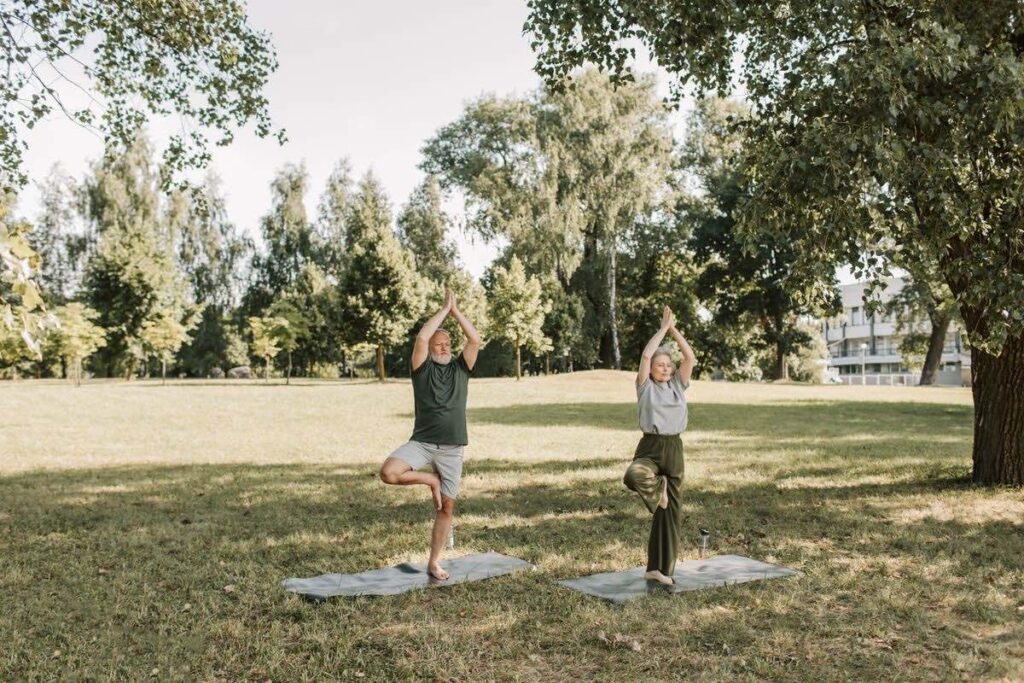
- Single-leg stand: lift one foot slightly while holding the counter. Try 10 seconds on each side.
Progress by lightening your grip, then by using one fingertip. Do not close your eyes unless a clinician has supervised the exercise.
Walking and stepping drills
- Heel-to-toe walk: walk along a counter, placing one heel directly in front of the other toes.
- Marching on the spot: lift each knee a little, holding support at first.
- Side steps: step sideways along the counter, 10 steps each way.
- Clock reach: stand tall, hold support, and reach the free hand toward the numbers of an imaginary clock.
Strength builders
- Sit to stand: rise from a sturdy chair and sit down slowly, 2 to 3 sets of 5 to 10.
- Heel raises: rise onto your toes while holding a counter, 2 sets of 8 to 12.
- Side leg lift: lift one leg out to the side while holding support, 2 sets of 8 to 10.
- Step-ups: low step with a rail or counter nearby.
If any exercise causes pain or makes you feel unstable, shrink it or skip it and tell your therapist.
How do you progress balance exercises?
Progress when an exercise feels steady and easy, not when you feel impatient. Change one thing at a time so you can tell what is working. A small step forward that feels safe beats a big jump that leads to a stumble.
Signs you are ready for a harder version
- You can finish the exercise without gripping the counter
- You feel steady the next day, with no new soreness or wobbliness
- You have done the same level for two weeks or more
Ways to make an exercise harder
Common steps include narrowing your stance, using less hand support, adding slow head turns, or holding the position a few seconds longer. Standing on a soft surface or closing your eyes is an advanced step and is best tried only under supervision.
The table lays out the steps in a safe order.
| Step | What changes | Safety note |
|---|---|---|
| Narrow your stance | Feet closer together, or one foot directly in front of the other | Keep a counter within reach |
| Use less support | Move from a firm grip to one fingertip, then hover | Stay right beside the counter |
| Add slow head turns | Look left and right while standing steady | Stop if you feel dizzy |
| Hold longer | Add a few seconds each week | Rest between holds |
| Soft surface or eyes closed | Advanced steps | Only with supervision |
When to stay at the same level
If you feel dizzy, notice pain, or have had a recent illness or fall, hold at the current level or step back. Plateaus are normal. A physiotherapist can help decide whether to progress, change the exercise or look for another cause.
Keep a simple weekly log. Note which exercises you did, how steady you felt and whether anything caused dizziness. Bring the log to your physiotherapist, who can use it to choose the next step with you.
How can you make your home safer?
Exercise lowers risk, and a safer home removes hazards that exercise cannot fix. The World Health Organization also lists home hazard reduction among effective fall prevention measures. A short walk-through can find most problems.
Room by room checklist
- Remove loose rugs or fix them with non-slip backing
- Add night lights between the bedroom and bathroom
- Install grab bars near the toilet and in the shower
- Keep frequently used items between waist and shoulder height
- Secure handrails on both sides of the stairs
Winter and outdoor steps in Halton
Ice and snow raise the risk for older adults in Milton and across Halton Region. Use boots with good tread, add clip-on ice grips when conditions are slippery, and keep walkways salted. Take shorter steps, keep your hands free and ask for help with heavy shovelling.
Plan ahead on icy days. Check the forecast, allow extra time and consider waiting for sidewalks to be cleared before heading out. Carry a small bag across your body so both hands stay free, and use handrails whenever they are available.
Vision, medicines and footwear
Have your eyes checked regularly, review your medicines with your doctor or pharmacist, and choose shoes that fit well with a firm sole. Some medicines can cause dizziness, so report new unsteadiness to your doctor instead of stopping anything on your own.
What if you are afraid of falling?
Fear of falling is common, particularly after a scare. It can lead people to move less, which weakens muscles and may raise the risk of a fall. Gradual, supported practice can rebuild confidence.
The fear and inactivity cycle
When you avoid walking or stairs, your legs weaken and your balance gets less practice. Weaker legs make unsteadiness more likely, which increases the fear. Breaking the cycle usually starts with small, safe steps.
Building confidence gradually
Start with supported exercises, celebrate small gains and keep a simple log of what you can do. Practising with a physiotherapist, a friend or a community exercise class can make it easier to keep going. Our article on osteopathy for seniors describes another gentle option some people use for stiffness.
What should you do after a fall?
Stay calm and take a minute to check for pain or injury before you try to move. The NHS advises that if you can get up, you should roll onto your side, move to hands and knees, find a stable support and rise slowly. If you cannot get up, call for help.
Right after the fall
- Check for pain in the head, neck, back, hip and wrists
- Do not get up quickly or try to push through severe pain
- Use a phone or alarm to call for help if you cannot get up
- Keep warm and change position if you are waiting for help
Follow up with your doctor
Tell your doctor about any fall, even without injury. They can check for causes such as medicines, blood pressure changes, vision problems and heart rhythm issues. The NHS guide to falls has a clear step-by-step overview.
When should you see a doctor or go to emergency?
Many balance problems can improve with exercise, but some need medical assessment before you start. Do not use exercise to treat new dizziness or sudden changes.
See a doctor soon if
- You have had more than one fall or a fall with injury
- You feel faint, lightheaded or dizzy when standing up
- Your legs feel weak, numb or heavy
- Your balance has changed suddenly over days or weeks
Go to emergency or call 911 if
Call 911 for sudden facial drooping, arm weakness or slurred speech, a sudden severe headache, chest pain, or loss of consciousness. Go to emergency after a fall with a head injury, a suspected broken bone or inability to bear weight. If you take blood thinners, any head knock needs urgent assessment.
How can physiotherapy in Milton help?
You do not need a doctor’s referral to see a physiotherapist in Ontario. At Tonic Physio, a physiotherapist can check your balance, strength and walking, then build a program matched to your level. Physiotherapists in Ontario are regulated by the College of Physiotherapists of Ontario.
What a balance assessment includes
Expect questions about falls and medicines, simple tests such as standing on one leg, rising from a chair and walking, and a look at footwear and home setup. You leave with a short set of exercises and advice on what to change. Learn more about balance and fall prevention in Milton.
If a cane or walker is part of your day, mention it. We can check the fit and show you how to use it safely, because a poorly adjusted aid can affect your balance rather than help it.
Coverage and billing
OHIP covers physiotherapy only in limited situations, so many people use extended health benefits. Ask your doctor or local health unit whether publicly funded exercise programs are available near you. Direct billing may be available with some insurers.
If you or a parent feel less steady than before, you can book a physiotherapy visit online to start a balance plan.