Scoliosis exercises can build back and core strength, support everyday movement and keep you active, but they do not reliably straighten a curve. Research on scoliosis-specific exercise, such as the Schroth method, is promising for some teens yet still mixed. A physiotherapist can shape a plan that works alongside your doctor’s monitoring.
Key Takeaway: Exercise is safe and useful for most people with scoliosis, mainly for strength, comfort and fitness. The evidence that exercise changes the curve itself is limited. Curve measurement and brace decisions belong with your doctor or spine specialist.
What is scoliosis?
Scoliosis is a sideways curve of the spine, often with a twist of the vertebrae, that can be seen on an X-ray and sometimes in how the body looks. The NHS explains that it can affect people of any age but most often starts in children aged 10 to 15.
Many curves are mild and never cause problems. A small number grow enough to need bracing or, rarely, surgery.
Types of scoliosis
In around 8 in every 10 cases the cause is unknown, which is called idiopathic scoliosis. Less often the curve is congenital, meaning the spine formed differently before birth, or neuromuscular, linked to a nerve or muscle condition. Degenerative scoliosis develops in older adults from wear and tear in the spine.
How a curve is measured
Doctors use an X-ray to measure the curve in degrees. This measurement is called the Cobb angle. It helps them decide whether to watch, brace or refer, and it is compared over time to see whether the curve is changing.
Does posture or exercise cause scoliosis?
No. The NHS says idiopathic scoliosis is not thought to be linked to bad posture, exercise or diet, so neither a parent nor a teen should feel at fault. Good posture habits can still ease tiredness and aches, as we explain in our posture guide.
What are the signs of scoliosis in teens and adults?
Signs can be easy to miss because scoliosis usually does not hurt in young people. A school screening, a family doctor or a physiotherapist is often the first to notice. Only an assessment and an X-ray can confirm it.
Signs in children and teens
The NHS lists a visibly curved spine, one shoulder or hip sticking out, uneven shoulders, ribs sticking out on one side and clothes that do not fit well. A parent may notice that a hem hangs unevenly or that a shoulder blade looks more prominent.
See a doctor if you think your child may have scoliosis. It is unlikely to be serious, but earlier checks give more options.
Signs in adults
Many people notice back pain, stiffness, a visible curve or a change in height or waist shape. Pain is more common in adults with the condition than in children. Older adults can develop a curve from age-related changes in the discs and joints.
How clinicians check for a curve
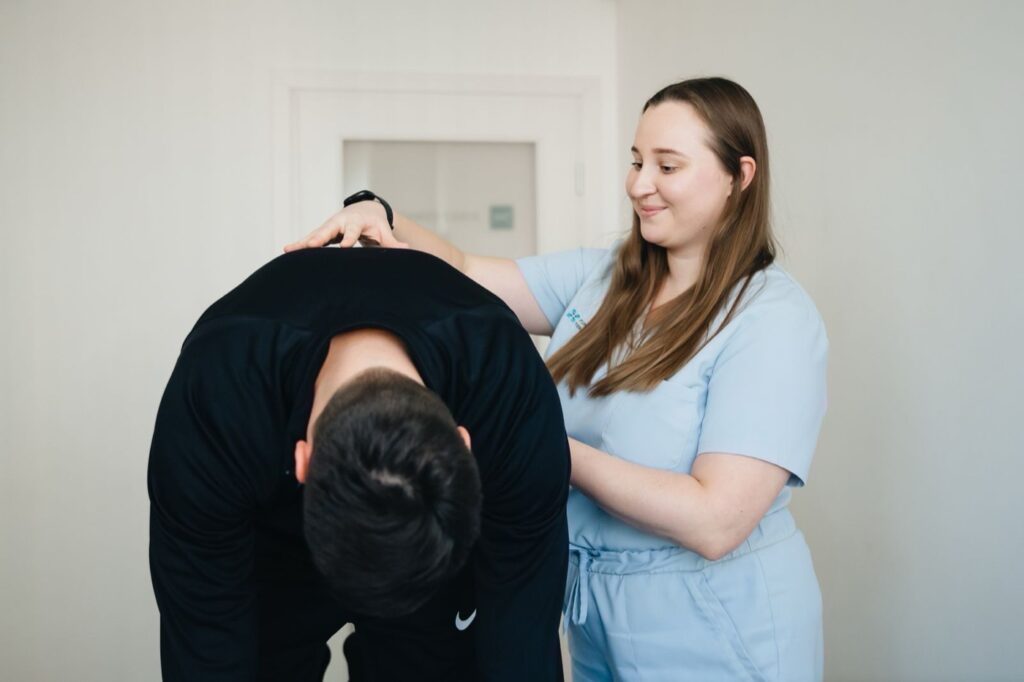
Clinicians often use a forward bend check. You bend forward with your arms hanging and knees straight, and the clinician looks along your back for a rib hump, uneven shoulder blades or a tilted waist. It takes a minute, does not hurt and cannot replace an X-ray.
If something looks uneven, your doctor may refer you for imaging or to a spine specialist.
What can exercise do, and not do, for scoliosis?
Exercise is a tool for strength, movement and confidence. It cannot promise that a curve will shrink. Being clear about this helps you choose a plan and avoid expensive promises.
What exercise can support
Strong trunk, hip and shoulder muscles can make daily movement feel easier and may reduce aches. Exercise also supports fitness, bone health, mood and sleep. For teens who wear a brace, staying active helps with fitness and body confidence.
What the research says about the curve
A 2026 randomized trial in braced teens found that supervised Schroth-based exercise gave limited extra benefit at 24 months compared with self-directed general exercise. A state-of-the-art review found mixed evidence for exercise alone in mild curves, with some controlled studies reporting lower progression rates. It also noted that results depend on how well people keep up their exercises.
Why general exercise is still encouraged
The NHS says it is not clear whether back exercises improve scoliosis, but general exercise is good for overall health and should not be avoided unless your doctor advises it. Most people with scoliosis can live normally and take part in sport.
Why consistency matters
Any exercise program only works if it is done regularly. Short sessions several times a week usually beat one long session. Pick a time that fits school, work or training, and ask a family member or friend to join in so that it is easier to keep going.
Which scoliosis exercise approaches are used?
Different approaches aim for different things, and some are used together. The table below compares the main options in general terms. Your own plan should be set after an assessment.
| Approach | What it involves | What to know |
|---|---|---|
| General strengthening and fitness | Walking, swimming, cycling, bodyweight strength work | Good for health and comfort; not aimed at the curve itself |
| Core and hip stability | Planks, bridges, bird dogs, band rows | Builds control for daily tasks and sport |
| Scoliosis-specific exercise (for example Schroth) | Individual postures, breathing and elongation taught by a trained therapist | Evidence is mixed; works best with regular practice |
| Mobility and stretching | Gentle trunk, hip and chest mobility | Can ease stiffness; stretch within comfort |
Scoliosis-specific exercise
Schroth-style programs teach a person to lengthen the spine, shift body parts to counter the curve pattern and use breathing into the flatter areas of the rib cage. They are personal, so two people with the same angle may do different exercises. Look for a therapist with training in the method.
Core, hip and upper back strength
General strength work builds the muscles that support the spine, such as the deep abdominals, glutes and muscles between the shoulder blades. Our guide to core strengthening for back pain shows safe starting points.
Breathing and rib mobility
Curves that twist the ribs can make one side of the chest feel tight. Slow breathing exercises, with a hand on the ribs to feel them expand, can help you notice and move the tighter side. These are gentle and suit most people.
What does a safe scoliosis workout look like at home?
A scoliosis workout should feel steady and controlled, never forced. The plan below is a general starter for healthy teens and adults without severe pain or nerve symptoms. It is not a treatment plan, and a physiotherapist can adjust it to your curve pattern.
A simple starter routine
- Cat-camel on hands and knees: 8 to 10 slow reps
- Bird dog: 2 sets of 6 per side, holding 5 seconds
- Glute bridge: 2 sets of 10
- Side plank on the knees: 2 holds of 15 to 20 seconds per side
- Band row or wall angels: 2 sets of 10
- Slow rib breathing: 5 deep breaths
Do this routine two to three times a week, and add more only when it feels comfortable.
Keep a simple record of what you did and how your back felt afterwards. A short weekly note shows whether the routine is helping, and it gives your physiotherapist something concrete to review. Tie the routine to a regular time of day, since habits that sit beside daily routines are easier to keep.
How to progress, and what to ease off
Add a few repetitions or a few seconds before adding difficulty. Stop any exercise that causes sharp pain, tingling or leg weakness. Mild muscle effort is fine, but pain that lingers into the next day is a sign to reduce the load.
Exercises for adults with degenerative scoliosis
Older adults with a curve from wear and tear benefit from regular walking, leg and hip strengthening, and balance work. These help you stay steady and independent. Check with your doctor before starting if you have osteoporosis, severe pain or nerve symptoms.
Avoid forceful twisting and heavy lifting until you have been assessed. Our guide to geriatric physiotherapy describes gentle strength and mobility programs.
What should families know about watching a mild curve?
A mild curve is often watched rather than treated. Watching means regular check-ups and measurements, not doing nothing. This section explains what that looks like for teens and their families.
What watchful waiting involves
Your doctor or specialist will repeat measurements at set visits to see whether the curve is stable. The NHS notes that many people will not need any treatment. Keep these appointments even when your teen feels well, because curves can change quickly during growth.
Supporting a teen’s confidence
The NHS recognises that having scoliosis or wearing a brace can be tough and may affect body image and self-esteem. Listen without minimising, let your teen choose clothes that feel comfortable and keep them in the activities they love. Support groups can help, and a school counsellor or doctor can advise.
Talking with coaches and teachers
Let coaches and gym teachers know about the diagnosis and any advice from your specialist. Most teens can join in fully. A short note from the specialist can settle questions about braces, contact sport and changing rooms.
Can you play sports and stay active with scoliosis?
For most people the answer is yes. The NHS says most people with scoliosis can do most activities, including exercise and sports. Your doctor or specialist will tell you if your curve needs any limits.
Choosing activities
Choose activities you enjoy, since you are more likely to keep them up. Swimming, cycling, running, dance, skating, martial arts and team sports all suit many people. Contact sports are a question for your specialist if you have a large curve or a brace.
Exercise while wearing a brace
Teens who wear a brace should follow the wear schedule set by their specialist or orthotist. Ask whether the brace should be on or off during sport and exercise, because advice varies. Keep up strength work out of the brace if you are allowed to.
Living with scoliosis as an adult
Adults often manage with regular walking, strength work and pacing of long sitting or standing. If pain is limiting you, a physiotherapist can look at movement habits and workloads. Our team also uses approaches for recurring back pain that suit many adults.
When should you see a doctor or go to emergency?
Book a visit if you notice a curve, uneven shoulders or hips, or a change in how your child’s clothes fit. Check in sooner if a known curve seems to be changing or if back pain is new or worsening. A family doctor can examine and refer you.
Signs that need urgent care
Go to an emergency department or call 911 for new weakness or numbness in the legs, loss of bladder or bowel control, or severe back pain after a fall or accident. Severe pain with fever, or breathing trouble that comes on suddenly, also needs urgent care. Health811 (8-1-1) can advise on where to go if you are unsure.
What a specialist does
A specialist will examine the back, order X-rays and track the curve over time. Growing teens are usually reviewed at regular intervals because curves can change during growth spurts. Bracing and surgery decisions are made with you and your family.
How can physiotherapy in Milton help with scoliosis?
Physiotherapy cannot promise to straighten a curve, but it can help you move well, build strength and manage pain. At Tonic Physio, our orthopedic physiotherapy service looks at how your spine, hips and shoulders work together.
What an assessment includes
We ask about your history, any pain and your goals, then look at posture, spinal movement, strength and breathing. We explain what we find in plain words. If something needs a doctor or spine specialist, we tell you and help with the next step.
Working with your doctor and your family
We work with your doctor, specialist and orthotist, and we can share our findings with them. For younger patients, our paediatric physiotherapy guide explains how we tailor care to children. Extended health plans often cover physiotherapy, and plans vary.
Booking
If you or your teen has scoliosis and would like a safe, practical exercise plan, you can book an assessment online and we will build one with you.