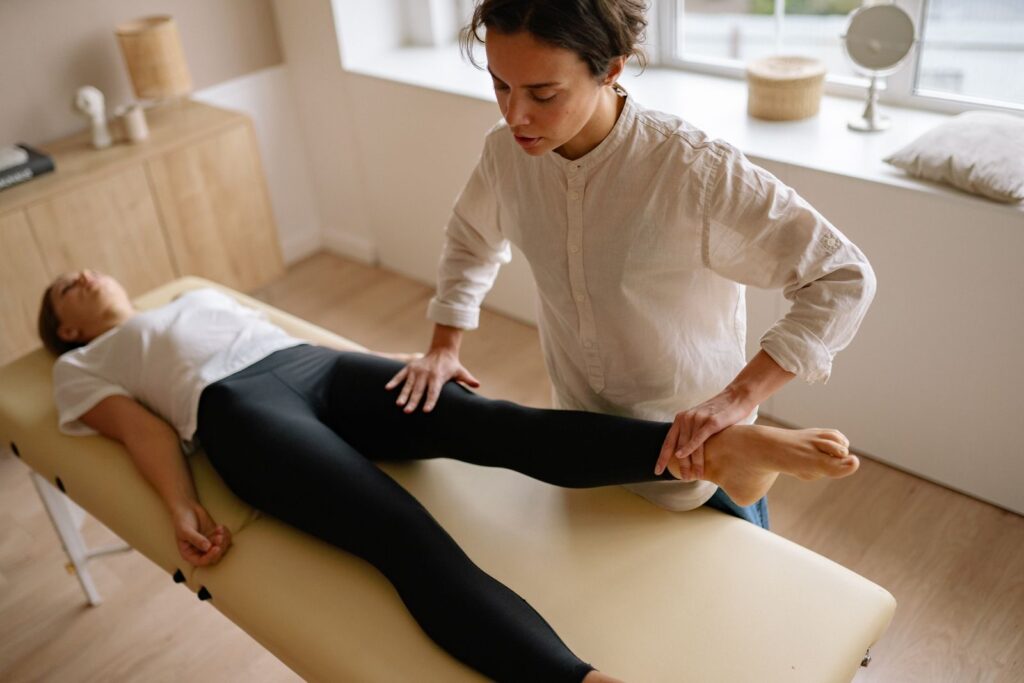
The main types of physiotherapy are orthopedic, sports, neurological, pelvic floor and vestibular physiotherapy. Other areas focus on heart and lung health, older adults, children and recovery after cancer care. Each type uses movement, hands-on care and education, but the focus changes with the problem you bring in.
This guide explains what each type treats, who it suits and what a session usually involves. It also covers how to tell which one you need and whether you need a referral in Ontario.
Key Takeaway: Physiotherapy is one profession with several areas of focus: joints and muscles, sport, the nervous system, the pelvic floor and the inner ear. Your main symptom usually points to the right type, and an assessment confirms it. In Ontario you can book physiotherapy without a doctor’s referral, though some insurance plans ask for one before they pay.
What are the types of physiotherapy?
Types of physiotherapy are areas of practice within the physiotherapy profession, each built around a group of conditions, a body system or a stage of life. Every physiotherapist trains in the same core skills: assessment, exercise, hands-on techniques and education. Many then build extra training and experience in one or more areas.
The types are not separate professions. They are focus areas, a bit like how family doctors may develop a special interest in sports medicine or women’s health.
How the types are usually grouped
Most clinics group physiotherapy by the part of the body or system involved. Orthopedic care covers bones, joints, muscles and tendons. Neurological care covers the brain, spinal cord and nerves, while vestibular care focuses on the balance system of the inner ear.
Other groupings follow a stage of life or a goal. Pelvic floor physiotherapy often supports pregnancy, birth recovery and bladder control. Sports physiotherapy centres on returning to activity, and geriatric care focuses on strength and balance in later life.
Why one person may need more than one type
Problems do not always stay in one box. A runner with hip pain may also have pelvic floor symptoms, and a person after a concussion may need both neurological and vestibular care.
A good assessment looks at the whole picture. Your physiotherapist may treat several areas or suggest a colleague with deeper experience in one of them.
What does orthopedic physiotherapy treat?
Orthopedic physiotherapy treats problems with bones, joints, muscles, ligaments and tendons. It is the type most people picture when they think of physiotherapy. Common reasons to go include back and neck pain, knee and shoulder pain, arthritis, sprains and recovery after joint surgery.
If you want to know how this compares with general care, our post on orthopedic physiotherapy versus regular physiotherapy explains the difference in more detail.
Who orthopedic physiotherapy suits
It suits people with pain or stiffness from daily strain, posture, an old injury or wear and tear. It also suits people preparing for or recovering from surgery such as a hip or knee replacement, a rotator cuff repair or a ligament reconstruction.
Desk workers, trades workers, parents lifting young children and older adults with arthritis all make up a large share of orthopedic caseloads.
What an orthopedic session involves
The first visit usually starts with questions about your pain, your work and your goals. Your physiotherapist then checks how you move, how strong you are and which movements bring on symptoms.
Treatment often combines exercise with hands-on care such as joint mobilization or soft tissue work. You will usually leave with a short home program. Learn more about orthopedic physiotherapy at our clinic.
What is sports physiotherapy?
Sports physiotherapy focuses on injuries linked to exercise, training and competition, and on safe return to activity. It covers sudden injuries such as ankle sprains and hamstring strains. It also covers overuse problems such as runner’s knee, shin splints and tennis elbow.
The goal goes beyond pain relief. Sports physiotherapy aims to rebuild strength, control and confidence so you can train again with a lower chance of the same injury coming back.
Who sports physiotherapy suits
You do not need to be a competitive athlete. Weekend hockey players, recreational runners, gym members, dancers and young athletes in school teams all benefit from this type of care.
It also suits people who want an assessment before starting a new sport or training plan, so weak spots can be addressed early.
What a sports physiotherapy session involves
Sessions tend to be active. Expect strength and balance work, movement drills that copy your sport and gradual loading to prepare tissues for training demands.
Your physiotherapist may also look at technique, footwear or training volume. Many plans finish with return-to-sport testing. See how sports physiotherapy works at our clinic.
What does neurological physiotherapy help with?
Neurological physiotherapy helps people whose movement, balance or coordination is affected by a condition of the brain, spinal cord or nerves. Common conditions include stroke, Parkinson’s disease, multiple sclerosis, spinal cord injury, acquired brain injury and some types of nerve damage.
Care aims to help you move more safely and do more for yourself. It builds on the nervous system’s ability to adapt with repeated, focused practice. You can read more in our post on the benefits of neurological physiotherapy.
Who neurological physiotherapy suits
It suits adults living with a long-term neurological condition, people recovering after a stroke and people with balance problems linked to nerve changes. Family members often join sessions to learn how to help at home.
Some people come soon after a hospital stay. Others come years after a diagnosis because walking, balance or fatigue has changed.
What a neurological session involves
Your physiotherapist will check walking, balance, strength, coordination and how you manage everyday tasks such as standing up from a chair. Sessions often include task practice, balance training and strength work matched to your energy levels.
Fall prevention and safe use of walking aids are common parts of care. Find out more about neurological physiotherapy with our team.
What is pelvic floor physiotherapy?
Pelvic floor physiotherapy assesses and treats the muscles that support the bladder, bowel and pelvic organs. These muscles help with bladder and bowel control, sexual function and core stability. Problems can show up as leaking, urgency, pelvic pain, heaviness or pain during sex.
The pelvic floor can be too weak, too tight or poorly coordinated. That is why general advice such as “just do Kegels” does not suit everyone.
Who pelvic floor physiotherapy suits
It is often used during pregnancy and after birth, including after a C-section. It also helps people going through menopause, people with chronic pelvic pain and men recovering from prostate surgery.
Anyone with bladder leaks when they cough, laugh or exercise may benefit. These symptoms are common, but they are not something you simply have to live with.
What a pelvic floor session involves
The first visit starts with a private conversation about your symptoms and history. With your consent, the assessment may include an internal exam to check muscle strength and tension. You can decline any part of the exam at any time.
Treatment may include breathing work, relaxation or strengthening exercises, bladder habits and posture advice. Learn more about pelvic floor physiotherapy at our clinic.
What is vestibular rehabilitation?
Vestibular rehabilitation is physiotherapy for dizziness, vertigo and balance problems linked to the inner ear and the brain’s balance centres. The vestibular system tells your brain where your head is in space. When it is not working well, you may feel spinning, unsteadiness or blurred vision when you move.
One common cause is benign paroxysmal positional vertigo (BPPV), where tiny crystals in the inner ear move out of place. Other causes include inner ear inflammation and concussion.
Who vestibular rehabilitation suits
It suits people who feel dizzy when rolling over in bed, looking up or turning their head quickly. It also suits people who feel off balance after a concussion or an inner ear infection.
Older adults with dizziness and a fear of falling often benefit too. Sudden or severe dizziness, especially with a new headache, weakness or trouble speaking, needs a doctor or emergency care first.
What a vestibular session involves
Your physiotherapist will test eye movements, balance and how your symptoms respond to head positions. If BPPV is found, gentle repositioning movements may be used to guide the crystals back into place.
Other sessions use gaze stability and balance exercises that help your brain adapt. Read more about vestibular rehabilitation and how it is delivered.
What other types of physiotherapy are there?
Beyond the five main types, physiotherapists also work with the heart and lungs, older adults, children and people recovering from cancer treatment. Some of this care happens in hospitals and community programs rather than in outpatient clinics.
Cardiorespiratory physiotherapy
Cardiorespiratory physiotherapy supports people with heart and lung conditions such as chronic obstructive pulmonary disease (COPD), or recovery after heart surgery. It uses breathing techniques, airway clearance and graded exercise to build stamina.
Much of this care is delivered in hospitals or through cardiac and pulmonary rehab programs.
Geriatric and paediatric physiotherapy
Geriatric physiotherapy helps older adults keep strength, balance and independence. It often focuses on fall prevention, arthritis and recovery after a hospital stay.
Paediatric physiotherapy supports babies, children and teens. It covers developmental delays, sports injuries in growing bodies and conditions that affect movement from birth.
Oncology physiotherapy
Oncology physiotherapy supports people during and after cancer treatment. It may address fatigue, reduced shoulder movement after breast surgery, swelling from lymphedema and loss of strength.
Care is usually planned alongside the cancer care team, and exercise is matched to each stage of treatment.
How do the types of physiotherapy compare?
The table below gives a quick side-by-side view of the main types. It shows common reasons people book each one and what sessions often include.
| Type | Common reasons people go | What sessions often include |
|---|---|---|
| Orthopedic | Back, neck, knee or shoulder pain, arthritis, recovery after joint surgery | Exercise, joint and soft tissue work, home program |
| Sports | Sprains, strains, overuse injuries, return to training | Strength and agility drills, gradual loading, return-to-sport tests |
| Neurological | Stroke, Parkinson’s, multiple sclerosis, brain or spinal cord injury | Walking and balance practice, task training, fall prevention |
| Pelvic floor | Bladder leaks, pelvic pain, pregnancy and postpartum recovery | Muscle assessment with consent, breathing, relaxation or strength work |
| Vestibular | Vertigo, dizziness, unsteadiness after concussion | Repositioning movements, gaze and balance exercises |
| Cardiorespiratory | COPD, recovery after heart or lung surgery | Breathing techniques, graded exercise |
| Geriatric | Falls, weakness, arthritis in later life | Strength and balance training, safe movement at home |
What every type has in common
Every type starts with an assessment and a plan built around your goals. Every type also leans on exercise you can do between visits, because steady practice tends to drive lasting change.
Hands-on care and tools such as heat or taping can help in the short term. To see how these fit with exercise, read our post on active versus passive physiotherapy.
How do you know which type of physiotherapy you need?
Your main symptom and your goal usually point you to the right type. You do not have to work it out alone, because the first assessment is designed to sort this out.
Start with your main symptom
Pain in a joint or muscle after strain, posture or surgery usually points to orthopedic care. An injury from running, a sport or the gym points to sports physiotherapy.
Spinning or dizziness with head movement points to vestibular care. Bladder leaks or pelvic pain point to pelvic floor care, and changes in walking or balance from a nerve condition point to neurological care.
Questions to ask before you book
Ask the clinic which physiotherapist has the most experience with your problem. Ask how long the first visit lasts, what it includes and whether you should wear anything specific.
It also helps to ask how progress will be measured and how often visits are usually needed. Our guide on how to choose a physiotherapist covers more questions worth asking.
When to see a doctor or go to emergency first
Some symptoms need a doctor before physiotherapy. Go to emergency or call 911 for sudden weakness or numbness on one side, trouble speaking, a severe sudden headache or chest pain.
Also get urgent care for new loss of bladder or bowel control, numbness in the groin area, or a fall with a suspected fracture. See your doctor for dizziness with hearing loss, unexplained weight loss or pain that keeps you awake every night.
Do you need a referral for physiotherapy in Ontario?
No, you do not need a doctor’s referral to see a physiotherapist in Ontario. Physiotherapy is a regulated health profession under the Physiotherapy Act, 1991, and physiotherapists can assess and treat you directly. This is often called direct access.
How direct access works
You can call or book online, and your physiotherapist will start with a full assessment. If they find something outside their scope, they will refer you to your family doctor or another provider.
The College of Physiotherapists of Ontario has patient information on what to expect from an appointment and how to check that your provider can practise physiotherapy in Ontario.
When your insurance asks for a doctor’s note
Direct access is about the law, not about payment. Some extended health plans still ask for a doctor’s note or referral before they reimburse physiotherapy, and the rules vary from plan to plan.
Check your benefits booklet or call your insurer before your first visit. Auto insurance and workplace injury claims follow their own steps, so ask about those too if your injury came from a collision or your job.
Government-funded physiotherapy
Ontario funds physiotherapy for some groups, such as people 65 and older, people 19 and under, and people recently discharged from hospital for the condition being treated. The Government of Ontario’s physiotherapy page lists who qualifies and how to get started.
Many people outside these groups use extended health benefits or pay privately. Clinics in Milton and across Halton Region can usually explain your options at booking.
If you are not sure which type of physiotherapy fits your needs, you can book an assessment online and start with a conversation about your goals.