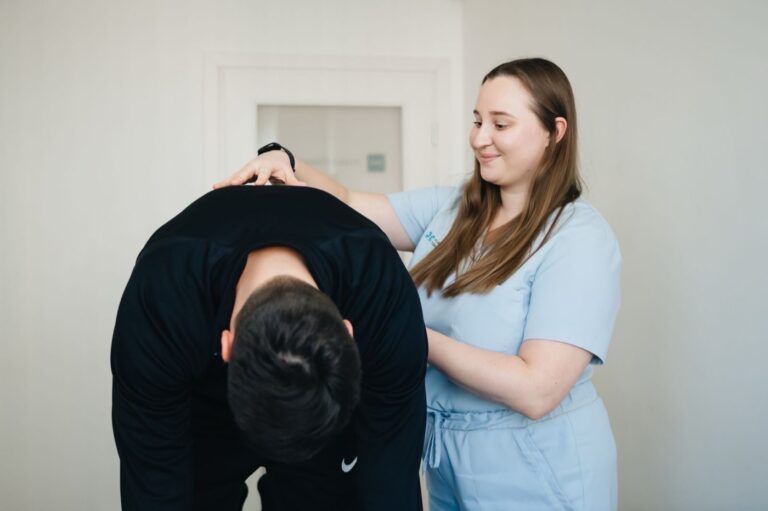
McKenzie exercises are repeated, pain-guided movements that your physiotherapist chooses after testing which direction of movement changes your back or neck pain. The best-known example is the prone press-up. The goal is to settle symptoms, then keep you in charge of a home routine that you can repeat whenever pain returns.
Key Takeaway: McKenzie exercises are repeated, pain-guided movements chosen after a physiotherapist tests which direction of movement changes your symptoms. The evidence is mixed, so they work best as one part of a plan with walking and strengthening, and pain that spreads down a limb or brings new numbness is a reason to stop and get assessed.
What are McKenzie exercises?
McKenzie exercises are pain-guided repeated movements drawn from the McKenzie Method of Mechanical Diagnosis and Therapy (MDT), a system for assessing and treating back, neck and limb pain. It starts with a movement assessment, then matches exercises to how your symptoms respond. Two people with similar back pain can end up with quite different programs.
Where the method comes from
The method is named after Robin McKenzie, a New Zealand physiotherapist who developed it in the mid-twentieth century. It spread worldwide and many physiotherapists, including those in Milton and across Halton Region, use parts of it. Some clinicians take extra training in the full method.
What is a directional preference?
A directional preference is a movement direction that eases your pain or pulls it closer to the spine. For one person that may be bending backward. For another it may be bending forward or sliding the trunk sideways.
The idea is simple. You repeat the movement that helps, avoid the one that makes things worse, and adjust the plan as you improve.
How does a McKenzie assessment work?
A McKenzie assessment combines a detailed history with repeated movement testing. Your physiotherapist asks where the pain sits, what changes it and how it behaves across the day. Then you move, and the response to each movement guides the plan.
Repeated movement testing
You perform a movement, such as standing back bends, several times in a row. Your therapist records whether your pain gets better, worse or stays the same, and where you feel it. The same test is then repeated in other directions.
This is why a McKenzie visit feels active. You are not just lying on a table while things are done to you.
Centralization and peripheralization
Centralization means pain that spreads into the buttock or leg retreats toward the spine during or after a movement. Peripheralization is the opposite, with pain travelling further down the limb.
Centralization is generally seen as a good sign. Peripheralization is a signal to stop that movement and tell your therapist. Researchers have studied both patterns in systematic reviews, including an updated review of centralization and directional preference.
Which McKenzie exercises are used for low back pain?
The exercises below are common examples, not a prescription. Your direction of benefit may be different, and some people should not do back extension exercises at all. Treat this list as background for the conversation you will have with your physiotherapist.
Extension exercises
- Lying on your stomach: rest face down for a few minutes with your arms by your sides.
- Prone on elbows: prop yourself on your forearms and let the lower back relax.
- Prone press-up: place your hands under your shoulders and press the upper body up while the hips stay down.
- Standing extension: place your hands on your hips and lean gently backward.
Many people find standing extension handy at work, because it needs no floor space. A common McKenzie-style dose is about ten slow repetitions every few hours while awake, but your therapist sets the dose for you.
Move slowly through your comfortable range and pause for a second at the end. Stop the set if pain moves further from the spine, and note whether your original pain feels better, worse or unchanged afterwards. That feedback is what your therapist uses to adjust the program.
Flexion exercises
Some people feel better bending forward. Examples include lying on your back and pulling one or both knees toward your chest, or sitting and leaning forward over your knees.
People who feel worse when standing or walking, and better when sitting or leaning forward, are sometimes in this group. An assessment is the safest way to tell, particularly if you have been told you have spinal stenosis.
Side glide exercises
If your trunk shifts to one side, or pain is mostly on one side, a side glide may be tested. You stand near a wall with your elbow tucked in, and gently slide your hips toward the wall.
Side glides are usually learned in clinic first, because the direction and the dose both matter.
Which McKenzie exercises are used for neck pain?
The same logic applies to the neck. Your therapist tests the effect of repeated neck movements on your pain, then builds a routine around the direction that helps. Many desk workers and drivers in Milton arrive with neck pain that builds across the working day.
Chin retraction
Sitting or standing tall, you gently draw your chin straight back, as if making a double chin, without tilting your head down. Hold briefly, then relax.
Retraction counters the forward head posture many people adopt at screens. Keep the movement small and smooth, and stop if you feel dizzy, tingling or arm symptoms that spread.
Retraction with extension
Once retraction is comfortable, your therapist may add a small look up at the end of the movement. This is a progression, not a starting point.
If you have dizziness, vision changes or a history of neck injury, do not try this version alone. Our guide to effective neck pain treatments covers other options.
Posture resets through the day
Short, frequent resets often work better than one long session. Stand up, retract the chin a few times and lift your screen toward eye level. Pair these resets with regular walking and shoulder movement.
Do McKenzie exercises work?
The evidence is mixed and depends on the type of back pain. McKenzie-based care helps some people, but research does not show it is better than every other approach for everyone. That is a fair reason to treat it as one useful tool rather than a fix for every spine.
Recent low back pain
A 2023 Cochrane review of the McKenzie method for recent non-specific low back pain found low-certainty evidence that it may slightly reduce pain in the short term. It found little clear effect on disability. You can read the abstract on PubMed.
Persistent low back pain
A 2018 review in the Journal of Orthopaedic and Sports Physical Therapy found that McKenzie care was not better than other rehabilitation for recent low back pain. For longer-lasting pain, the results favoured it over some comparison treatments, depending on what it was compared with. See the full abstract.
What this means for you
Most good back pain programs share common ground: they keep you moving, build strength and reduce fear. McKenzie exercises can be a useful part of that, especially when you respond clearly to a direction.
If you have not noticed a clear response after a couple of weeks of regular practice, say so. A lack of response is useful information, and your therapist may switch direction or move to a different approach.
Our guide to physiotherapy exercises for lower back pain covers the wider picture.
Can you do McKenzie exercises at home?
Many people do, but it is safest to learn them first from a clinician. The movements look simple, yet the right direction, depth and dose are specific to you. Doing an exercise that pushes pain further down the leg can set you back.
Why learn the exercises in clinic first
Your therapist can watch your technique, check how your symptoms respond and correct small details. Those details matter. A press-up done too far, or too often, may irritate a sensitive back.
After the first visit you can repeat the routine at home and report back. Most plans are reviewed and adjusted as your pain changes.
Who should be cautious
- People with new leg weakness, numbness or changes in bladder or bowel control
- Anyone with back pain after significant trauma, such as a car accident or a fall
- People with osteoporosis, a recent spinal surgery or a known spinal fracture
- Anyone whose pain increases with every repetition
If any of these apply, speak with your doctor or physiotherapist before you try any exercise. Some people need imaging or a medical review first.
How McKenzie fits with strength work
McKenzie exercises mainly aim to settle symptoms and teach you what your back tolerates. Strength, walking and general fitness build the capacity to stay well. Our guide to core strengthening exercises for back pain is a good next step once pain has calmed.
Most people add strengthening once their pain is calmer and more predictable. Walking, hip and trunk exercises and a gradual return to lifting build the capacity that keeps flare-ups shorter and easier to settle.
How do you know if a McKenzie exercise is helping?
Watch where the pain goes and how it behaves afterward, not just how it feels in the moment. A mild increase in local pain that settles within a short time is often acceptable. Pain that spreads further from the spine is a sign to stop.
A simple response guide
| Response | What it suggests | What to do |
|---|---|---|
| Better, or pain retreating toward the spine | The direction suits you | Keep going and tell your therapist |
| Same, and settling soon after | Neutral response | Continue gently and review at your next visit |
| Worse, spreading down the leg or arm, or new numbness | The movement is irritating the area | Stop and get assessed |
Making it a habit
Tie the exercise to something you already do, such as each coffee break or red light on a longer drive. Frequent short sets tend to suit McKenzie programs better than one long session.
Pair the routine with regular walking and gradual strengthening. If you are struggling to sleep, tell your therapist, because night pain changes the plan.
Set a phone reminder, or link a set to every time you stand up from your desk. Aim for steady repetition across the day, and write down how each set felt for the first week or two.
When should you see a doctor or go to emergency?
Most back and neck pain is mechanical and improves with time and movement. A small number of cases signal something that needs prompt medical care. Do not start exercises until serious causes have been ruled out.
See a doctor soon if
- Pain follows a fall, car accident or other injury
- Pain is constant, severe or wakes you at night despite changing position
- You have a fever, unexplained weight loss or a history of cancer
- Numbness, tingling or weakness is spreading into an arm or leg
Go to emergency or call 911 if
Go to the nearest emergency department if you notice numbness around the groin or inner thighs, new difficulty controlling your bladder or bowels, or leg weakness that is getting worse. These can be signs of serious nerve compression. Sudden severe neck pain with a headache, vision changes or trouble speaking also needs emergency care.
How can physiotherapy in Milton help?
You do not need a doctor’s referral to see a physiotherapist in Ontario. At Tonic Physio, a physiotherapist can take your history, test your movement and decide whether a McKenzie approach suits you. Physiotherapists in Ontario are regulated by the College of Physiotherapists of Ontario.
What your first visit may include
Expect questions about your pain, a posture and movement check, repeated movement testing and a short list of exercises to start at home. Learn more about our McKenzie Method physiotherapy in Milton.
Wear loose clothing that lets you move your back and neck freely. Bring a note of what makes your pain better or worse across a normal day, because that history shapes the testing.
Coverage and billing
OHIP covers physiotherapy only in limited situations, so many people use extended health benefits. Direct billing may be available with some insurers, and work or auto accident injuries may fall under WSIB or Ontario auto insurance. Bring your plan details to your visit.
If back or neck pain keeps coming back, you can book a physiotherapy visit online to find out which movements suit you.