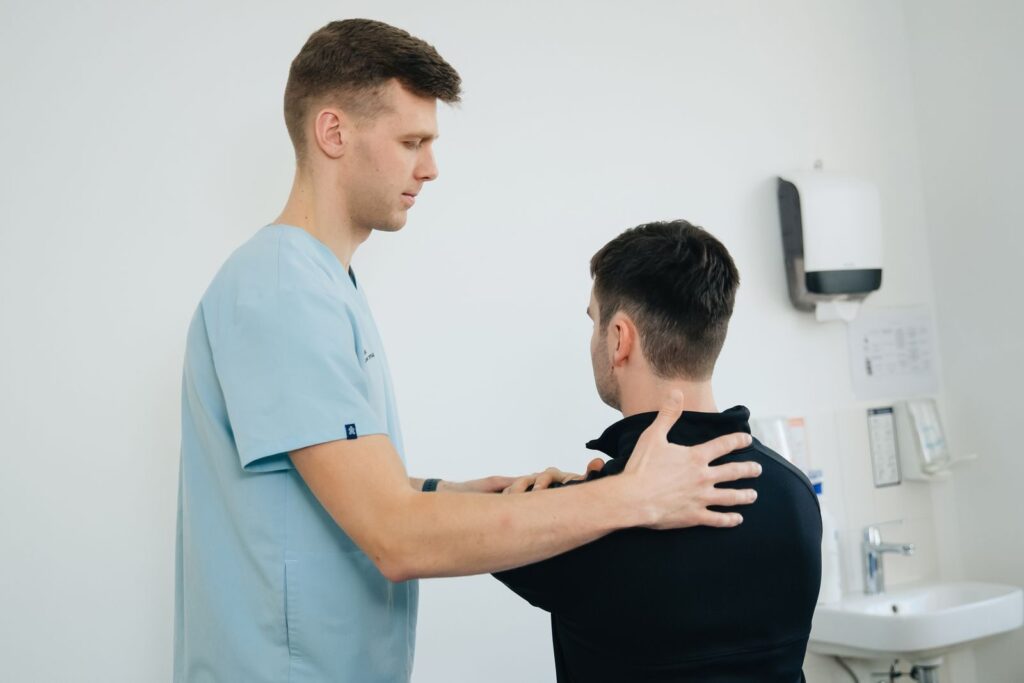
Shoulder impingement is pain at the top or outside of the shoulder when you lift your arm, often worse overhead or at night. It happens when tendons in the shoulder become irritated as they pass under the bony roof of the joint. Most cases settle with the right exercise and activity changes over weeks to months.
Key Takeaway: Shoulder impingement is pain from irritated rotator cuff tendons that usually settles over weeks to months with the right exercise and activity changes. Exercise is the best-supported first treatment, and being unable to lift the arm, pain after a fall or chest symptoms need prompt medical care.
What is shoulder impingement?
Shoulder impingement is the common name for pain caused by irritation of the rotator cuff tendons and the small fluid-filled sac (bursa) beside them. Clinicians now often call it rotator cuff related shoulder pain or subacromial pain. The NHS describes it as a tendon that swells and rubs against tissue or bone as you lift your arm.
What does impingement mean in plain language?
Your rotator cuff is a group of four muscles that steady and move the shoulder. Their tendons run through a narrow space under the bony tip of the shoulder blade (the acromion). When those tendons or the bursa become sensitive, lifting the arm can pinch or ache.
The word suggests a simple mechanical squeeze. In practice, the cause is often a mix of load, tendon sensitivity and how the shoulder blade moves.
Impingement versus a rotator cuff tear
An irritated tendon is not the same as a torn one. A tear usually brings clearer weakness, and it may follow a fall or a heavy lift. The American Academy of Orthopaedic Surgeons describes rotator cuff tears and how they differ in symptoms and care.
Many tendon changes are also found on scans of people with no pain at all. Your assessment matters more than the picture.
What are the symptoms of shoulder impingement?
The typical symptom is pain at the top and outside of the shoulder that is worse when you raise your arm, especially above your head. The NHS also lists night pain and arm weakness among the main symptoms. The pain may start suddenly or build gradually.
Where it hurts and when
- A dull ache at the top or side of the shoulder, sometimes spreading toward the upper arm
- Pain when reaching overhead, behind your back or into a car back seat
- Pain when you lie on the sore side at night
- A catching or pinching feeling partway through lifting the arm
The painful arc
Many people notice pain in the middle part of lifting the arm, then relief as it goes higher or comes back down. Clinicians call this a painful arc. It can help point toward the rotator cuff area, but it does not prove impingement on its own.
Symptoms that point elsewhere
Neck problems, frozen shoulder and joint arthritis can feel similar. Pain that spreads below the elbow, tingling in the fingers or a stiff shoulder that will not move at all suggests a different cause. Our guide to frozen shoulder stages explains one common look-alike.
What causes shoulder impingement?
Shoulder impingement rarely has a single cause. It usually appears when the load on the rotator cuff rises faster than the tendons can adapt. Overhead work, new training and long periods of poor shoulder control can all play a part.
Overhead activity and sudden load changes
Painters, electricians, swimmers, tennis and volleyball players and people who lift overhead at work are commonly affected. A new gym program, a home renovation weekend or a snow shovelling session can also tip an unprepared shoulder over its limit.
Posture and shoulder blade control
A rounded upper back and a forward head can change how the shoulder blade sits and moves. Weak or slow-to-activate muscles around the shoulder blade may reduce the space available for the tendons. Many Milton desk workers and drivers notice symptoms build after long days at a screen.
Age and tendon changes
Tendons change as we age, and they often tolerate less sudden load. That is normal, and it does not mean the shoulder is damaged. It does mean that gradual progression and regular strengthening matter more.
Which exercises help shoulder impingement?
Exercise is the best-supported first treatment. A 2020 umbrella review of conservative care for subacromial shoulder pain gave a strong recommendation for exercise therapy as first-line treatment. You can read the abstract on PubMed.
The review noted that more research is needed on the best type, dose and duration of exercise. That is why your plan should be built around your shoulder, not a generic sheet.
Common starting exercises
- Shoulder blade squeeze: 2 sets of 10, holding each squeeze for 3 to 5 seconds.
- Band external rotation: elbow at your side, 2 to 3 sets of 10 to 12.
- Wall slide: forearms on a wall, slide upward within a comfortable range, 2 sets of 8 to 10.
- Row with a band: 2 to 3 sets of 10 to 12, keeping the shoulders relaxed.
Work within mild discomfort that settles soon after. Pain that climbs or lingers into the next day is a signal to reduce the dose.
Slow, controlled movement matters more than heavy load at the start. Take two or three seconds to lift and lower, keep your neck relaxed and stop a repetition short of fatigue. Add a set or a little resistance only when the current level feels easy.
Exercises and movements to pause
While the shoulder is irritable, many therapists suggest reducing movements that repeatedly pinch the tendon. The NHS advice is to avoid activities that repeatedly lift the arm overhead, but not to stop moving the shoulder completely.
- Upright rows and behind-the-neck presses
- Heavy overhead pressing or repeated overhead throwing
- Reaching or sleeping with the arm stretched high above the head
Building back up
As pain settles, the plan usually moves from light band work to heavier loads and then to your sport or job tasks. Each step should feel manageable the next day. Our guide to physiotherapy for shoulder pain explains how this progression usually runs.
How is shoulder impingement diagnosed?
Diagnosis is usually based on your history and a physical examination. A physiotherapist or doctor checks how your shoulder and neck move, tests strength and pain with different positions, and rules out other causes. Most people do not need a scan at the start.
The physical examination
Your clinician may test lifting the arm in different directions, resisting movement and pressing on tender spots. No single test is perfect on its own, so the pattern across several tests carries more weight. Your neck is checked too, because neck problems can refer pain into the shoulder.
When imaging helps
An ultrasound, X-ray or MRI may be requested if a tear, fracture or arthritis is suspected, or if you are not improving. Scans can show changes that are common in people without pain, so results are read alongside your symptoms.
What other treatments are used for shoulder impingement?
Exercise sits at the centre of care, and other options are added when they make sense. The same 2020 umbrella review suggested that manual therapy may be added as an extra treatment in the early phase. Some other popular treatments have weaker support.
The table summarises what the sources say about each option.
| Option | What the sources say | Role |
|---|---|---|
| Exercise therapy | A strong recommendation as first-line care in the 2020 umbrella review | The core of most plans |
| Manual therapy | May be added as an extra treatment in the early phase | A partner to exercise |
| Shockwave, laser, therapeutic ultrasound | Moderate evidence of no effect for subacromial shoulder pain | Ask why it is suggested for you |
| Steroid injection | The NHS notes it may be offered if rest and exercise are not enough | A medical decision with your doctor |
| Surgery | Widens the space around the tendon | Reserved for people who have not improved with other care |
Hands-on care
Manual therapy, such as joint and soft tissue techniques, may ease pain and stiffness and make exercise easier to start. It works best as a partner to exercise, not a replacement for it.
Shockwave and electrical therapies
The umbrella review found moderate evidence of no effect for shockwave therapy, laser, therapeutic ultrasound and pulsed electromagnetic energy in subacromial shoulder pain. Shockwave is used for other tendon problems, such as calcific shoulder tendinopathy, so ask your therapist why it is being suggested for you.
Injections and surgery
The NHS notes that some people with impingement may be offered steroid injections if rest and exercise are not enough. Surgery to widen the space around the tendon is reserved for people who have not improved with other care. These are medical decisions to discuss with your doctor.
How long does shoulder impingement take to heal?
The NHS says shoulder impingement usually gets better in a few weeks or months. Recovery varies with how long you have had it, how irritable the shoulder is and how much overhead work you do. Longer-standing pain usually takes longer.
A realistic timeline
In the first few weeks, the aim is to calm pain and keep the shoulder moving. Over the next weeks to months, you build strength and add overhead work back. Setbacks are common and do not mean you are starting over.
Keep a short note of the movements that bother the shoulder and the ones that feel easier. Reviewing it every couple of weeks shows trends that are hard to see day to day, and it helps you and your physiotherapist decide when to progress.
What can slow recovery
- Complete rest, which can leave the shoulder weaker
- Returning to full overhead work or sport too fast
- Skipping the shoulder blade and upper back exercises
- Poor sleep, which can make pain more sensitive
Can you prevent shoulder impingement?
You cannot prevent every episode, but you can lower the chance of flare-ups. The main idea is to prepare the shoulder for the work you ask of it. Gradual changes and regular strength work are the best tools.
Warm up and build load gradually
Before overhead sport or work, spend a few minutes on easy arm circles and light band work. When you start a new program or a big home project, spread the effort over several days rather than one long session.
Set up your day for your shoulders
Raise screens toward eye level, keep frequently used items between waist and shoulder height, and change position often. If you sleep on your side, a pillow hugged in front of you can reduce strain on the top shoulder.
If night pain is the main problem, try lying on the other side with a pillow supporting the sore arm in front of you, or sleeping slightly propped up. Small changes to sleep position can make a rough week easier.
When should you see a doctor or go to emergency?
Most shoulder pain is not dangerous. The NHS advises seeing a doctor if pain does not go away after a few weeks or stops you from doing usual activities. Some signs need faster attention.
See a doctor soon if
- You cannot lift your arm, or it suddenly feels very weak
- Pain started after a fall, collision or heavy lift
- Pain is constant, severe or wakes you every night
- You have numbness, tingling or weakness spreading down the arm
Go to emergency or call 911 if
Shoulder or arm pain with chest pressure, shortness of breath, sweating or nausea can be a heart emergency. Call 911 straight away. Go to the nearest emergency department for a hot, red, swollen shoulder with a fever, a visible deformity after injury, or loss of feeling in the arm.
How can physiotherapy in Milton help?
You do not need a doctor’s referral to see a physiotherapist in Ontario. At Tonic Physio, your visit includes a history, shoulder and neck testing, and a plan built around your work and sport. Physiotherapists in Ontario are regulated by the College of Physiotherapists of Ontario.
What your first visit includes
We look at how your shoulder blade moves, test strength and range, and check your neck. You leave with a few key exercises and clear guidance on overhead activity.
Bring a note of the activities that set off your pain, such as a particular lift, a sport or a job task. We use those to choose and progress the exercises, so the plan matches what your shoulder needs to do.
Learn more about shoulder pain treatment in Milton. If you suspect a tear, our article on rotator cuff injury symptoms explains the signs.
Coverage and billing
OHIP covers physiotherapy only in limited situations, so many people use extended health benefits. Direct billing may be available with some insurers, and work injuries may fall under WSIB. Bring your plan details with you.
If shoulder pain is limiting your work or training, you can book a physiotherapy visit online to talk through a plan.