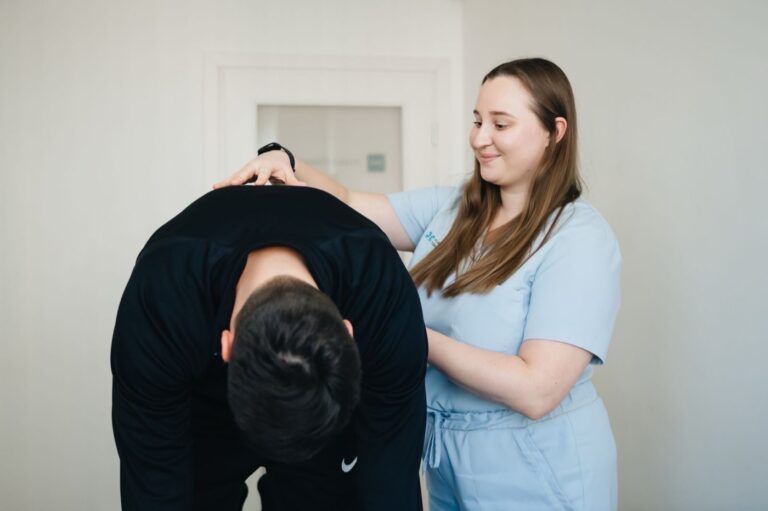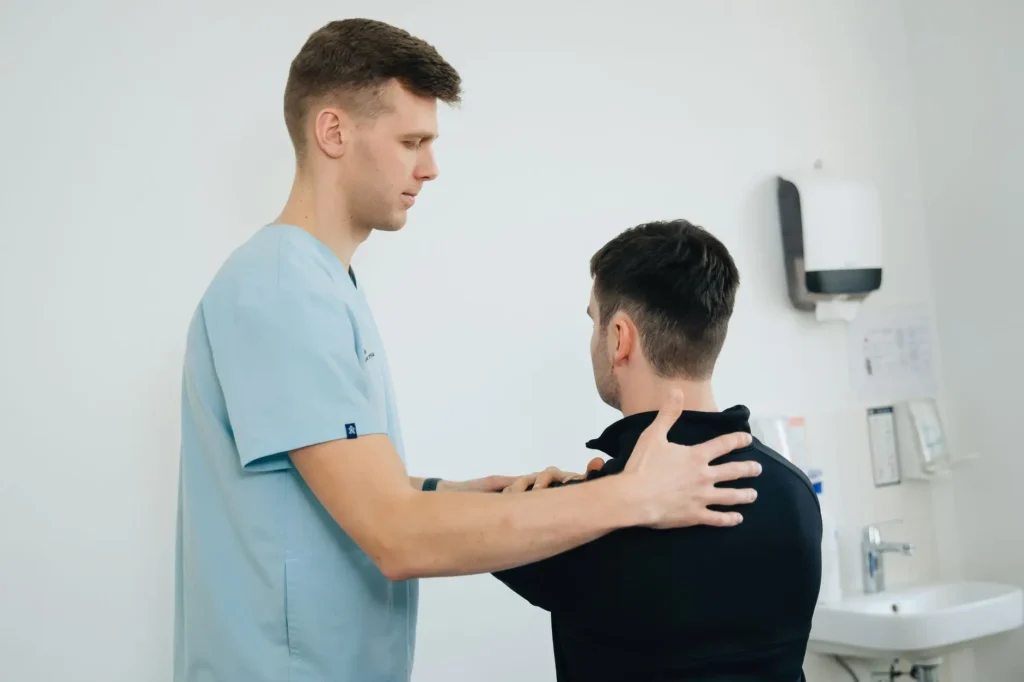
Frozen shoulder moves through three distinct stages, and each stage reward is different treatment while punishing the wrong kind. The freezing stage punishes aggressive stretching, the frozen stage punishes impatience, and the thawing stage punishes doing nothing. Knowing which stage you are in changes every decision you make about your shoulder.
You can learn more about orthopedic physiotherapy in Milton on our service page.
Key Takeaway: Adhesive capsulitis progresses through freezing, frozen, and thawing phases that typically span 12 to 24 months total. Treatment matched to your current stage speeds recovery and prevents setbacks, while mismatched treatment, especially aggressive stretching too early, reliably makes symptoms worse. To learn more, read about physiotherapy for rheumatoid arthritis flare-ups.
What frozen shoulder actually is
Frozen shoulder, called adhesive capsulitis clinically, is a thickening and tightening of the capsule that surrounds the shoulder joint. The capsule normally folds loosely enough to allow full overhead reach. When it inflames and contracts, it clamps down on the joint like a shrunken sleeve, and stiffness becomes the defining symptom.
There is more detail in our post on shockwave therapy for frozen shoulder.
The condition follows its own clock more than any treatment schedule. That frustrates patients used to injuries that heal on a predictable six-week arc, and it explains why so many people describe frozen shoulder as the most frustrating condition their shoulder has ever produced.
Who gets it and why
- Adults between 40 and 60, with women affected more often than men
- People with diabetes, who face roughly triple the risk and slower recovery
- After any period of shoulder immobilization: a sling, a surgery, injury that stopped you from moving the arm
- Thyroid conditions and hormonal changes raise the risk as well
Notably, it often starts without any injury at all. Many patients trace the beginning to nothing more than a night of sleeping on the sore side, which is why the early stage gets dismissed until stiffness takes hold.
Stage 1: the freezing stage, roughly 2 to 9 months
Pain leads this stage, and stiffness follows it. Night pain is the signature complaint: lying on the side becomes impossible, and rolling onto the shoulder wakes you. Reaching behind the back, fastening a bra, or grabbing a seatbelt starts to hurt before meaningful stiffness sets in.
What the freezing stage feels like
- Pain at rest, often worse at night, sometimes aching down the upper arm
- Gradually shrinking range of motion, most noticeable limitations are reaching overhead or behind
- Pain that spikes sharply at the end of any forced reach
- Aching at rest that no position fully quiets
What to do in the freezing stage
Protect the shoulder from provocation and keep it gently moving. Pain-dosed pendulum swings, supported overhead positions, and comfortable-range mobility keep the capsule from sealing further. Sleep with a pillow under the affected arm and avoid sleeping on that side entirely.
The mistake that makes stage 1 worse
Aggressive stretching is the classic error. The capsule is actively inflamed, and forcing range through inflammation is like stretching a burned hand: it calms nothing and inflames everything. Patients who push hard stretching in the freezing stage reliably report worse night pain and faster stiffness. Gentle beats aggressive for the entire stage.
Stage 2: the frozen stage, roughly 4 to 12 months
Pain recedes to an ache at end range while stiffness takes center stage. The shoulder often feels stuck rather than painful, and daily life reshapes itself around the limitation: jackets go on arm by arm, hair washing shortens, and reversing the car becomes a whole-body twist.
What the frozen stage feels like
- Marked stiffness in every direction, with external rotation usually most limited
- Much less night pain than stage 1, though end-range reaches still protest
- A hard, blocked feel at end range rather than a stretchy resistance
- Compensation patterns: shrugging to lift, rotating the trunk to reach
What to do in the frozen stage
This stage rewards structured, progressive mobility work more than any other. The inflammation has settled and the capsule can now tolerate and respond to graded stretching. This is where professional treatment earns its keep, and where hands-on frozen shoulder treatment shows its value: joint mobilizations at the restriction, capsular stretching dosed to tolerance, and a home program that holds the gains between sessions.
The mistake that stalls stage 2
Waiting passively for the thaw. The frozen stage can drift along for many months when nothing challenges the capsule, and the shoulder that gets no structured input typically thaws slower and stiffer. The second classic error is the opposite: cranking the arm into range with a well-meaning family member forcing the stretch. Graded, specific, sustained work wins this stage; force and neglect both lose.
Stage 3: the thawing stage, roughly 2 to 24 months and improving
Range returns gradually, usually external rotation and overhead reach first among the big functional motions. Every month brings measurable improvement in this stage, and the job is rebuilding strength and full function while the capsule loosens.
What the thawing stage feels like
- Steady, measurable range gains week over week
- Occasional mild aching after new ranges are first reached, which settles quickly
- Weakness from months of disuse, which outlasts the stiffness itself
What to do in the thawing stage
Push range progress and rebuild strength together. The capsule gives range back, but the rotator cuff and shoulder blade muscles have been idle for a year and need deliberate retraining. Loading at newly recovered ranges is what turns a thawed shoulder back into a dependable one.
The mistake that haunts stage 3
Stopping rehab at 80 percent. Most shoulders reach comfortable daily function and motivation fades, leaving the last 20 percent of rotation and strength unrecovered. That residual limitation surfaces later on the tennis court, the gym floor, or the first heavy snow shoveling of the season. Finish the program; the final margin is where durability lives.
The full timeline at a glance
| Stage | Typical duration | Priority |
|---|---|---|
| Freezing | 2 to 9 months | Pain control, gentle movement, protect sleep |
| Frozen | 4 to 12 months | Graded stretching, joint mobilization, home program |
| Thawing | Improvement over months | Range recovery plus strength rebuilding |
Timelines overlap and vary with diabetes status, severity, and treatment quality. The numbers set expectations rather than promises. What treatment changes is not the calendar so much as the trajectory: properly treated shoulders move through stages with less pain, less residual stiffness, and far fewer surprises.
When to consider medical options beyond physiotherapy
Most frozen shoulders resolve with time plus correctly staged conservative care. Two medical options exist for cases that stall, and knowing the criteria prevents both premature intervention and unnecessary suffering.
Cortisone injection: the early-stage tool
A corticosteroid injection in the first months can shorten the painful freezing stage, especially where night pain is destroying sleep. It does not cure the condition; it buys comfort and sleep during the inflammatory phase. Used early and combined with gentle mobility work, it helps the right patient at the right time.
Hydrodilatation and manipulation under anesthesia
For shoulders still rigid late in the frozen stage, distension arthrography or MUA can jump-start range. These are second-line tools after structured conservative care, not first moves. The staged physiotherapy route resolves the large majority of shoulders without them.
What makes frozen shoulder recover faster
Three factors consistently separate the shoulders that resolve cleanly from the ones that drag. None of them involve forcing range.
- Correct staging: treatment matched to the phase rather than a generic shoulder program
- Consistency through the long middle: the frozen stage rewards steady dosed work over months, not heroic weeks
- Diabetes management: blood sugar control measurably affects both severity and duration
The sleep setup that gets you through stage 1
Sleep on your back with a pillow under the affected arm’s elbow, or on the unaffected side hugging a pillow. Keep the arm supported so the capsule never hangs on stretch. A warm shower before bed relaxes the guarding muscles. Night pain drives most frozen-shoulder despair, and protecting sleep protects your ability to do everything else.
Frozen shoulder against the Halton calendar
The 12 to 24 months arc collides with real seasons, and patients plan around it. Knowing how the stages interact with a Halton year helps you schedule life, sport, and treatment realistically.
Winter: the hardest stretch for stage 1 and 2
Cold mornings stiffen the capsule further, coats are the hardest garment of the year to don, and snow shoveling demands exactly the rotation a frozen shoulder refuses. In stage 1, push rather than lift when clearing the driveway or hire the neighborhood student. In stage 2, use the lighter shovel and push piles rather than lifting and throwing them.
Golf and tennis season with a thawing shoulder
The backswing demands external rotation, which is the last range to return. Return to golf in the thawing stage in three steps: putting and chipping first, then half-swing irons, then full swings once rotation recovers. Players who sequence it this way usually avoid the re-irritation that resets a summer.
Work accommodations that actually help
- Desk workers: raise the monitor so overhead reaching shrinks, and keep files in the front drawer, not the high shelf
- Teachers and retail staff: ask for help with high stocking and overhead board work during the frozen stage
- Trades: protect the shoulder with tool selection and work positioning, and pace overhead tasks in shorter blocks
Answers to the questions patients ask most
Can frozen shoulder appear on both sides?
Yes, and it can recur on the same side years later. Roughly one patient in six develops it in the opposite shoulder within five years. The practical takeaway: once you have had one, protect the other shoulder’s mobility with the same gentle routine through any immobilization event.
How do I know which stage I am in?
Night pain and worsening pain at rest mark the freezing stage. Stiffness with less pain, marks the frozen stage. Steady range improvement marks the thaw. An assessment confirms it with range measurements, because stage transitions are gradual and self-staging is unreliable at the boundaries.
Does it ever resolve without treatment?
Eventually, in many cases, unresolved shoulders average a worse final range of motion and a longer total duration of recovery. The research on structured conservative care shows faster recovery of function and less residual stiffness. Given the timeline involved, most patients prefer shortening a 24-month arc over enduring one.
Is exercise supposed to hurt during the frozen stage?
Mild stretch discomfort at the end range is expected and acceptable. Pain that lingers into the evening or spikes of night symptoms means the dose was too aggressive. The rule: challenge the capsule, then let the next morning tell you whether the dose was right.
The exercises that match each stage
Generic shoulder routines treat a frozen shoulder like a rotator cuff strain and slow recovery. These stage-matched movements are the backbone of what we prescribe, scaled to each patient’s measured range.
Freezing stage: keep it moving, keep it kind
- Pendulum swings: lean forward, let the arm dangle, swing gently in small circles for 1 to 2 minutes, twice daily
- Supported overhead reach: lie on your back and walk a stick overhead to a comfortable range only
- External rotation at side: elbow tucked, rotate out to a comfortable range with a stick for assistance
Frozen stage: Stretch the capsule
- Sustained end-range holds: 3 holds of 30 to 60 seconds at the restriction, once or twice daily
- Sleeper stretch modified: side lying with a towel under the arm, gentle pressure toward the bed, no forcing
- Table slides: seated, slide the hand forward on a towel, letting gravity grade the stretch
Thawing stage: recover range and rebuild strength
- Band external rotation and rows for the cuff and shoulder blade muscles, 3 sets of 12, progressing resistance monthly
- Overhead press pattern with light load once range allows, to rebuild confident overhead capacity
- Sport-specific loading: golf swings with a weighted club, swimming strokes on land first, then in water
Getting staged treatment in Milton
Tonic Physio assesses and stages frozen shoulder for patients across Milton, Oakville, and Halton Hills, then builds treatment around the phase you are actually in rather than where a template says you should be. Stage-matched care starts at your first appointment, and no referral is needed to book.
If your shoulder has been tightening for weeks and your sleep is paying for it, one assessment tells you the stage, the prognosis, and the specific plan for this month, not for a generic 18-month arc. The earlier the stage is matched, the shorter the whole journey tends to run.
Returning to Life in Milton After Knee Replacement
Call us at (905) 878-7775 to book your shoulder pain/frozen shoulder physiotherapy assessment, or book online through JaneApp for an appointment that fits your schedule. Our team in Milton will guide you from your first steps to a full return to the activities you love.