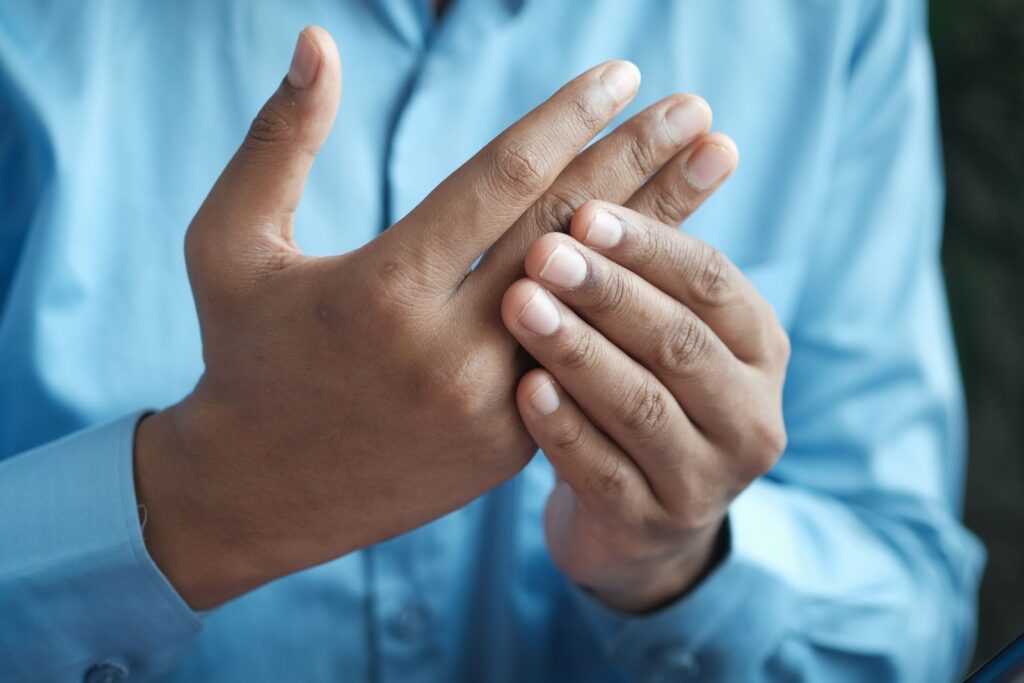
Trigger finger is a painful catching or locking of a finger or thumb as it bends and straightens. It happens when the tendon and its sheath in the palm become irritated and no longer glide smoothly. Many people improve without surgery through activity changes, splinting, hand therapy and sometimes an injection.
In Short: Trigger finger is an irritation of the flexor tendon at the base of a finger or thumb. Early care often helps, and surgery is usually discussed only when other options have not worked or the finger is stuck.
What is trigger finger?
Trigger finger, also called stenosing tenosynovitis, is a condition in which a finger tendon catches as it passes through a tight tunnel at the base of the finger. Finger tendons run through a series of small tunnels called pulleys. When the tendon swells or a small nodule forms, it catches as it passes through the first pulley at the base of the finger.
What is trigger finger in simple terms?
Think of a string pulled through a tight loop. If the string has a knot, it snags as it passes through and then pops free. In your finger, that snag feels like a click, catch or sudden release.
The ring finger and thumb are affected most often, but any digit can be involved. More than one finger can be affected at once.
The tendon is not damaged in the way a tear is damaged. It is irritated and thickened, and the tunnel it passes through becomes snug. That is why many cases settle once the load on the area is reduced.
Where it hurts
Pain is usually felt in the palm at the base of the finger, sometimes with a tender bump you can feel. Some people feel pain in the finger joint instead, which can be confusing. A hands-on assessment helps confirm where the problem sits.
You can often feel the problem yourself. Pressing gently on the palm at the base of the finger may reveal a tender spot or small lump. Press lightly and never try to force a catching finger straight.
What are the symptoms and stages of trigger finger?
Symptoms often start mildly and become more noticeable over weeks. They are usually worst in the morning, when the hand is stiff.
Common symptoms
- Pain or tenderness at the base of a finger or thumb
- A small lump in the palm that moves with the tendon
- Clicking, popping or catching when you bend the finger
- Stiffness that is worse in the morning
- The finger locking in a bent position
How trigger finger tends to progress
It is helpful to think in four rough stages. Each stage guides which options make sense.
- Early: pain and tenderness in the palm, with no catching yet.
- Catching: clicking or catching that frees by itself.
- Locking: the finger locks and you must free it with your other hand.
- Fixed: the finger stays bent and cannot be straightened without help.
Earlier stages generally respond better to non-surgical care. If your finger is stuck, ask for a medical review soon.
How trigger finger differs from other hand problems
Several conditions can cause finger pain, so the details matter. A hands-on assessment helps tell them apart.
- Trigger finger: catching or locking, with tenderness in the palm.
- Carpal tunnel syndrome: numbness and tingling in the thumb, index and middle fingers.
- Arthritis: stiff, swollen finger joints, often with morning stiffness.
- De Quervain’s tendinopathy: pain at the thumb side of the wrist.
Who gets trigger finger and why?
Trigger finger can affect anyone, but some people are more likely to get it. It often appears in middle age and is seen more often in women than men. The exact reason is not always clear.
Health conditions linked with trigger finger
Trigger finger is more common in people with diabetes. It can also occur with rheumatoid arthritis, carpal tunnel syndrome and some other conditions that affect tendons. Our guide to carpal tunnel syndrome treatment explains a related hand problem.
If you have diabetes, your doctor should know about the symptoms. Good overall health care supports tendon health.
Work and daily activities
Repeated or forceful gripping can irritate the tendon sheath. Tools, handles, keyboards, phones and sports grips can all add up. Many Milton workers in trades, warehousing, hairdressing and office settings report hand strain.
If you think your job contributes, read our guide on repetitive strain injury at work to learn when to report it.
How do hand therapy and exercises help trigger finger?
Hand therapy aims to calm the tendon, protect it from overload and keep the finger moving. Physiotherapists and other hand therapists use a mix of education, splinting, gentle exercise and manual techniques. Early treatment often works better than waiting.
Activity changes and tendon gliding
Reduce hard gripping for a few weeks, and pad tool handles. Tendon gliding exercises then help the tendon slide in its sheath. Move slowly and stop if the finger catches sharply.
- Straight hand: fingers together and straight.
- Hook fist: bend the knuckles at the top, keeping the base straight.
- Full fist: make a gentle full fist.
- Straight fist: bend at the base knuckles only.
Do 5 to 10 slow cycles, a few times a day. A clinician can adjust the set for you.
Stretching and warm-up
Warm water soaks for five to ten minutes can ease morning stiffness. Gently stretch the finger straight with your other hand, holding for 20 to 30 seconds. Do not force a locked finger open.
Progress is often gradual. Many people notice less catching over several weeks, and some need a few months. If your finger is getting worse, tell your clinician early so your plan can change.
Tracking progress helps. Each week, note how often the finger catches in the morning, whether it ever locks, and how far you can close a full fist. These simple notes show whether the plan is working and give your clinician something concrete to adjust.
Manual therapy and shockwave
Soft tissue work in the palm and forearm may reduce tenderness. Some clinics also use shockwave therapy for hand and tendon conditions. Ask about suitability and the research that supports it.
What are the splinting, injection and surgery options?
If symptoms continue, other options can be added. A systematic review and network meta-analysis of trials in adult trigger digits, available on PubMed, compared non-surgical and surgical treatments.
It found steroid injections, anti-inflammatory injections and extracorporeal shockwave therapy each had higher odds of success than placebo injection. It also found surgery was more effective than non-surgical care. These findings guide decisions, but your doctor should advise on your case.
| Option | What it involves | Points to consider |
|---|---|---|
| Activity changes and exercise | Less hard gripping, tendon gliding, stretching | Low risk, works best early |
| Splint | Holds the joint in a gentle position | Often worn at night for several weeks |
| Injection | Medication placed near the tendon sheath | Given by a doctor, may not suit everyone |
| Shockwave | Pulses applied to the palm | Evidence is growing, ask about suitability |
| Surgery | Releases the tight pulley | Considered when other care has not helped |
Splinting
A splint holds the affected joint in a gentle, mostly straight position, often at night. The aim is to stop the tendon from catching while you sleep, and to calm the area. Wear time and the type of splint vary, so ask your clinician which design suits your finger.
If you wear a splint at night, check your skin each morning for redness or pressure marks, and adjust the fit if it feels tight. Numbness, tingling or a change in finger colour means you should take it off and contact your clinician.
Injections
A doctor may offer a corticosteroid injection near the tendon sheath. It can ease symptoms for many people, but it is not suitable for everyone, and the effect may not last. People with diabetes may notice a temporary rise in blood sugar, so tell your doctor.
Ask your doctor what to expect afterwards. Some people have a sore palm for a day or two, and you may be told to avoid heavy gripping for a short time. Follow the instructions you are given for your own situation.
When surgery is discussed
Surgery is usually considered when non-surgical care has not worked, symptoms keep returning, or the finger is stuck. The procedure releases the tight pulley so the tendon can glide again. Your surgeon will explain the risks, recovery and what to expect.
Ask about recovery before you decide. Questions worth raising include how long the hand will be sore, when you can return to work and driving, and which exercises to do afterwards. A hand therapist can guide the rehabilitation.
The American Academy of Orthopaedic Surgeons has a patient guide to these options.
Which daily habits ease trigger finger?
Small changes in how you use your hands can protect the tendon while it settles. The goal is to reduce the load, not stop using your hand.
Protect your grip
- Use padded or larger handles on tools, pens and utensils
- Break up long gripping tasks with short hand rests
- Use your whole hand rather than a tight pinch
- Switch tasks between hands where you can
- Keep tools sharp so you need less force
A few minutes of care at set times can fit around a busy day. Many people find it helps to link the exercises to habits they already have.
- Morning: warm water soak, then gentle tendon glides.
- Midday: a short hand break and a gentle finger stretch.
- Evening: tendon glides and a warm soak if the hand feels stiff.
- Night: a splint if your clinician has recommended one.
Support your hands through the day
Warm up the hands before heavy work with a few gentle finger movements. Keep your wrists in a neutral position when typing or using a mouse. Warm water on cold mornings may reduce stiffness.
Gloves with padded palms and tools with cushioned grips can spread the pressure across your hand. Try to hold tools with a relaxed grip, and take a short break before your hand feels sore rather than after.
If your finger starts to catch more often, scale back the activity and book an assessment. Early advice can save weeks of discomfort. Our guide to thumb tendon pain covers another common hand tendon problem.
When should you see a doctor or go to emergency?
Trigger finger is usually not dangerous, but some changes need prompt medical attention. Seek care if you notice any of the signs below.
Seek urgent care if you notice
- A hot, red, swollen finger or palm, especially with a fever
- A finger that turns white, blue or very pale
- Sudden loss of movement after an injury
- Severe pain after a cut, bite or puncture wound
Go to the nearest emergency department or call 911 if these signs appear. Infection of the hand can spread quickly and needs urgent treatment.
See a doctor soon if
Book a medical review if the finger is stuck bent, if numbness or tingling develops, or if symptoms continue after several weeks of care. Also see your doctor if several fingers are affected, or if you have swelling in other joints. The NHS page on trigger finger gives a clear summary of when to seek help.
How can physiotherapy in Milton help with trigger finger?
You do not need a doctor’s referral to see a physiotherapist in Ontario. Physiotherapists are regulated by the College of Physiotherapists of Ontario. We work with your doctor when an injection or surgical opinion makes sense.
Our clinic serves Milton and the wider Halton Region, and many of our hand patients work in trades, hospitality, warehousing and offices. We keep advice practical so you can follow it at work. Short, clear exercise lists are easier to keep up than long programs.
What an assessment includes
We review your daily tasks, check hand strength and movement, and look for the nodule in the palm. You receive tendon gliding exercises, advice on splinting and tips for your work setup. Learn more about wrist and hand pain treatment in Milton.
Coverage and billing
OHIP covers physiotherapy only in limited situations, so many people use extended health benefits. Direct billing may be available with some insurers, and a work-related hand problem may fall under WSIB. Bring your plan details to your visit.
If a catching finger is getting in the way of work or daily tasks, you can book a physiotherapy visit online to talk through your options.