The circles on Michael Phelps’ shoulders at the 2016 Olympics made cupping therapy famous overnight, and the circles have been confusing patients ever since. Cupping is an ancient therapy with modern clinics, real short-term effects, honest evidence limits, and myths on both sides: the enthusiasts who claim everything and the skeptics who claim nothing. This article separates the marks, the benefits, and the myths from what the evidence actually says.
Key Takeaway: Cupping therapy uses suction to lift tissue, producing the signature circular marks (blood brought to the surface, not bruising from trauma) and measurable short-term effects on pain and muscle tension. The evidence supports it as a short-term comfort therapy for musculoskeletal pain; the evidence does not support the stronger claims circulating online. It works best inside a rehabilitation plan, and it is safe when performed by trained clinicians on screened patients.
What cupping actually does to tissue
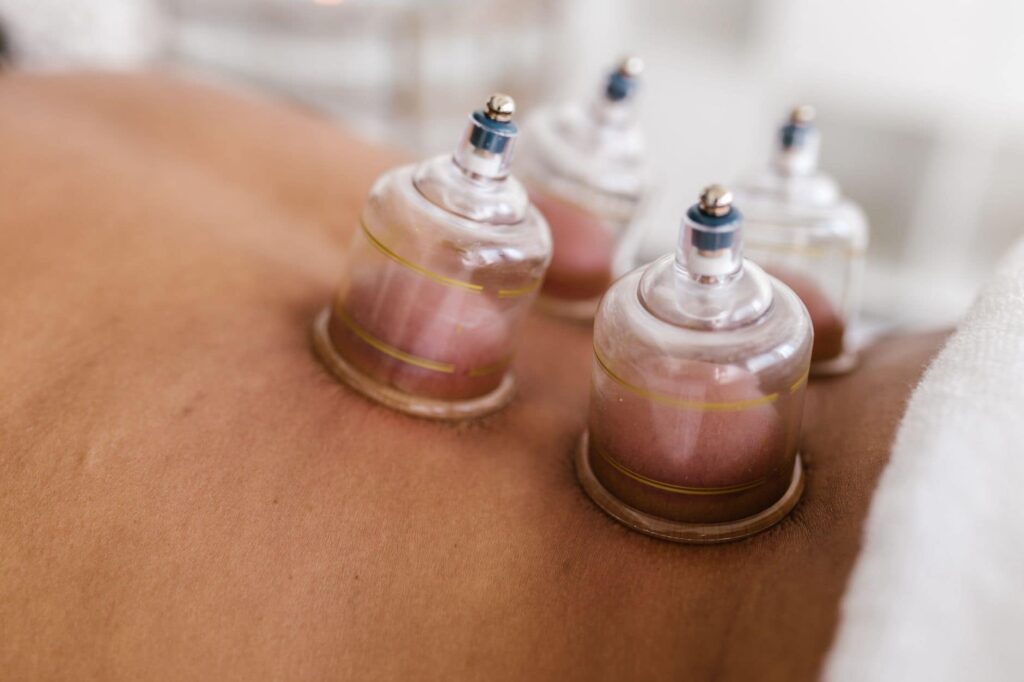
Cupping creates negative pressure, suction, over the skin, and the mechanical effects follow:
- Tissue lifting: the skin and fascia lift away from underlying structures, creating space where compression had built
- Circulation surge: blood flows to the treated area, which is why the marks appear and why the area feels warm and loose after
- Muscle relaxation: the stretch input to the guarded muscle, and the nervous system’s release response
- The marks explained: the dark circles are blood and fluid brought to the surface by the suction, not bruising from impact; they fade in 3 to 10 days and are painless to touch, unlike a bruise
The two cupping styles
| Style | How it works | Feel |
|---|---|---|
| Dry cupping (static) | Cups placed and left 5-10 minutes | Tight pulling sensation, then settling |
| Moving cupping (gliding) | Oiled skin, cups glided along muscles | Feels like a reverse massage: lifting instead of pressing |
Patients receiving Cupping Therapy in Milton get the style matched to the goal: the static cups for the dense restrictions, the gliding for the broad tension patterns.
What the evidence supports, honestly
- Short-term pain reduction: multiple trials and meta-analyses show cupping reduces musculoskeletal pain in the short term, especially neck, back, and shoulder complaints
- Muscle relaxation and range: measurable improvements in range of motion after cupping sessions
- The honest limits: the long-term evidence is thin, the placebo question is unresolved (cupping is hard to blind), and the dramatic claims (detox, curing disease) have no support
- The framing that serves patients: cupping is a comfort-and-mobility tool that helps some patients meaningfully, best used inside a plan that also treats the cause
The myths, on both sides
Myth 1: the marks are toxins leaving the body
The marks are blood and fluid at the surface, brought by the suction’s pressure gradient. The darker marks reflect local tissue states and suction intensity, not a detox scoreboard. The body detoxifies through the liver and kidneys; the cups do not participate.
Myth 2: cupping cures everything from migraines to cellulite
The evidence supports short-term musculoskeletal pain relief. The disease-curing claims online outrun the research by miles, and the honest clinic says so.
Myth 3: it is just a bruise, so it is pointless
The mark is not the treatment; the tissue’s response is. The lifting, the circulation, and the relaxation effects are real even where the evidence is modest, and patients’ short-term relief is a legitimate outcome.
Myth 4: darker marks mean better results
The mark’s darkness reflects suction intensity, skin type, and local tissue state, not therapeutic quality. The chase for darker circles is the technique’s misunderstanding in one behavior.
What cupping helps, in the clinic’s experience
- The tight upper back and neck: the broad tension patterns that hands and rollers reach slowly
- The post-training soreness: the circulation and relaxation effects athletes report
- The dense fascial restrictions: the cups as a companion to the manual therapy work
- The pain that blocks exercise: the short-term relief that gets the program moving
Safety: who should not be cupped
- Blood thinners and bleeding disorders: the marks are controlled but not risk-free
- Skin conditions, open wounds, or active infection at the treatment sites
- Fragile skin and the elderly’s thin skin: modified pressures or alternatives
- Deep vein thrombosis history: physician conversation first
- Pregnancy: specific regions avoided, the practitioner informed
The screening is standard, the single-use or sterilized equipment is verified, and the technique’s safety record in trained hands is excellent. The marks should be circular and painless; anything sharp or lasting deserves a report.
Cupping inside a rehabilitation plan: where it fits
The honest positioning: cupping is a supporting tool, and the plan’s spine is the assessment, the manual therapy, and the exercise. Where the cups add value:
- The guard that blocks hands-on work: the cups relax the guarding first, and the deeper techniques land better
- The mobility session’s opener: the cups before the movement work, the range gained faster
- The athlete’s recovery day: the circulation and relaxation between training blocks
- The pain that limits everything: the short-term relief that starts the program the pain was blocking
The cups never carry a plan alone: the tissue’s cause needs its own treatment, and the assessment sequences it all.
The cupping session, minute by minute
- Minutes 1 to 10: the assessment update, the region’s preparation, the skin check
- Minutes 10 to 20: the cups placed (or glided), the pressure checked, the settling
- Minutes 20 to 25: the cups off, the marks inspected, the movement re-tested
- After: the warmth and looseness, the marks’ care (nothing needed; they manage themselves), the plan’s next step
Wear clothing you can adjust to the region, expect the circles, and plan the wardrobe for the next week accordingly: the marks are visible and harmless, and the tank top decision is yours to make in advance. This ties in closely with physiotherapy after a knee replacement, covered in a separate article.
Cupping versus the manual therapy family
- Cupping and massage: the lift versus the press; the dense restrictions and the broad tension both have fans
- Cupping and dry needling: the surface and the depth; the two pair well for the layered patterns
- Cupping and Graston: the decompression versus the instrument work; the assessment orders them
The tools are a family, and the assessment picks the member by the tissue’s response, not by fashion. The patients who benefit most are the ones whose plans use several tools deliberately.
The history in one paragraph
Cupping is ancient: the Egyptian Ebers Papyrus describes it, Chinese medicine refined it, and Middle Eastern, Greek, and European traditions all carried it. The modern clinic’s version is the same mechanical principle with better screening, sterile equipment, and the research lens that separates its real effects from its mythology. The therapy survived three thousand years because it does something; the evidence is catching up to what, exactly.
The marks care guide: what to do with the circles
The marks need nothing, and the few guidelines keep them that way:
- No cream requirements: the marks fade alone; the arnica is optional belief
- The shower is fine: gentle water, no aggressive scrubbing
- The sun: the freshly marked skin is happier covered for a day or two
- The timeline: darkest in the first 48 hours, fading through the week, gone by day 10 in most skin
The marks that blister, stay sharp-edged beyond two weeks, or hurt to touch get reported: the technique adapts, and the skin’s feedback is part of the treatment’s data.
Cupping for specific presentations
- The upper back and neck: the most cupped region in any clinic, the broad tension’s favorite canvas
- The low back: the gliding version along the paraspinals, the relaxation athletes book monthly
- The IT band and thighs: the moving cups along the lateral line, the runner’s favorite alternative to rolling
- The shoulders: the rotator cuff region’s guarding, the cups before the mobility work
Each region’s cupping has its technique details, and the practitioner’s training covers the map. The self-applied versions exist but lack the screening and the technique; the clinic’s session is where the learning starts.
The athlete’s recovery question: cupping and training
- Post-training: the circulation and relaxation effects pair with the recovery day; the intense training waits 24 hours after a strong session
- Competition week: the light gliding sessions are fine; the heavy static cupping before competition is a preference question, not a recommendation
- The marks in competition: the athlete’s visibility call, made with the calendar in mind
The athletes who use cupping treat it as recovery infrastructure: scheduled, purposeful, and honest about what it does and does not deliver.
The dry versus wet question, answered
Cupping’s traditions include wet cupping (hijama), where the skin is nicked, and blood is drawn; the modern physiotherapy clinic practices dry cupping only. The distinction matters:
- Dry cupping: suction alone, no skin breaking, the marks from fluid brought to the surface
- Wet cupping: a medical procedure with its own risk profile and its own practitioners; not offered in physiotherapy clinics
Patients seeking wet cupping for religious or cultural practice should seek practitioners trained and licensed for that specific procedure; the two practices share a name and little else.
The equipment question: what touches your skin
- Modern clinics use sterile equipment: single-use cups or properly sterilized glass and plastic sets
- The pump or fire question: modern clinics use hand pumps; the fire-cupping theater is a tradition, not a requirement
- The hygiene verification: the patient is entitled to see the equipment’s cleanliness, and the good clinics expect the question
The bottom line: the circles, honestly
Cupping is a legitimate comfort-and-mobility tool with ancient roots, real short-term effects, and honest evidence limits. The marks are circulation’s signature, not toxins’ departure. The therapy works inside plans that treat causes, and it disappoints when used as a cure-all.
If the circles have intrigued you since the Olympics, the assessment answers the real question: whether your tissue is the kind that responds, and what the cups should be paired with to make the response last. One session shows you; the evidence tells you what to expect; the plan makes it count.
Cupping and the nervous system: why it relaxes
The relaxation effect patients report is measurable, and the mechanism is nervous-system:
- The parasympathetic shift: the sustained gentle input moves the nervous system toward rest-and-digest, the state where muscles release
- The gate effect: the skin’s input competes with the pain signals, the same mechanism TENS uses with different hardware
- The stretch response: the guarded muscle’s stretch receptors read the tissue’s new position, and the tone drops
The nervous-system effects explain why cupping sessions feel calming beyond the mechanical lifting, and why the therapy pairs well with the stress-driven tension patterns. The body that feels safe lets go; the cups are one way of telling it the coast is clear.
The frequency question: how often is cupping useful?
- The marks’ timeline sets the pace: the same region waits for the circles to fade before repeating
- The plan’s rhythm: 1 to 2 weeks between sessions for the same region, paired with the other tools in between
- The honest limit: cupping is a tool, not a subscription; the sessions decrease as the plan’s exercises take over
The patients who benefit long-term are the ones whose cupping lives inside a plan with an end date, and whose home program carries what the cups started.
Getting cupping therapy in Milton
Tonic Physio offers cupping within physiotherapy and massage therapy plans for Milton, Oakville, and Halton patients: the screening, the style matched to the goal, and the rehabilitation plan the cups support.
If the circles have been a curiosity since the Olympics, the assessment tells you whether your tissue is the kind that answers to suction. One session shows you; the marks tell everyone else.
Answers to the questions patients ask most
Does cupping hurt?
The suction feels tight, occasionally intense for the first minute, and settles into a pulling warmth. The gliding version feels like reverse massage. Pain that persists past the session means the pressure was too aggressive; report it.
How long do the marks last?
Three to ten days depending on the intensity, the location, and your skin. They fade through yellow-green like a bruise in reverse, and they are painless to the touch.
How many sessions will I need?
Cupping is usually part of a plan rather than a course itself: 1 to 3 sessions paired with the manual therapy and exercise that treat the cause. The marks’ fading guides the spacing.
Can I exercise after cupping?
Gentle movement is fine and helps the circulation; the intense session on freshly cupped tissue waits a day. The area feels warm and tender for hours; treat it like a mild workout’s aftermath.
Is cupping better than massage?
Different tools: the cup lifts what the hand presses, and the dense restrictions often prefer the lift. The best sessions use both, sequenced by the assessment.