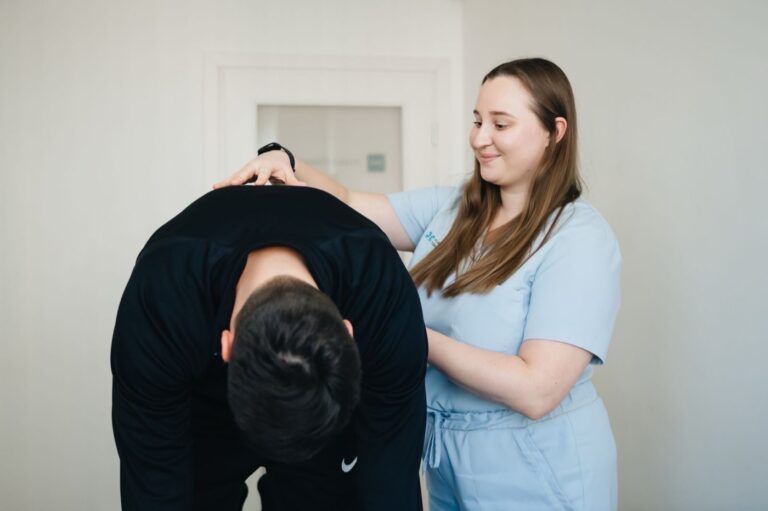
You walked away from the collision feeling shaken but fine. Two days later you can barely turn your head to reverse the car, and by day 3 your shoulders and lower back have joined in. This sequence surprises almost everyone, and it has a name: delayed onset injury. Understanding why it happens changes what you do next, and what you do next matters more than most people realize.
Key Takeaway: Pain appearing 24 to 72 hours after a car accident is normal physiology, not a sign the injury is worsening: adrenaline masks tissue damage at impact, and inflammation builds over the following days. Gentle early movement protects recovery while prolonged rest actively prolongs symptoms. Getting assessed within the first week protects both your health and any Ontario accident benefit claim.
For the next step, read our guide to starting concussion rehab after a crash.
Why the pain waits: the physiology of delayed symptoms
Three mechanisms stack up to hide an injury in the first hours, then reveal it over days.
Adrenaline: the body’s own anesthetic
A collision floods your system with adrenaline and endorphins, the same chemicals that let athletes finish games on broken bones. The tissue damage from the impact exists from the first second. What changes by day 2 is your ability to feel it, because the chemical veil thins while inflammation builds underneath.
Inflammation on its own schedule
Soft tissue injuries swell on a timeline. Microtears in muscle, ligament sprains, and joint capsule irritation all release inflammatory mediators that peak 24 to 72 hours after the insult. The swelling stiffens tissue, presses on pain receptors, and converts a manageable Tuesday into a Wednesday where the seatbelt suddenly hurts to wear.
Muscle guarding arriving late
After impact, the neck and back muscles brace to protect injured structures. The bracing itself stiffens over the following days, and much of the day-3 stiffness you feel is protective tension layered on the original injury. This is why morning stiffness after a collision is often worse than evening stiffness: the night is eight hours of unbroken guarding.
What injuries hide behind the delay
Delayed pain covers a spectrum from nuisance to serious, and the first 72 hours are when you sort which one you have.
Common: the whiplash family
Whiplash describes the acceleration injury where the head snaps relative to the torso faster than muscles can control. Symptoms classically include neck pain and stiffness, reduced rotation, shoulder and upper back pain, headaches starting at the skull base, and sometimes dizziness or jaw soreness. Most whiplash injuries are soft tissue strains that recover well with early, correctly dosed care.
Common but overlooked: the lumbar and thoracic strain
The seatbelt saves lives and concentrates force. Lower back strains from the impact, chest wall bruising where the belt crossed, and mid-back joint irritation frequently ride along with the neck symptoms and get ignored until the neck quiets and they surface.
Serious: the red flags that need same-day assessment
- New arm or leg numbness, tingling, or weakness, especially if progressing
- Severe headache unlike any you have had, or a headache that keeps worsening
- Repeated vomiting, confusion, or memory gaps around the collision
- Severe pain at the midline of the spine, or pain down the spine with coughing
- Abdominal pain, especially with belt-shaped bruising: seatbelt syndrome needs ruling out
- Any loss of bladder or bowel control: emergency, immediately
None of these are delayed-pain curiosities. They are the small fraction of collision injuries that change outcomes with speed, and they are why the first 72 hours include a proper screen even when you feel mostly fine.
Why rest is the wrong prescription
The collision-era advice was rest, wait, and see. Modern sports medicine and spine research landed somewhere else years ago, and car accident recovery followed.
What prolonged rest actually does
- Muscle guarding hardens into habit, and stiff tissues stay stiff longer
- Discs and joints lose the fluid exchange that movement provides; cartilage feeds through motion, not stillness
- Fear of movement takes root, and fear predicts chronic pain better than injury severity does
- Soft tissue heals in a shortened, disorganized pattern when never moved through range
The research on early intervention after whiplash consistently shows that people who move early and recover faster than people who rest and wait. The dose matters: early movement is gentle, frequent, and symptom-guided, not aggressive stretching through sharp pain. That distinction is exactly what a rehabilitation after a car accident program is built to manage, because the right dose in week one looks nothing like the dose in week four.
The first 72 hours: what early movement looks like
- Walk short distances frequently: 5 to 10 minutes, several times daily, within your symptom tolerance
- Perform gentle range-of-motion movements for the neck and shoulders every waking hour or two, staying short of sharp pain
- Sleep with neck support: a rolled towel inside the pillowcase keeps the curve neutral through the night
- Sit for short stretches only; change position every 30 to 40 minutes
- Use heat after 48 hours to ease guarding; ice helps some people in the first 48, and both are comfort measures, not treatments
The insurance clock: Ontario accident benefits and your claim
Ontario’s system has its own timeline, and it runs parallel to your recovery. Knowing the sequence early prevents the paperwork problems that complicate otherwise straightforward claims.
We cover how SABS accident benefits work in its own article.
The key deadlines
| Step | Deadline | Notes |
|---|---|---|
| Report collision to police | Immediately if injuries, damage over threshold, or hit and run | Collision report reference number matters later |
| Notify your insurer | As soon as possible, within 7 days | Opens the accident benefit claim |
| OCF-1 application | Within 30 days of receiving forms | The core accident benefits application |
| Treatment plans (OCF-18) | Filed by your physiotherapist | Most minor injury plans are approved within 10 business days |
What minor injury guideline means for you
Most soft tissue collision injuries fall under Ontario’s minor injury guideline, a streamlined lane where your physiotherapy clinic files a treatment plan directly and, once approved, bills your insurer rather than you. You do not need a lawyer to access accident benefits, and you do not need to wait for fault to be determined: accident benefits are available regardless of who caused the collision.
Documentation habits that protect the claim
- A brief daily symptom note for the first two weeks: what hurts, what is better, what is new
- Keep every appointment; gaps in treatment records read as recovery in claim reviews
- Photograph visible bruising; it dates the injury better than memory
- Report new symptoms the week they appear, because late-arriving complaints invite dispute
What recovery actually looks like
Most collision-related soft tissue injuries recover substantially within 6 to 12 weeks with appropriate care. The path has a shape, and deviations from it are information.
Weeks 1 and 2: settle and move
Pain peaks in the first days and trends down. Treatment focuses on restoring rotation and reducing guarding, with movements dosed to a mild-stretch level. Work continues where possible; concentration struggles from headaches or dizziness are worth flagging to your provider because they change the plan.
Weeks 3 to 6: rebuild range and strength
Stiffness lingers after pain fades, and this phase rebuilds what the guarding took. Rotation returns, strength work begins for the neck and shoulder blade muscles, and the specific deficits from your assessment drive the program. Most people who feel back to normal in this phase still measure reduced rotation; finishing the program prevents next winter’s surprise.
Beyond 6 weeks: the persistent minority
A meaningful minority of whiplash cases become persistent, and the predictors are known: high initial pain, early passive coping, and long rest. The antidote to persistence is the opposite of waiting: graded exposure to feared movements, progressive loading, and structured support. This is the population that benefits most from professional rehabilitation rather than self-management alone.
When headaches and dizziness join the picture
Post-collision headaches and brief dizziness are common and usually benign, but they deserve precise attention because occasionally they signal something that needs more than physiotherapy.
Watch for, and report, these patterns
- Headache that worsens day over day rather than improving
- Dizziness triggered by specific head positions versus constant imbalance; the first pattern is usually inner ear and treatable, the second needs medical evaluation
- Any cognitive fog, memory trouble, or visual disturbance: these belong in a medical assessment for concussion
- Headache with jaw clicking or ear fullness: the temporomandibular joint took part in the injury and has its own treatment path
The delayed pain patterns by body region
Collision forces distribute through the whole body, and each region reveals its injury on its own schedule. Knowing the local patterns helps you report symptoms accurately in week one.
The neck: 24 to 72 hours, the classic window
Neck symptoms peak early and loudest. Stiffness on rotation, pain at the skull base, and shoulder blade aching dominate. The morning-after pattern, where day 2 and day 3 mornings are markedly worse, is the signature of inflammation plus overnight guarding, and it settles with movement and proper support rather than with waiting.
The low back: the overlooked passenger
Lumbar strains ride along in rear-end and side impacts and often peak after the neck has begun settling, around days 3 to 5. People interpret the sequencing as a new injury. It is the same event surfacing region by region, and the treatment plan accounts for all of it from the first assessment.
Hips and knees: the belted lower body
Bracing against the floor and pedals strains hip flexors and knee structures. Bruising at the knee from the dash, or groin discomfort from the belt, belongs in the first-week report even when walking seems fine, because those tissues guard quietly and surface later.
Jaw: the injury nobody connects
The temporomandibular joint absorbs real force in collisions, and jaw symptoms surface late: chewing fatigue, clicking, ear fullness, or morning jaw stiffness. Flag them early, because jaw involvement changes the headache treatment and has its own simple exercises.
Answers to the questions collision patients ask most
Should I go to the emergency room if pain starts on day 2?
Emergency care is for red flags: neurological symptoms, worsening severe headache, abdominal pain with belt bruising, spinal midline pain, or bladder changes. Delayed soft tissue pain without red flags belongs in a physiotherapy assessment, which screens for the serious patterns and treats the common ones.
Do I need a lawyer to open accident benefits?
No. You notify your insurer, complete the OCF forms, and your treating clinic files the treatment plan. Lawyers matter for disputed serious claims, not for the standard minor injury pathway. Starting treatment does not commit you to anything legal.
Will my premiums rise for using accident benefits?
Accident benefits are the portion of your own coverage designed for exactly this use, and accessing them is separate from fault determination. The collision itself, not the treatment claim, drives any premium conversation with your insurer.
How do I know if my symptoms are whiplash or something worse?
Whiplash pain is mechanical: it changes with position and movement, peaks early, and trends better. Symptoms that progress steadily, that include neurological changes, or that ignore position entirely are the ones that need same-day medical eyes. When in doubt, the assessment itself is the sorting tool.
Can I keep training through recovery?
Usually yes, with a modified plan. Lower body training continues early for most people; overhead lifting and loaded neck positions wait for the range to return. Athletes and gym-goers recover faster when they stay in the gym at reduced intensity than when they vanish for a month, and your program will say exactly which movements stay and which pause.
Getting assessed in Milton after a collision
Tonic Physio assesses and treats collision injuries for Milton, Oakville, and Halton Hills residents, files the insurer paperwork directly, and builds the early-movement program that the research supports. No referral is needed to start. Ask us about the next available appointment.
If your collision was this week and the pain is just arriving, you are on schedule, not unlucky. One assessment maps the injuries, screens the red flags, and starts the movement plan that keeps the recovery measured in weeks rather than months. Bring your claim number if you have one; if not, we will walk you through the sequence.