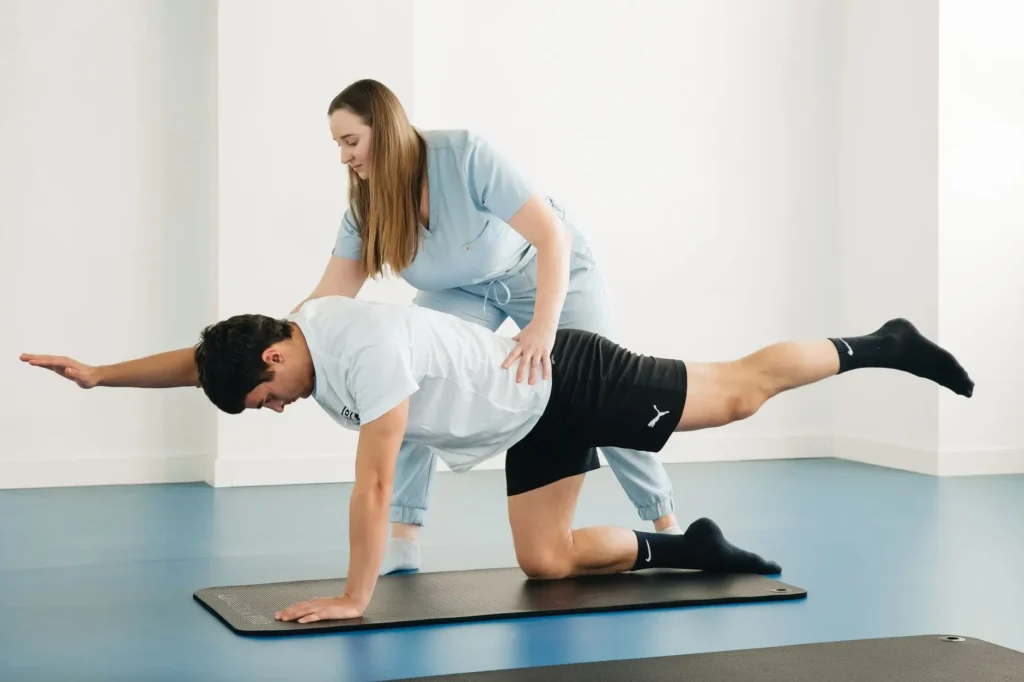
Pelvic floor physiotherapy is marketed to women, and men’s pelvic floors are just as real, just as trainable, and just as treatable. The male pelvic floor produces pelvic pain, urinary symptoms, and sexual dysfunction when it fails, and it fails more often than any men’s health conversation mentions. This article is the men’s version of the conversation.
Key Takeaway: Men’s pelvic floor physiotherapy treats chronic pelvic pain, post-prostatectomy incontinence, urinary urgency, and sexual dysfunction through the pelvic floor muscles. The male pelvic floor is accessible through internal and external assessment, responds to training like any other muscle group, and improves in the majority of treated patients. Most extended plans cover it, and the assessment is less intimidating than a decade of silent symptoms.
What the male pelvic floor actually does
The male pelvic floor is a hammock of muscles spanning the pelvis, and it does four jobs at once:
Our team has also written about the complete guide to pelvic floor therapy.
- Continence: closing the urethra against pressure, from coughs to deadlifts
- Support: holding the bladder and bowel in position
- Sexual function: the erection and ejaculation mechanics run through these muscles
- Core stability: the floor is the bottom of the cylinder the diaphragm and abdominals pressurize
When the floor fails, it fails in two directions, and men usually arrive with one of them:
- The weak floor: leaking with activity, post-prostate urgency, the reduced firmness that weak erections report
- The overactive floor: the chronically gripping pelvic floor that produces pelvic pain, painful ejaculation, urgency without cause, and sitting intolerance
The overactive floor is men’s most common presentation, and it is the opposite of the weakness the word “Kegels” assumes, which is why self-prescribed Kegels often make men worse.
If this applies to you, see our post on B-Pulse for postpartum pelvic weakness.
The conditions men bring to pelvic floor physiotherapy
| Presentation | What it feels like | What treatment addresses |
|---|---|---|
| Chronic pelvic pain / CPPS | Perineal ache, testicular or penile pain, pain with sitting | The overactive floor downregulated, trigger points released |
| Post-prostatectomy incontinence | Leaking with movement, urgency, pad use | Strength and coordination rebuilt pre- and post-surgery |
| Erectile dysfunction contributors | Weak or unreliable erections without vascular disease | Floor strength and blood flow mechanics improved |
| Urinary urgency and frequency | The sudden “now,” the bathroom mapping of every route | The floor and bladder system retrained together |
| Post-surgical or post-radiation recovery | Everything above, after prostate or bowel treatment | Staged rehabilitation around the treatment timeline |
Chronic pelvic pain: the most common and most missed
Chronic prostatitis/chronic pelvic pain syndrome affects a meaningful percentage of men at some point, and the standard medical workup often finds no infection and offers few answers. The pelvic floor is where most of those answers live:
- The overactive floor compresses nerves, restricts blood flow, and produces the aching, burning, pressure symptoms men describe
- The symptoms flare with stress and sitting, and ease with relaxation and standing: the overactive muscle’s signature
- Treatment downregulates the floor: internal release techniques, breathing retraining, and the graded return to comfortable sitting and activity
Men typically arrive after years of antibiotics for a prostate infection that was never there. The pelvic floor assessment is what the workup was missing.
What assessment involves, described plainly
The words “internal exam” stop most men from booking, so here is the honest version:
- The history: symptoms, timeline, medical history, including prostate, and your goals
- External assessment: posture, hips, low back, abdominal mechanics, and the external pelvic floor muscles through the perineum
- Internal assessment, with your consent: via the rectum, which assesses the pelvic floor’s strength, tone, and coordination directly. External-only paths exist and are honored when preferred
- The plan: your specific findings, your program, and the timeline
Men’s internal assessment is simpler anatomically than women, the discomfort is brief, and the information it provides is what makes the treatment precise. Patients seeking pelvic floor physiotherapy in Milton describe the first appointment as clinical, matter-of-fact, and far easier than the decade they spent not booking it.
The treatment, by presentation
For the overactive, painful floor
- Downregulation first: learning to release the floor, with breath coordination, positions, and manual release techniques
- The paradox explained: a muscle that never relaxes cannot generate clean force, and pain feeds the guarding, which the treatment unwinds in sequence
- Sitting and activity re-introduction: graded, so the flares stop reinforcing the guard
For the weak floor, post-prostate or otherwise
- Find-then-train: many men cannot feel the right muscles initially; the assessment teaches the correct contraction before the strengthening starts
- Progressive training: quick flicks, long holds, and functional integration with coughing, lifting, and the specific leaks
- The pre-hab option: men scheduled for prostatectomy who train beforehand recover continence significantly faster, one of the best-evidenced interventions in the field
For urgency and the bladder system
- Bladder retraining: the urge-wave surfed rather than obeyed, the interval stretched gradually
- Fluid and irritant audit: the caffeine, alcohol, and carbonation that feed urgency
- The floor’s role: the overactive floor and the urgency feed each other, and both get treated
The post-prostatectomy timeline: what the evidence says
Prostate cancer treatment saves lives and challenges continence, and the rehabilitation timeline matters enormously:
- Pre-surgical training: men who train the floor before surgery regain continence weeks faster on average, the strongest finding in the field
- Early post-op: the catheter comes out, the leaks are real, and the training starts immediately with the surgeon’s clearance
- Weeks 2 to 12: the strength and coordination program, with most men reaching pad-free daytime continence inside 3 to 6 months of active rehab
- The persistent cases: the men still leaking at 6 months benefit from the detailed re-assessment and the advanced techniques, not from resignation
The men who recover fastest are the ones who started before the surgery. Men with prostate surgery on the calendar should book the pre-hab as soon as the date exists.
The cyclist’s and lifter’s pelvic floor
Two active male populations carry predictable floor loads:
- The cyclists: the saddle’s perineal pressure, the numbness and the sitting pain; the saddle fit, position, and the floor’s tone all feed it
- The heavy lifters: the breath-holding and bracing that spikes floor pressure; the exhale-on-effort technique that trains the lift without training the leak
Both populations respond well to the mechanical assessment plus the technique work, and the sports questions belong in the first appointment.
The stress connection, again
The pelvic floor is the body’s other stress organ, and men’s floors guard with the same loyalty their shoulders do:
- The flares that track work and life stress are the overactive floor’s signature
- The breath retraining that treats it: the diaphragm and floor move together, and the shallow stressed breath keeps the floor gripping
- The sleep and the pain spiral: the same unwind, one system lower
Men with pelvic pain who describe themselves as “always tense” are describing the mechanism, and the treatment plan that includes the nervous system works better than the one that treats muscles alone.
The silence problem: why men wait years
The average man with pelvic symptoms waits years before mentioning them to anyone, and the reasons are cultural, not medical. The cost of the silence:
- The overactive floor’s patterns solidify with years of guarding
- The post-prostate leaks that self-managed with pads while the trainable muscles waited
- The relationship strain that the untreated symptoms tax quietly
The counter-programming is simple information: the male pelvic floor is a muscle group, it fails and recovers like any other, and the specialty that treats it exists in Milton with clinicians who do this daily. The conversation is clinical, the treatment is efficient, and the outcomes are better than the silence.
Prostate health and the physiotherapy partnership
Prostate conditions and pelvic floor rehabilitation overlap constantly, and the partnership runs both ways:
- Before surgery: the pre-hab training
- After radiation: the floor’s tone often changes with treatment; the assessment tracks and addresses it
- Chronic prostatitis workups: the pelvic floor assessment belongs in the workup when infection has been ruled out, because the floor is usually the finding
Urologists refer to pelvic floor physiotherapy routinely; men should feel no hesitation asking for the referral, or simply booking directly, which Ontario requires no referral for B-Pulse Pelvic Floor Strengthening.
The pelvic floor and the core: the cylinder explained
The pelvic floor does not work alone; it is the floor of a pressure system whose walls are the abdominals and whose roof is the diaphragm. Every cough, sneeze, lift, and laugh pressurizes the cylinder, and the floor’s job is to catch what the pressure pushes down.
- The breath connection: the diaphragm and floor move together in healthy systems; the breath-holder’s floor takes every spike alone
- The bracing pattern: the weightlifter’s all-day brace that keeps the floor at work even between sets
- The training integration: the floor exercises that coordinate with breath and load, which is what makes the strength functional rather than theoretical
Men whose leaks or pain track effort, lifting, coughing, or laughing are describing the pressure system, and the training that treats it coordinates the whole cylinder rather than squeezing one muscle in isolation.
What progress looks like, by the numbers
- Post-prostatectomy: pad-free days typically arrive in weeks to months of active rehab, with the pre-hab group fastest
- Chronic pelvic pain: the sitting tolerance and symptom intensity usually shift measurably within 4 to 6 sessions
- Urgency: the bathroom map shrinks within 2 to 4 weeks of retraining
- Erectile function: improvements typically register across 8 to 12 weeks of training
The timelines are honest, the majority outcomes are good, and the assessment is where both get personalized to your case.
The first appointment, minute by minute
- Minutes 1 to 15: the history, the symptoms, the goals, spoken in clinical plain language
- Minutes 15 to 30: the external assessment: posture, hips, spine, and the external floor
- Minutes 30 to 45: the internal assessment if you consent, or the external-only program start
- Minutes 45 to 60: the findings explained, the program written, the first exercises started
Bring your symptom list and your questions. The appointment is yours, the consent is yours, and the pace is yours. The only thing the decade of silence has ever protected is the problem itself.
Getting assessed in Milton
Tonic Physio provides men’s pelvic floor physiotherapy for Milton, Oakville, and Halton patients: the full assessment, the internal or external path you choose, the specific program, and the direct billing that keeps the course affordable.
If you have been carrying pelvic symptoms in silence because the conversation seemed impossible, the assessment is the conversation, and it is shorter than the years you have carried the symptoms. Book it, bring the symptom list, and let the floor tell you what it has been doing.
Answers to the questions men actually ask
How do I know if I even have a pelvic floor problem?
The symptom list: pelvic or perineal pain, pain with sitting, urinary urgency or leaking, painful or unreliable erections, or post-prostate changes. Any of them earns an assessment, and the assessment says which of the two presentations you carry.
Are Kegels enough?
For the weak floor, done correctly, they are the start. For the overactive floor, they are the problem. The assessment decides which floor you have, which is why the self-prescription fails so reliably.
Will this fix my erections?
Pelvic floor training improves erectile function in men without major vascular disease, and the research supports it meaningfully. Erections have many inputs: vascular, hormonal, psychological, and mechanical. The pelvic floor is the mechanical one, and its training helps the others work better too.
Is it awkward?
The first minutes are, the way any new clinical conversation is. The practitioners do this daily, the language is clinical, and the treatment is efficient. By the second visit, it is simply healthcare.
Does insurance cover men’s pelvic floor physiotherapy?
Yes: extended plans cover it as physiotherapy, with direct billing at most clinics. No referral is needed to book in Ontario.
Men’s pelvic floor and the cyclist’s clinic
Milton’s cycling community brings its own pelvic floor presentations, and the assessment covers them:
- The saddle pressure: the perineal numbness and the sitting pain that long rides produce
- The fit questions: the saddle width, the tilt, the position; the mechanical fixes that pair with the floor work
- The strength paradox: the cyclist’s strong legs sitting on an untrained floor; the floor’s training completes the system
The cyclists who combine the saddle fitting with the floor program report the numbness resolving and the long rides returning, and the assessment includes the bike questions for exactly this population.
The pelvic floor and the gym: training through treatment
Men in strength programs keep training through pelvic floor rehabilitation, with the technique adjustments the program prescribes:
This ties in closely with physiotherapy through pregnancy and menopause, covered in a separate article.
- The exhale-on-effort rule: the bracing pattern that spikes floor pressure, replaced with the coordinated breath
- The loading progression: the lifts continue, dosed to the floor’s current capacity
- The floor’s integration: the exercises that train the floor with the lifts rather than instead of them
The gym patient’s plan includes the training calendar, because the floor’s rehabilitation happens inside the training week rather than instead of it.
The post-radiation and post-TURP presentations
Beyond prostatectomy, the other prostate treatments carry their own pelvic floor pictures:
- Radiation changes: the tissue’s tone and the urinary symptoms that follow, assessed and treated on their own timeline
- TURP procedures: the retrograde ejaculation conversation and the floor’s role, addressed honestly
- The coordination: the urologist’s care and the physiotherapy run in parallel, and the notes travel
Every prostate pathway has a pelvic floor chapter, and the assessment writes the patient’s version of it.