Osgood-Schlatter disease is irritation of the growth plate just below the kneecap, where the patellar tendon attaches to the top of the shin. It is a common cause of knee pain in young athletes, often appears during a growth spurt and usually settles once growth slows.
This article explains what Osgood-Schlatter disease is, why growth and sport set it off, how long it tends to last, which activities to keep or trim during a flare, and the signs that mean a knee needs a medical check.
Key Takeaway: Osgood-Schlatter disease is a traction problem at a growth plate, not a torn ligament or a broken bone. Symptoms can come and go until the growth spurt finishes in the mid-teens. Most young athletes stay active with a plan that trims painful loads, builds strength and returns to sport in steps.
What Is Osgood-Schlatter Disease?
Osgood-Schlatter disease is an apophysitis, which means irritation of a growth plate where a tendon attaches to bone. Here the patellar tendon pulls on the tibial tubercle, the bony point just below the kneecap. Repeated pull during running, jumping and kicking irritates that spot and can enlarge the bump.
Why Growth Spurts Matter
During a growth spurt, the thigh and shin bones lengthen faster than the muscles and tendons around them. The quadriceps become relatively tight and pull harder on a growth plate that is softer than mature bone. That pull is normal, but repeated many times a day it can outpace the body’s ability to recover.
Published reviews describe the condition most often in girls around ages 10 to 13 and in boys around ages 12 to 14. Girls tend to be affected a little earlier because their growth spurt usually comes sooner. Both knees can be involved, although one side is often worse.
What It Is Not
Osgood-Schlatter disease is not the same as an adult patellar tendon problem, a meniscus tear or a ligament sprain. Those involve different tissues and need different plans. A sudden pop, locking or the knee giving way points away from Osgood-Schlatter disease and toward an injury that needs its own assessment.
What Are the Signs of Osgood-Schlatter Knee Pain?
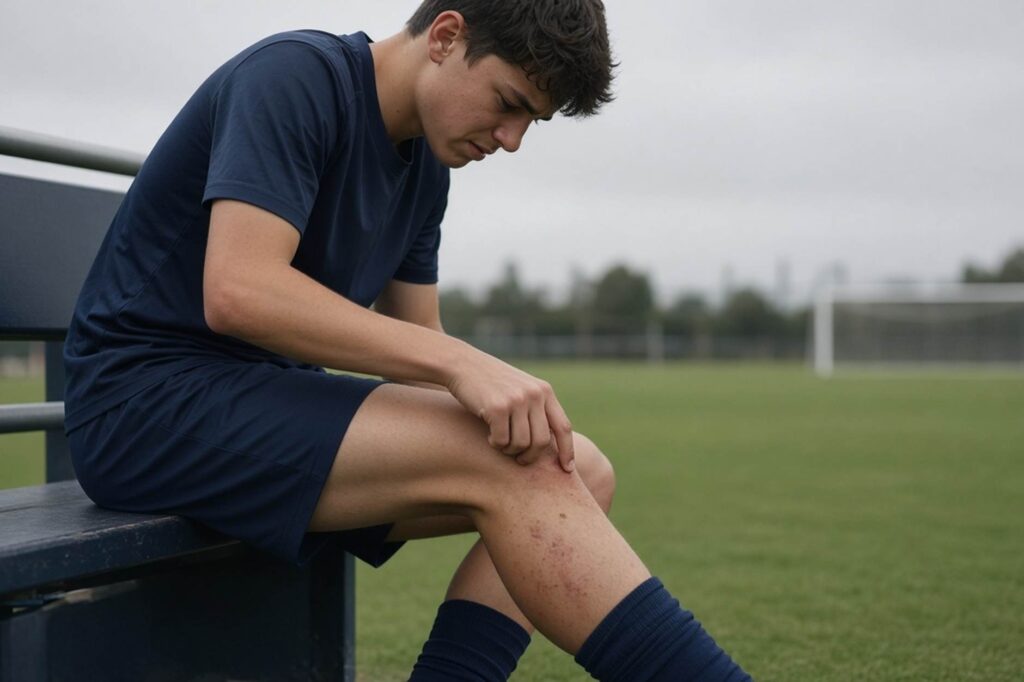
The pain usually has a clear home: a tender bump on the front of the shin, a few centimetres below the kneecap. Parents often search for “bump below the kneecap” before they ever hear the condition’s name.
Common Symptoms
- A tender, sometimes swollen bump below the kneecap
- Pain with running, jumping, kneeling, squatting or stairs
- Pain that builds during sport and eases with rest
- Tightness in the front or back of the thigh
- A limp after practice or games on bad days
Why the Bump May Stay
The bump can remain visible after the pain has settled. This is the tibial tubercle reshaped by months of pull, and it is usually harmless. Many adults who had Osgood-Schlatter disease as teens still have a small bump with no pain at all.
Who Gets It Most
Sports with sprinting, jumping, landing and kicking load the patellar tendon the most. Soccer, basketball, volleyball, hockey, gymnastics, dance and track come up often. A sudden jump in training, such as a new club team on top of school sport, is a common trigger.
How Long Does Osgood-Schlatter Disease Last?
Recovery time varies from child to child. A single flare often calms over a few weeks once the load is adjusted, but symptoms can return on and off for 12 to 24 months. OrthoInfo, from the American Academy of Orthopaedic Surgeons, notes that symptoms usually go away once the adolescent growth spurt is complete.
Typical Pattern Over Time
Many families see good weeks and flare weeks, often linked to busy sport seasons or growth spurts. Pain tends to fade as the growth plate closes, often around age 14 for girls and 16 for boys. Surgery is rarely needed and is usually only discussed for adults with a painful loose bone fragment.
What Research Shows About Active Plans
A prospective cohort study of adolescents with Osgood-Schlatter disease used activity modification, pain monitoring and progressive strengthening over 12 weeks. Most participants reported a good outcome, and many had returned to sport by 12 months. It had no comparison group, so it supports a structured plan rather than a fixed recovery time.
Which Activities Are Safe During a Flare?
Complete rest is rarely the best first step. Most young athletes can keep moving if pain stays mild during activity and settles by the next morning. When pain takes the fun out of sport, or a limp lasts into the next day, the load needs a temporary cut.
Activity Guide by Stage
The table below is a general guide. Your child’s therapist or doctor may adjust it based on how the knee responds.
| Activity | During a painful flare | As pain settles |
|---|---|---|
| Walking, swimming, easy cycling | Usually fine, keep going | Keep as part of weekly fitness |
| Running at steady pace | Shorten or reduce if pain builds | Build distance slowly |
| Sprinting and hard cutting | Pause or reduce sharply | Add back in short sets |
| Repeated jumping and landing | Pause most jumping drills | Reintroduce low hops, then higher |
| Deep squats and lunges | Keep shallow and pain-free | Progress depth as pain allows |
| Kneeling on hard floors or turf | Avoid or use a thick pad | Use padding for kneeling sports |
| Full games and tournaments | Trim minutes or skip one event | Return once practice feels easy |
The Next-Morning Rule
A simple way to judge load is to check the knee the morning after activity. Mild soreness that fades quickly is usually acceptable. If the knee is clearly worse the next morning, the previous day was too much, and the next session should be lighter.
Trimming the Calendar, Not the Season
Many young athletes play on several teams at once. Removing one extra session a week, or one day of a tournament weekend, often helps more than cancelling a whole season. Shared decisions between the athlete, parents and coach tend to work better than a strict ban.
What Exercises Help Osgood-Schlatter Disease?
Exercise aims to reduce pull on the growth plate and build the strength that helps the knee cope with sport. The examples below show how many plans are built. They are not a personal prescription, and sets and progressions should be set by a clinician who has examined the knee.
Gentle Stretching
Tight quadriceps and hamstrings are common during growth spurts. Gentle stretches for the front and back of the thigh, held for 20 to 30 seconds without bouncing, may reduce pull on the tibial tubercle. Stop if a stretch causes sharp pain at the bump.
Early Strength Work
- Quad holds with a rolled towel under the knee, pressing the back of the knee down gently
- Glute bridges with the hips level
- Side-lying hip lifts or clams within comfort
- Wall sits held at a shallow angle when pain stays low
Pain Monitoring and Progression
A common clinic guide is to keep pain during exercise at about 2 out of 10 or less, and no worse the next morning. When the early exercises feel easy, plans often add step-ups, controlled lunges and then low hops. If morning pain spikes, the plan steps back one level for a few days.
Do Straps, Tape or Ice Help?
Supports can make sport more comfortable for some young athletes. They work best as helpers alongside load changes and exercise, not as the whole plan.
Patellar Tendon Straps
A patellar strap sits on the tendon between the kneecap and the bump. It may change how force travels through the tendon, and some teens report less pain during sport. Research on straps for Osgood-Schlatter disease is limited, so results vary from child to child.
Taping and Padding
Taping is sometimes used for comfort during a return week. Our guide to kinesio tape versus athletic tape explains how the two types differ. A soft pad over the bump helps in kneeling sports such as volleyball or hockey goaltending.
Ice and Medication
Ice for 10 to 15 minutes after activity can ease soreness for many families. Medication choices for children and teens belong with your doctor or pharmacist, who can advise on what is suitable for your child’s age and health.
How Do Young Athletes Return to Full Sport?
Return to sport is a ladder rather than a single date. Moving up one step at a time helps avoid the cycle of two good weeks followed by a painful flare.
A Step-by-Step Ladder
- Calm daily pain so walking and stairs feel normal
- Rebuild thigh and hip strength without flaring the bump
- Add controlled hops, skipping and changes of direction
- Return to practice skills and drills before full games
- Resume full game load when pain after sport fades quickly
Using Objective Checks
Strength and hop tests can show whether both legs are working evenly before a big tournament. Our article on return to sport testing criteria describes the kinds of checks clinicians use. Passing them gives athletes and parents more confidence than counting pain-free days alone.
Can Osgood-Schlatter Disease Come Back?
Flares can return during a later growth spurt or a busy season, even after months of calm. This is common and does not mean the plan failed. Going back one or two steps on the ladder for a week or two usually settles things faster than stopping sport completely.
Common Myths
Many parents worry that playing will damage the knee for life. OrthoInfo states that activity as tolerated does not cause long-term harm in typical cases, although pain still deserves respect. Another myth is that stretching alone fixes the problem; for most athletes, load management and progressive strength matter more.
When Should You See a Doctor About Knee Pain?
Most cases of Osgood-Schlatter disease are clear from the history and a hands-on exam. X-rays are not always needed and are usually ordered when another problem must be ruled out. Some symptoms do not fit the typical picture and need prompt medical care.
Signs That Need Urgent Care
See a doctor promptly, or go to the emergency department, if your child has:
- Pain that wakes them at night or is present at complete rest
- Fever, unexplained weight loss or feeling generally unwell
- A knee that locks, gives way or followed a sudden pop
- Swelling of the whole knee joint rather than the bump alone
- Inability to bear weight after a fall or collision
When an Assessment Helps
An assessment is worth booking if pain stops your child enjoying sport, if a limp lasts into the next day, or if flares keep returning despite rest. Our post on signs your child may need physiotherapy covers other situations where a young athlete may benefit from a plan.
How Physiotherapy Supports Young Athletes
Physiotherapy for Osgood-Schlatter disease focuses on the knee, the sport calendar and the athlete’s understanding of their own symptoms. The aim is to keep young people active while the growth plate settles.
What a First Visit Usually Covers
- A review of practices, games, gym sessions and recent growth
- A hands-on exam of the tibial tubercle, knee, hip and ankle
- Strength checks for the quadriceps, hamstrings and hips
- Movement tasks such as squats, step-downs or hops when suitable
- A written plan for what to keep, what to trim and what to practise at home
Working With Coaches
A short written note for the coach can help. It may list which drills to limit for now, how many minutes the athlete can play and which signs mean they should sit out. Clear communication keeps the athlete involved with the team while the knee settles.
Education for the Athlete
Teens tend to do better when they understand why kneeling on hard turf hurts and how to rate pain after a session. A clear plan helps the athlete, parents and coach make the same decisions each week. You can learn more about our approach on the knee pain treatment page.
Further Reading
For background on the condition, see the OrthoInfo page on Osgood-Schlatter disease and the StatPearls clinical summary. Both explain the growth-plate mechanism and the usual course in plain terms.
If your child has a sore bump below the kneecap that keeps flaring with sport, you can book an assessment online. Bring a short note of recent practices and the moves that hurt most.
This article is general information and is not a personal diagnosis. Knee pain in children and teens should be assessed by a qualified clinician, especially when warning signs are present.