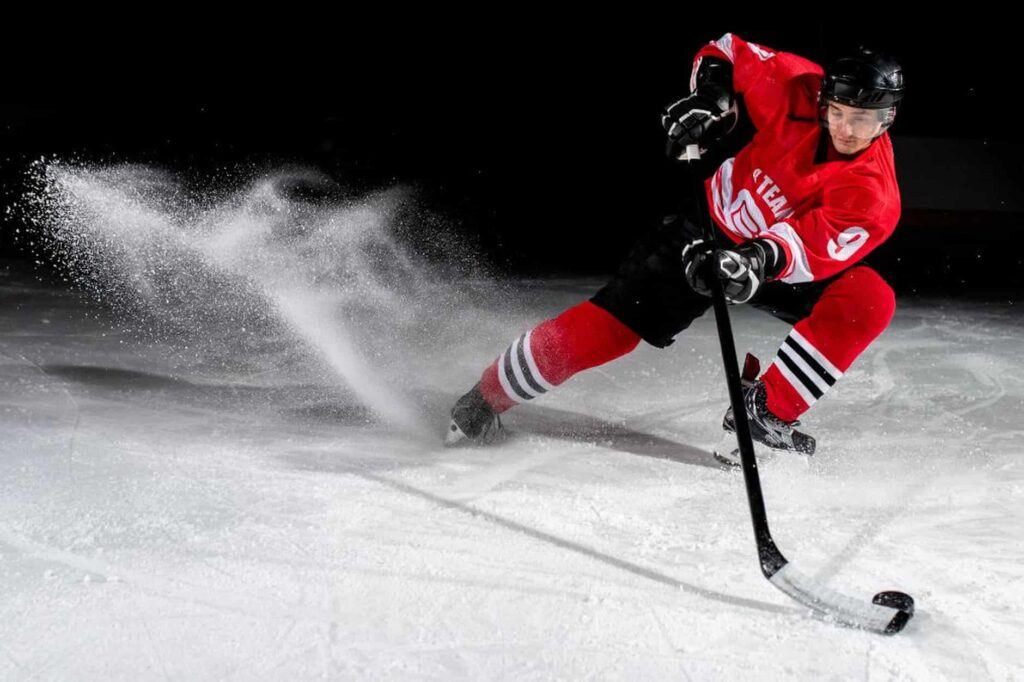
A groin strain is a tear of some fibres in the inner thigh muscles, called the adductors, which pull the leg in toward the other leg. A hockey groin strain usually happens on a hard stride, a crossover or a sudden stop, when the adductors are working hard while they lengthen.
This article explains strain grades, the stages of recovery with typical timelines, the checks to pass before returning to the ice and the warning signs that need a medical check.
Key Takeaway: Most hockey groin strains settle with relative rest followed by graded strengthening. Mild strains often take a few weeks, while bigger tears take longer. Return to the ice in stages, and move forward only when skating, crossovers and stops feel normal and stay quiet the next day.
What Is a Hockey Groin Strain?
The adductors sit on the inside of the thigh and run from the pelvis to the thigh bone. In a skating stride they also control the leg as it pushes out to the side, which is a heavy job.
A sudden extra reach, a slip, a tight turn or a sprint start can overload some fibres. That overload is a strain, and the adductor longus, high on the inner thigh, is the muscle most often involved.
Why Skating Loads the Inner Thigh
Crossovers add another job. The top leg crosses the midline while the bottom leg pushes out to the side, so a crossover at speed or when tired is a classic moment for a pull.
Hard stops load the area too. The inside edge bites, the hip rotates and the inner thigh brakes the motion.
Muscle or Tendon?
Some strains sit in the muscle belly, while others sit closer to where the tendon attaches to the pubic bone. These do not always recover on the same timeline.
Tendon pain near the bone often needs gradual loading rather than rest alone. That is one reason an exam matters before you plan a return date.
What Are the Grades of Groin Strain?
Clinicians often sort muscle strains into three grades. The grade gives a rough idea of how much tissue is involved and how long recovery may take.
Grades at a Glance
| Grade | What players notice | Typical recovery range |
|---|---|---|
| — | — | — |
| Grade 1 (mild) | Soreness with a squeeze or long stride; walking is normal | Often 1 to 3 weeks |
| Grade 2 (moderate) | Limp, bruising after a day or two, painful push-off | Often 3 to 8 weeks |
| Grade 3 (severe) | A pop, large bruise, very weak or painful squeeze | Often several months; needs a medical check |
These ranges are a guide, not a promise. A small strain you skated on for three games can take longer than a bigger one you rested from day one.
What Affects Recovery Time
A study of adductor injuries and return to sport found that pain on pressing the tendon attachment, a gap you can feel in the muscle and injury where the tendon meets the bone were linked to longer recovery.
Other factors include previous groin injuries, how soon you stopped playing, your strength before the injury and how steadily you follow the rehab plan.
What Does a Groin Strain Feel Like?
On the ice the pain usually shows up on a push, a crossover or a hard stop, then eases if you only glide. It can feel small at home and sharp as soon as the stride gets long.
Common Signs Off the Ice
- Soreness along the inner thigh or up into the groin crease
- Pain when you press the knees together or squeeze a ball between them
- Pain getting out of a car or pulling a skate on
- A stiff, guarded walk the next morning
- Bruising on the inner thigh that appears a day or two later
Pain That May Not Be a Strain
Groin pain in hockey is a location, not a diagnosis. A consensus statement on groin pain in athletes groups it into adductor-related, hip flexor-related, inguinal-related and pubic-related pain, plus hip joint problems and other causes.
Lower belly pain with cutting or coughing, a lump in the groin or pain into the testicle are not typical of a simple strain. Those signs need an exam, and some need a medical check.
When Should You Stop Playing?
Leave the ice if the pain makes you change your stride. A shorter push, a one-sided glide or a crossover you skip means the muscle is not doing its job.
Clear Signs to Stop
- Sharp pain, or pain that builds through the period
- A pop at the moment of injury
- Being unable to push off on that skate
- Swelling, or weakness when you try to bring the leg inward
- A stride that looks or feels different
A Note for Parents and Coaches
Young players often say they are fine because they want the next shift. If the stride changes, pull the player and have the injury checked.
A dull ache the day after a normal skate can be training fatigue. Pain that changes the push is an injury.
Why Playing Through It Backfires
Skating on a strain changes how you move. You may shorten the stride, lean away from the sore side or push harder with the other leg, which loads the hip and lower back in new ways.
A strain that is skated on for several games often becomes larger or more irritable. Stopping early usually means a shorter time away overall.
What Should You Do in the First 72 Hours?
The first three days are for calming the injured tissue, not stretching it. Use relative rest: skip skating, sprint starts and deep lunges, but keep walking short distances if pain stays low.
Comfort and Gentle Movement
Ice can ease pain. Wrap it in a cloth and apply it for about 10 to 15 minutes, a few times a day, as a comfort tool.
Snug compression shorts may feel supportive, but loosen them if the skin tingles. Keep the hip moving in a pain-free range.
What to Avoid Early
Long groin stretches are a poor idea in the first days, because they pull on fibres that have just torn. Save lengthening work for later, when the tissue can tolerate it.
Avoid heavy massage on the fresh injury and avoid testing it with a skate. An early assessment usually tells you more than a month of testing it in games.
Daily Tasks and Sleep
Small changes can make the first days easier. Get in and out of the car with both knees together, take stairs one step at a time and avoid long strides when walking.
At night, a pillow between the knees can stop the sore leg from falling inward or outward. If pain wakes you every night and does not ease with a change of position, have it checked.
What Are the Stages of Rehab?
Rehab moves from calming the injury to rebuilding strength, then to skating-specific work. You move to the next stage when the current one feels easy and stays quiet the next morning.
Typical Stages and Timelines
| Stage | Typical timing | Main focus |
|---|---|---|
| — | — | — |
| Protect and calm | First few days | Relative rest, walking, gentle range of motion |
| Early loading | Days 3 to 14 | Pain-free squeeze holds against a ball or pillow |
| Building strength | Weeks 2 to 6 | Side-lying leg lifts, longer-lever and single-leg work |
| Sport-specific | Weeks 3 to 8 or more | Lateral movement, edge work, crossovers, starts |
| Return to play | When all checks are passed | Full practice, then games |
How Strength Work Progresses
Early treatment is often quiet. An isometric squeeze, where you press the knees inward against a ball and hold, lets the muscle work without moving through a big range.
As the injury calms, exercises move to longer levers, more range and more speed. Research on active training for long-standing adductor-related groin pain found that a structured strengthening program helped more athletes return to sport than passive treatment alone.
Gym Moves to Pause Early
- Wide squats and sumo stances
- Side lunges and deep lateral steps
- Slide board or skating treadmill work
- Sprints, hill runs and sudden cuts
What Should You Check Before Returning to the Ice?
Counting weeks is a habit worth dropping. Strength, control and skating-specific drills matter more than a date on the calendar.
Return-to-Ice Checks
- Walking, stairs and getting into a car feel normal.
- A squeeze test is close to the strength of the other side, with no pain the next morning.
- You can glide and hold an edge without a sharp pull.
- Practice-pace strides and crossovers stay quiet during the skate and the next day.
- A full practice with hard stops and starts stays quiet.
- Only then is a game the next step.
Why Testing Matters
Going back too soon is a common cause of a second strain, which often takes longer to recover from. Our article on return to sport testing criteria explains how strength and movement tests are used.
If you still shorten your stride, you are not ready. One more week of practice costs less than a repeat injury.
Tape and Supports
Tape can change how the skin feels and may help some players feel more secure. It does not repair a tear or replace strength work, as our article on kinesio taping and athletic tape explains.
How Can You Lower the Risk of Another Strain?
Groin strains often come back when strength drops off after the season or after rehab ends. Keeping the inner thigh strong is one of the most useful habits for hockey players.
Strength and Preseason Work
A study in professional ice hockey players found fewer adductor strains after a preseason strengthening program for players whose adductors were weak compared with the hip muscles on the outside of the thigh.
Exercises such as side-lying adductor lifts and the Copenhagen side plank are often used, building up slowly over weeks.
Warm-Up and Workload
- Warm up with gradual skating, including easy crossovers and edge work
- Build ice time slowly after a break or early in the season
- Keep one or two strength sessions a week during the season
- Rest when the inner thigh feels tight and tired for several days
What a Physiotherapy Exam Covers
A physiotherapist asks how the injury happened, checks hip range of motion and tests squeeze strength in different positions. They also screen the hip joint and lower abdomen, so a hernia or joint problem is not treated as a simple pull.
When Should You See a Doctor or Go to Emergency?
Most hockey groin strains are muscle or tendon problems that settle with a sensible plan. Some groin pain is not a strain and needs medical care.
See a Doctor Promptly
- A lump or bulge in the groin, especially one that shows when you cough
- Pain or swelling in the testicle
- Being unable to put weight through the leg
- Fever, or a hot, painful groin with feeling unwell
- Night pain that wakes you and does not ease when you change position
- A loud pop, a large bruise and no ability to squeeze the legs together
Go to Emergency
Go to emergency for sudden severe testicle pain, fainting, pain that rises quickly after a collision or a heavy check into the boards, chest pain or trouble breathing. These need urgent care, and rest at home is not enough.
This article is education for players and parents. It is not a diagnosis or a promise that you will be back for a certain game.
Getting Help With a Groin Strain
An early assessment sorts a strain from other causes of groin pain and sets the starting level for loading. You do not need a doctor’s referral to see a physiotherapist in Ontario, although some insurance plans ask for one before they reimburse.
What Happens at the First Visit
Your physiotherapist asks how the injury happened, watches you walk and stand on one leg, tests hip motion and checks squeeze strength. They feel along the inner thigh and the tendon near the pubic bone to judge the grade and location.
You leave with a clear starting point: what to do this week, what to pause and which signs mean you are ready to move on.
What to Bring to Your Visit
Note when the pain started, which skate edge hurts and whether you felt a pop. Bring your skates or training shoes if you can.
Our sports physiotherapy team builds a return-to-ice plan around your position and schedule. When you are ready, you can book an assessment online at Tonic Physio in Milton.