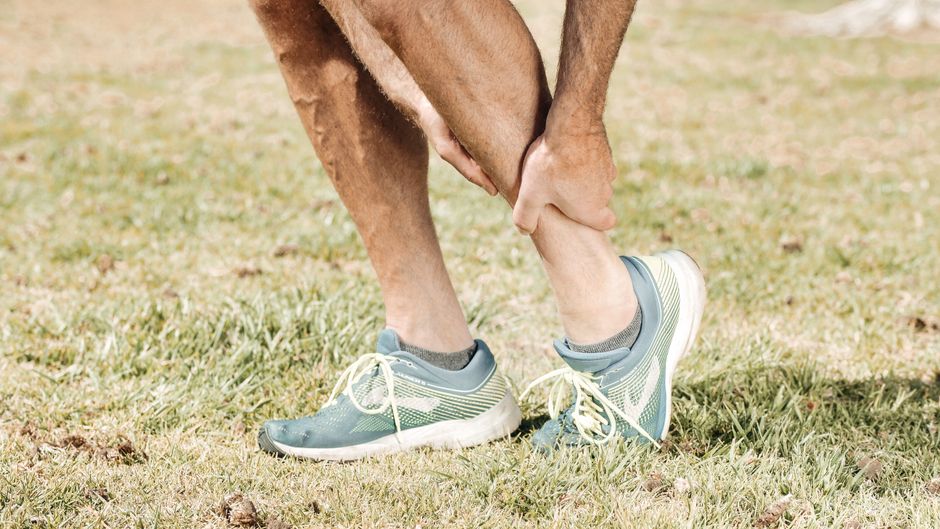
Achilles tendonitis is pain and irritation in the thick tendon that joins the calf muscles to the heel bone. If you are asking how long does Achilles tendonitis take to heal, the honest answer is that mild cases often settle in 2 to 6 weeks, while longer-standing cases usually need 3 to 6 months of steady loading exercise.
This article explains the stages of Achilles healing, a typical timeline for each, what slows recovery down, how loading exercise works and how to return to running without a setback.
Key Takeaway: A recent, mild flare of Achilles tendonitis often calms within a few weeks once the load is managed. Tendon pain that has lasted more than three months usually takes 3 to 6 months of progressive calf strengthening to settle, and sometimes longer. Full rest rarely speeds healing, while a steady, graded loading program often does.
What Is Achilles Tendonitis?
Achilles tendonitis is an overuse problem of the Achilles tendon, the strongest tendon in the body. It usually causes pain, stiffness and tenderness at the back of the ankle, often worst first thing in the morning or at the start of a run.
Tendonitis or Tendinopathy?
Many clinicians now prefer the word tendinopathy. The “itis” ending suggests ongoing inflammation, but in tendon pain that lasts more than a few weeks, the main change is usually in the structure of the tendon rather than swelling. The tendon has become less able to handle load.
This matters for healing time. Inflammation can settle with a short break, but a tendon that has lost load capacity needs to be rebuilt slowly with exercise. Our article on why rest alone often fails for tendon pain explains this in more detail.
Mid-Portion and Insertional Pain
Mid-portion Achilles pain sits 2 to 6 centimetres above the heel, in the narrow part of the tendon. Insertional pain sits right where the tendon attaches to the heel bone. Insertional pain often takes longer to settle and needs exercises done on flat ground rather than off a step edge.
How Long Does Achilles Tendonitis Take to Heal?
Healing time depends mostly on how long the pain has been there and how well the load is managed. The table below shows typical stages. These are ranges, not promises, and many people move back and forth between stages.
Typical Stages and Timelines
| Stage | Typical length | Main focus |
|---|---|---|
| Reactive (new flare) | 1 to 3 weeks | Reduce aggravating load, start gentle calf holds |
| Early recovery | 2 to 6 weeks | Slow heavy calf raises, walking program |
| Rebuilding strength | 6 to 12 weeks | Heavier loading, single-leg work, hopping drills |
| Return to running | 3 to 6 months | Graded running plan, speed and hills added last |
| Long-standing (over 6 months of pain) | 6 to 12 months | Patient, steady loading and a review of the whole plan |
Why Tendons Heal Slowly
Tendons have a smaller blood supply than muscle, so they adapt more slowly. Muscle strength can improve in a few weeks, but tendon tissue usually takes several months to become stiffer and stronger. This is why a calf can feel strong long before the tendon is ready for running.
Signs You Are on Track
- Shorter morning stiffness: The first steps out of bed loosen up faster than before
- Stable next-day response: Pain the morning after exercise is no worse than usual
- More calf raises: You can do more single-leg heel raises before the calf tires
- Less tenderness: Squeezing the sore part of the tendon is less painful
What Slows Achilles Healing?
Several common habits and health factors can stretch recovery out by weeks or months. Most of them can be changed once you know about them.
Training and Load Factors
- Complete rest: Stopping all activity lets the tendon lose more capacity, so pain often returns when you restart
- Pushing through sharp pain: Running on a tendon that is getting worse each day can keep it in the reactive stage
- Sudden jumps in training: Adding distance, speed, hills or jumping all at once is a common trigger
- Stop-start rehab: Skipping exercises for weeks at a time resets progress
- Stretching hard into pain: Deep stretches off a step can compress an insertional tendon and irritate it
Health and Lifestyle Factors
Age, diabetes, raised cholesterol and higher body weight are linked with slower tendon recovery. Poor sleep and high stress can also affect how sore tendons feel. Some antibiotics in the fluoroquinolone group are linked with tendon problems, so tell your doctor or pharmacist if Achilles pain starts while you take one.
Footwear and Surfaces
A sudden switch to flat or minimal shoes, or to lower-drop running shoes, adds load to the Achilles. Hills, stairs and soft sand do the same. Keep footwear consistent during rehab and make changes slowly once the tendon has settled.
How Does Loading Exercise Help the Tendon Heal?
Loading exercise means slowly and repeatedly putting controlled weight through the tendon so it adapts and becomes stronger. It is the treatment with the most research support for Achilles tendinopathy.
A small 1998 study of heavy-load eccentric calf training helped make this approach standard care. The 2024 clinical practice guideline for mid-portion Achilles tendinopathy from the Academy of Orthopaedic Physical Therapy also recommends progressive calf loading as a first-line treatment.
A Simple Loading Progression
- Calf holds: Rise onto your toes on both feet and hold for 30 to 45 seconds, 4 to 5 times. These can ease pain in an irritable tendon.
- Double-leg heel raises: Rise up over 3 seconds and lower over 3 seconds, 3 sets of 15, with knees straight and then bent.
- Single-leg heel raises: Move to one leg when double-leg raises feel easy, again slow up and slow down.
- Weighted heel raises: Add a backpack or hold weights so that 8 to 12 slow raises feel hard.
- Faster and springy work: Quick heel raises, skipping and small hops prepare the tendon for running.
For mid-portion pain, heel raises can move to the edge of a step once they are comfortable on flat ground. For insertional pain, stay on flat ground so the heel does not drop below the step.
How Much Pain Is Acceptable?
Many physiotherapists use a pain monitoring rule. Mild pain up to about 3 or 4 out of 10 during exercise is often acceptable, as long as it settles by the next morning and morning stiffness is not getting worse week to week.
If pain is higher than that, or the tendon is stiffer the following morning, drop back one step for a few days. Progress is measured over weeks, not single sessions.
A simple training diary helps here. Write down the exercises, the weight used and your morning stiffness on a 0 to 10 scale. Over a few weeks the trend becomes clear, even when single days feel up and down.
Flare-ups are common during rehab and do not mean the tendon is damaged. They usually follow a sudden change, such as a long walk, a new pair of shoes or a missed week of exercise. Ease back to an earlier step for a few days, then build up again.
How Often to Do the Exercises
Heavy strength work is usually done every second day, about three times a week, which gives the tendon time to adapt between sessions. Gentle calf holds can be done daily when pain is high. Most loading programs run for at least 12 weeks.
What Else Can Support Recovery?
Loading exercise is the base of the plan. Other treatments may help with comfort and make it easier to keep exercising, but they work best as add-ons.
Activity Changes Instead of Full Rest
Most people can stay active by swapping high-load activities for lower-load ones for a while. Cycling, swimming and walking on flat ground are often well tolerated. The aim is to keep the tendon and the rest of the body working without flaring the pain.
Heel Lifts, Hands-On Care and Shockwave
A small heel lift in both shoes can reduce strain on an irritated tendon for a few weeks. Hands-on treatment for a tight calf may ease stiffness. For pain that has lasted several months despite good loading, some clinicians add shockwave therapy, though evidence for it is mixed.
You can read more in our article on shockwave therapy for chronic tendon pain, including who it may suit and who should avoid it.
Treatments to Be Careful With
Cortisone injections directly into the Achilles tendon are generally avoided because they may weaken the tendon. Pain relief medicine can help in the short term, but it does not repair the tendon. Talk with your doctor or pharmacist before taking any medicine regularly.
When Can You Return to Running?
Returning to running is a separate step from getting out of pain. A tendon can feel fine walking around but still flare when asked to handle the spring and impact of running.
Checks Before Your First Run
- Walking: 30 minutes of brisk walking with no increase in pain the next morning
- Heel raises: About 20 to 25 slow single-leg heel raises on the sore side, close to the other leg
- Hopping: 20 to 30 small single-leg hops with pain no higher than 2 or 3 out of 10
- Morning stiffness: Little or none, and stable from day to day
A Graded Running Plan
Start with walk and run intervals, such as 1 minute running and 1 minute walking for 15 to 20 minutes, on flat ground every second day. If the tendon feels the same or better the next morning, add a little more running time.
Build continuous running first, then distance, then speed and hills last. Keep doing calf strength work twice a week, even once you are back to normal training. Our article on how to increase running mileage without injury covers safe weekly increases.
How Can You Stop It Coming Back?
Achilles pain has a habit of returning, especially when training ramps up quickly. A few steady habits can lower the chance of another flare.
Habits That Protect the Tendon
- Keep calf strength work: Two short sessions of heavy heel raises a week
- Increase load slowly: Change only one thing at a time, such as distance or speed
- Plan easy days: Follow hard sessions with an easy day or a rest day
- Change shoes gradually: Rotate new shoes in over several weeks
- Act early: Ease back for a few days at the first sign of morning stiffness
Other Causes of Back-of-Ankle Pain
Not all pain at the back of the ankle comes from the Achilles. Bursitis behind the heel, a strained calf, irritated nerves and pain under the heel can all feel similar. If you are unsure, our guide to calf muscle strain recovery explains how a calf injury differs.
When Should You See a Doctor or Go to Emergency?
Most Achilles tendonitis is an overuse problem that can be managed with exercise. Some signs point to something more serious and need prompt medical care.
Signs of a Possible Rupture
Go to emergency the same day if you feel a sudden snap or a sensation like being kicked in the back of the ankle, followed by trouble walking or pushing off. A rupture is time-sensitive, and early treatment matters for the result.
Other Reasons to See a Doctor
- Pain in both Achilles tendons with joint pain or swelling elsewhere in the body
- Heat, redness and fever around the tendon
- Calf swelling, warmth or tenderness that could be a blood clot
- Tendon pain that started soon after a new medicine
- No improvement after several months of consistent loading
Getting Help With Achilles Pain
A physiotherapist can confirm whether your pain is mid-portion or insertional, check calf strength and set the starting level for loading so you are not guessing. You do not need a doctor’s referral to see a physiotherapist in Ontario, although some insurance plans ask for one before they reimburse.
Our team offers ankle and foot pain treatment with a loading plan matched to your sport and daily routine. When you are ready, you can book an assessment online at Tonic Physio in Milton.