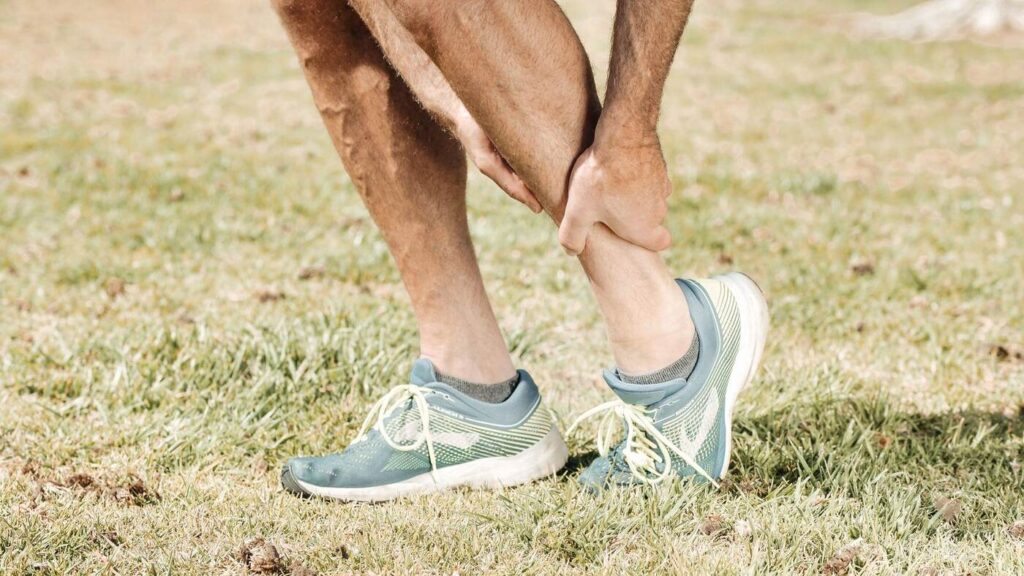
A calf muscle strain is a stretch or tear in the muscles at the back of your lower leg. Mild strains often settle in one to two weeks, while moderate ones usually need several weeks of rehab and severe tears can take months. Sudden severe pain, a pop, or a swollen, hot calf needs a doctor’s check.
Key Takeaway: A calf strain is an overstretched or torn muscle at the back of the lower leg. Mild strains often settle in one to two weeks, and moderate ones usually need several weeks of staged rehab. A pop, severe pain, or a swollen, hot calf needs a doctor’s check.
What is a calf muscle strain?
A calf muscle strain is an overstretch or tear in one of the two main muscles at the back of the lower leg. The gastrocnemius is the larger, rounded muscle you can see and feel. The soleus lies underneath it and does most of the slow, steady work when you walk or jog.
A strain, also called a pulled muscle, happens when muscle fibres are overstretched or torn. The NHS describes strains as an overstretched or torn muscle, most common in the feet, legs and back.
Gastrocnemius strain versus soleus strain
A gastrocnemius strain tends to happen suddenly, often during a push-off, a sprint start or a jump, when the knee is straight. People often describe it as being kicked or hit in the back of the leg.
A soleus strain usually builds more slowly, often in distance runners or after long walks. The pain sits lower in the calf and may be felt more when the knee is bent.
Who gets calf strains?
Calf strains are common in runners, soccer and hockey players, tennis and pickleball players, and weekend athletes who return to sport after a break. A systematic review of risk factors found that older age and a previous calf strain were the strongest predictors of another one. The authors also noted that the overall evidence is limited.
What are the signs and grades of a calf strain?
Most clinicians describe strains in three grades, from mild to severe. The grade is a rough guide to how many fibres are damaged and how long recovery may take. Only an assessment can tell you which grade you have.
Grade 1: mild strain
You feel tightness or a mild pull in the calf. You can usually walk with little or no limp, and the muscle is sore when you stretch it or rise onto your toes. Swelling and bruising are minimal.
Grade 2: moderate strain
You notice sharp pain at the time of injury, then swelling, tenderness and sometimes bruising a day or two later. Walking is uncomfortable and you may limp. Rising onto your toes on that leg is painful and weak.
Grade 3: severe strain or tear
Severe pain, often with a pop, makes it hard to walk or push off at all. Swelling and bruising can be large, and you may feel a gap or lump in the muscle. This grade needs prompt medical assessment.
How long does a calf muscle strain take to heal?
Recovery time depends on the grade, which muscle is involved, your age, and how well rehab is paced. Treat the ranges below as general guides, not promises. Your own timeline may be shorter or longer.
Typical recovery ranges
- Grade 1: often one to two weeks before normal walking and light activity feel comfortable
- Grade 2: often three to six weeks before you are ready to return to running
- Grade 3: commonly several months, and sometimes surgery or specialist care is discussed
The NHS says most sprains and strains feel better after about two weeks, but suggests avoiding strenuous exercise such as running for up to eight weeks because of the risk of further damage. Severe injuries can take months.
What affects your own timeline
Age, the muscle involved and how quickly you started treatment all play a part. A strain high in the muscle belly often settles faster than one near the Achilles tendon. Previous calf strains can slow progress, which is why a careful, staged plan matters.
Keep a simple log of the date, what you did and how the calf felt that evening and the next morning. After a couple of weeks, the notes show whether you are moving forward or stalling. They also give your physiotherapist clear information.
Why calf strains can feel slow
The calf works every time you step, so it rarely gets a true rest. Soleus strains in particular can linger because the muscle is constantly loaded. Returning too early is one of the most common reasons a calf strain flares up again.
What should you do in the first few days?
The first days are about protecting the calf, controlling swelling and keeping gently moving. You do not need to stay in bed, and you should not push through sharp pain. These steps suit most mild to moderate strains.
Protect, rest and ice
For the first two to three days, the NHS suggests protecting the injury, resting it, and applying an ice pack wrapped in a towel for up to 20 minutes every two to three hours. Compression with a bandage and keeping the leg raised on a pillow can also help with swelling.
The NHS also advises avoiding heat packs, hot baths, alcohol and massage in the first couple of days. We explain more in our guide to massage and sports injuries.
A different view: PEACE and LOVE
Some sports medicine authors favour a newer approach called PEACE and LOVE. It places more weight on protecting the area early, then gradually loading it, staying optimistic and returning to movement as pain allows. It also questions routine use of anti-inflammatory medicines.
If you are unsure which approach suits you, a physiotherapist can help you choose. Ask a pharmacist or doctor before taking any pain medicine.
Walking and early movement
If walking hurts, shorten your steps and avoid pushing off hard. Some people use crutches for a few days, and a small heel lift in your shoe may reduce the stretch on the calf. Gentle ankle circles and pumps within comfort help keep the leg moving.
Sleep with the leg slightly raised on a pillow if it swells overnight. Compression sleeves or a light bandage can be comfortable, as long as they are not tight or numbing. Remove them if the toes tingle or feel cold.
What does calf strain rehab look like?
Rehab rebuilds the strength and endurance of the calf in stages, so that it can handle running, jumping and stairs again. It should move forward only when the stage before feels comfortable. The outline below is general, and a physiotherapist can tailor it to your grade.
Stage 1: calm things down (about days 1 to 7)
- Ankle pumps and circles: 2 sets of 15, several times a day
- Gentle, pain-free calf stretch: hold for 20 to 30 seconds, 2 or 3 times a day
- Short, comfortable walks on flat ground
Stop any stretch that causes sharp pain. Mild pulling is acceptable, but sharp pain is not.
Stage 2: start to load (about weeks 1 to 3)
- Seated heel raises with the knee bent, which target the soleus: 3 sets of 12 to 15
- Double-leg heel raises, lowering slowly over 3 seconds: 3 sets of 10 to 15
- Stationary cycling at an easy pace for 10 to 20 minutes
Aim for a comfortable ache that settles by the next morning. If the calf is sorer the day after, reduce the sets or the range.
Stage 3: build strength (about weeks 3 to 6)
- Single-leg heel raises on flat ground, then on the edge of a step: 3 sets of 8 to 12
- Bent-knee single-leg raises: 3 sets of 8 to 12
- Walking up hills or stairs without a limp
These exercises are more demanding, so add them gradually. Do strength work two to three times a week, with a rest day between sessions.
Count slowly and keep the movement smooth rather than bouncing. Hold onto a wall for balance if you need it, and use both legs at first if single-leg raises are too hard. Quality matters more than the number of repetitions.
How do you return to running and sport after a calf strain?
A staged return gives the calf time to adapt to impact. Most plans move from walking to jogging intervals, then to continuous running, and finally to speed, hills and sport-specific moves. Progress depends on how your calf responds, not on the calendar.
Signs you may be ready to jog
You can walk briskly without a limp, climb stairs normally and do single-leg heel raises without pain. The injured side should feel close to the other side in strength. Your physiotherapist can test this directly.
A useful home check is to try 10 single-leg heel raises on each side and compare. If the injured side tires much sooner or pulls, keep building strength a little longer. Stop if you feel sharp pain.
A sample walk-jog progression
Start with a 20 to 30 minute walk, then add intervals such as 1 minute of easy jogging and 2 minutes of walking. Build the jogging time in small steps over several sessions. Add speed, hills and jumping last, once flat running feels easy.
Choose flat, even ground for the first sessions, and avoid downhill running at first. Wear supportive shoes with enough heel cushioning. If the calf feels tight afterwards, stay at the same step for another session before moving on.
Our posts on increasing running mileage safely and return to sport testing criteria explain how readiness is judged.
Reducing the chance of another strain
Warm up before harder sessions, increase load gradually, and keep calf strength training in your routine once a week. Replace worn shoes, and avoid jumping from rest into sprinting. A running gait assessment can show whether your technique adds extra load to the calf.
When could it be more than a calf strain, and when should you see a doctor?
Most calf pain after exercise is a muscle strain, but some serious conditions can feel similar. Knowing the warning signs helps you act quickly. If you are unsure, it is safer to get checked.
| Condition | Typical clues | What to do |
|---|---|---|
| Calf strain | Pain after exertion, a tender muscle, pain when rising onto your toes | Staged care and physiotherapy |
| Achilles tendon rupture | A sudden snap, a gap above the heel, unable to rise onto your toes | Prompt medical care |
| Blood clot in the leg (DVT) | Throbbing pain, swelling and red or darkened skin in one leg | Urgent same-day care |
Achilles tendon rupture
A sudden snap, a feeling of being kicked in the back of the ankle, or a gap above the heel can point to an Achilles tendon tear. You may be unable to rise onto your toes or push off. Seek medical care promptly, ideally within a day or two.
Blood clot in the leg (DVT)
The NHS lists throbbing pain in one leg, usually in the calf, swelling in one leg, and red or darkened skin as symptoms of a deep vein thrombosis. A clot can feel like a strain, especially if you have not had a clear injury.
If you think you could have a clot, get urgent medical help the same day. In Ontario that means a walk-in or urgent care clinic, or an emergency department, or a call to Health811 on 8-1-1 for advice on where to go.
Call 911 or go to the nearest emergency department if calf pain or swelling comes with chest pain or shortness of breath. Read the NHS guide to DVT for the full list of symptoms.
Other reasons to see a doctor
See a doctor if you cannot put weight on the leg, the calf is very swollen, tight or hot, or your toes feel numb or cold. The same applies if the pain is not improving after a few weeks of careful rest.
Health811 offers free advice from a registered nurse if you are unsure how urgent your symptoms are. People with diabetes, circulation problems or a history of clots should be especially quick to get a leg checked.
How can physiotherapy in Milton help with a calf strain?
A physiotherapist confirms that your pain is a muscle strain, grades it, and rules out the conditions above. They then guide your load, strength work and return to sport so you are not guessing. You also learn what to change so the strain is less likely to return.
What an assessment includes
At Tonic Physio in Milton, we ask how the injury happened and what you want to return to. We test calf strength and ankle movement, check your walking or running, and set out a staged plan. Our sports physiotherapy service covers this kind of rehab.
Extended health benefits may apply, and many insurers can be billed directly. Check your plan, as coverage varies.
Working with your care team
Your physiotherapist can also share findings with your family doctor, which is helpful if you need imaging or want to rule out a clot. In Ontario you can book physiotherapy without a doctor’s referral, although some insurers ask for one.
Booking
If a calf strain is keeping you off the field, trail or court, you can book an assessment online to see what stage of rehab suits you.