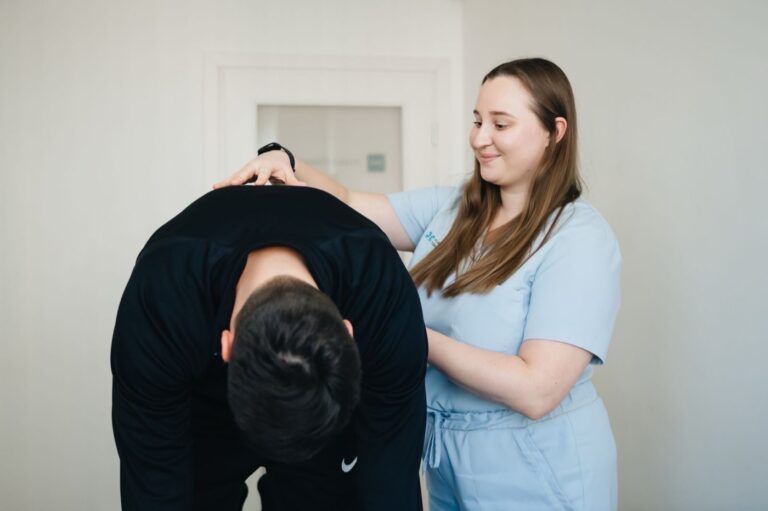
TMJ pain has a cruel rhythm: the day manages it, and the night ambushes it. You fall asleep fine, and you wake at 3 a.m. with an aching jaw, a tired temple, or a face that feels clenched from the inside. Severe nocturnal clenching often radiates tension into the temporal muscles, which is why many patients also require specialized headaches and migraines treatment alongside jaw therapy. The positions you sleep in, the pillow under your head, and the habits of the last hour before bed decide most of that ambush. This article is the nighttime protocol that quiets it. Our article on cupping therapy marks, benefits and myths goes into more detail.
Key Takeaway: Sleeping on your back with supported neck alignment is the most TMJ-friendly position; side sleeping works with the right pillow height; stomach sleeping is the one to break. Pair the position with evening jaw unloading, a warm compress, and a pillow that keeps the head neutral, and most patients cut their nighttime flares substantially within 2 to 3 weeks. Persistent night pain deserves assessment, because clenching patterns and joint problems have their own treatments.
Why TMJ pain peaks at night
The jaw joint and its muscles run their repair-and-guard cycle overnight, and three forces stack against you while you sleep:
We cover piriformis syndrome or sciatica in a separate guide.
- Bruxism and clenching: the unconscious grinding and clenching that peaks in light sleep stages, loading the joint for hours without your knowledge
- Position compression: stomach sleeping and wrong pillow height press the jaw into the pillow or hang it open under gravity
- The day’s accumulated load: the chewing, clenching, and stress of the day settle into the joint by early morning, which is why TMJ pain is characteristically worse on waking
The morning jaw ache, the tired face, the temple headache at sunrise: those are the night’s report, and the protocol below is how you change what it says.
The positions, ranked
Best: on your back, head supported neutral
Back sleeping keeps the head, neck, and jaw in neutral alignment, with no pressure on the joint and no gravitational hang on the mouth. The setup:
- A pillow that fills the neck curve without pushing the head forward: the ears stay aligned with the shoulders
- A second, softer pillow or towel roll under the neck’s curve if your pillow is thin
- Arms relaxed at the sides or on the stomach, not overhead, which tensions the neck-jaw line
Workable: on your side, with the pillow height right
Side sleeping is fine when the pillow keeps the spine straight: the head neither droops toward the mattress nor lifts toward the ceiling. The rules:
- Pillow height matches shoulder width: the neck stays level
- The face rests on the pillow, not the jaw: avoid pressing the jaw sideways into the pillow all night
- A body pillow between the arms keeps the top shoulder from curling forward and dragging the neck
- Alternate sides across the week: one-sided nights feed one-sided joint load
Break this habit: stomach sleeping
Stomach sleeping rotates the neck 90 degrees, compresses the jaw into the pillow, and holds the joint off-axis for hours. Sleeping on your stomach forces your neck into rotation, creating asymmetric pressure on the jaw that frequently calls for dedicated back and neck pain physiotherapy to restore proper spinal biomechanics. It is the single worst position for a TMJ complaint, and the honest advice is to train out of it: a body pillow alongside, plus starting the night on your back, retrains most stomach sleepers within a few weeks.
| Position | TMJ verdict | Setup notes |
|---|---|---|
| On your back | Best | Neutral neck support, mouth relaxed, tongue at palate |
| On your side | Good with adjustments | Level pillow height, no jaw compression, alternate sides |
| On your stomach | Worst | Train out of it; neck rotated, jaw compressed all night |
The pillow question, answered specifically
The TMJ pillow is really a neck pillow: the joint’s night load depends on neck alignment. The characteristics that matter:
- Height that matches your sleep position: back sleepers need less loft than side sleepers
- Support that holds the neck curve without pushing the chin toward the chest, which drags the jaw
- Memory foam or adjustable-fill designs work well because they hold the alignment without springing back
- Avoid the ultra-thin pillows on your side, and the giant stacks everywhere
The test: after a week, is the morning jaw ache better or worse? The pillow is the right one when the morning report improves; brand names matter less than that measurement.
The pre-sleep protocol: the hour that saves the night
The joint you sleep on is the jaw you used all evening. The last hour sets the night:
- Warm compress: 5 to 10 minutes over the jaw muscles in the final hour, relaxing the guarding before it settles
- Jaw unloading: teeth apart, tongue resting on the palate, lips closed; the resting position is teeth never touching, and rehearsing it before sleep sets the night’s default. Gently easing jaw tension prior to sleep using clinical myofascial release therapy relaxes overactive chewing muscles and protects the joint throughout the night.
- Gentle opening and closing: 10 slow, pain-free cycles, reminding the joint of its range without loading it
- The screen and the chew: avoid gum, chewy dinners, and jaw-clenching tension in the last hour; the joint falls asleep with what it last did
- Daytime stress: the clench you did all day is the clench you do all night; the stress management is part of the jaw protocol
Patients starting TMJ treatment in Milton get this protocol with the specifics tuned: which muscles to release before bed, which habits to break first, and the morning routine that resets the joint for the day.
Waking at 3 a.m. with the ache: the mid-night reset
- Do not stretch into pain: wake the joint gently with small, slow movements
- Run the tongue-up, teeth-apart position for two minutes; the resting position is the reset
- Warm the area: a warm cloth over the jaw for 5 minutes settles the guarding
- Check your position: if you woke on your stomach or jaw-first into the pillow, the position is the clue
- Return to sleep on your back or the adjusted side
When night pain means more than position
Position fixes and evening protocols resolve most nighttime TMJ complaints. Some presentations need more, and the assessment sorts them:
- Sleep bruxism: the grinding guard conversation, with your dentist, about a night guard; physiotherapy and the guard are partners, not competitors
- Joint-level problems: clicking with locking, limited opening, or pain that ignores every position change deserves assessment
- Sleep-disordered breathing: snoring, waking unrefreshed, and daytime fatigue alongside jaw pain point to the sleep apnea conversation
- Arthritis patterns: age-related joint changes change the loading rules and deserve their own plan
The daytime habits that protect the night
- Teeth apart awareness: a sticky note reminder until the resting position becomes automatic
- Single bites: the sandwich and the apple cut smaller, the joint spared the wide stretch
- No gum: the joint’s most common provocation, worn all day
- Chew on both sides: the one-sided habit loads one joint for every meal
- Phone posture: the head-forward scroll loads the jaw’s platform; raise the phone instead
The jaw’s anatomy, briefly: why night mechanics matter
The temporomandibular joint is the body’s most used joint, opening and closing thousands of times daily, and its mechanics depend on a platform: the head and neck above it. The joint itself holds a small disc that glides between the bones, and the muscles around it, the masseters, temporalis, and pterygoids, are among the body’s strongest for their size.
Night mechanics matter because the joint’s disc position, the muscle resting length, and the head’s alignment all interact: the forward-head posture shortens the neck muscles that share fascia with the jaw, the rotated sleep position torques the joint capsule, and the clenched jaw loads the disc while its support muscles should be resting. The night protocol is really a whole-platform protocol: the neck, the jaw, and the habits between them.
The tongue position most people have never heard of
The tongue’s resting place is part of the jaw’s support system: resting fully on the palate, lips closed, teeth apart. That position stabilizes the jaw, encourages nasal breathing, and reduces the night clench. The mouth-breathing pattern, tongue low and lips open, changes the jaw’s rest position and loads the joint differently. The tongue-posture habit is the protocol’s quiet centerpiece, and it costs nothing.
Stress, clenching, and the daytime-nighttime loop
The jaw is the stress organ nobody names: the clench that arrives with every difficult email, the daytime bruxism that becomes the nighttime version. Breaking the loop works from both ends:
- Daytime: the awareness check, hourly at first, “are my teeth touching?” The answer should be no; the resting position is the habit to build
- Evening: the unload protocol above, plus the wind-down that lowers the nervous system’s clench setting
- The body scan: the jaw tightens with the shoulders and the breath; the relaxation that helps the neck helps the jaw
Patients whose TMJ flares track their workweeks already know the stress connection; the protocol gives it a mechanical handle.
What TMJ treatment adds beyond the nighttime protocol
The night protocol manages the load; treatment changes the system that produced it:
- Manual therapy: the joint mobilization and muscle release that restore opening mechanics
- Deep neck flexor and scapular retraining: the platform the jaw sits on
- Specific jaw exercises: controlled opening, lateral movements, the coordination work
- Trigger point treatment for the masseters, temporalis, and pterygoids, including intraoral techniques where indicated
- Posture correction: the forward head that loads everything below it
The nighttime protocol and the treatment plan arrive together, and most patients see the night change first, because the night is where the protocol acts fastest.
Answers about appliances and the dentist partnership
Do I need a night guard, and when?
The dentist decides with evidence: heavy wear patterns, morning jaw fatigue, and the physiotherapy assessment’s muscle findings together make the case. The guard and the physiotherapy plan are partners: the guard protects, the therapy retrains, and the combination outperforms either alone.
My guard made things worse. Why?
Guard design matters: the wrong height or a too-soft appliance can increase clenching or reposition the joint badly. The adjustment conversation belongs with the dentist, ideally with the physiotherapist’s findings in the room.
Should the guard go in every night?
If prescribed, yes, consistently: the bruxism does not take nights off, and the guard’s protection works only when it is in. The cleaning routine matters too; the guard is a nightly appliance with a nightly rinse.
The morning routine that completes the cycle
- Warm the jaw in the shower: 2 minutes of heat over the muscles before the first wide yawn
- Gentle opening cycles: 10 slow, pain-free, before breakfast loads the joint
- Check the night’s clues: pillow position, jaw location, morning ache level; the log tracks what the changes are worth
The nighttime protocol and the morning routine bracket the joint’s hardest hours, and together with treatment they turn the 3 a.m. ambush into a quiet night and a calm morning.
TMJ and the sleep-breathing connection
The jaw, the tongue, and the airway share real estate, and the connections run deeper than position. Patients with TMJ complaints who also snore, wake unrefreshed, or doze through afternoons deserve the sleep conversation alongside the jaw one:
- Sleep-disordered breathing changes sleep architecture and increases arousal, which increases bruxism
- The forward-head and open-mouth patterns that accompany airway issues load the jaw differently
- Treating the airway, through sleep medicine when indicated, often reduces the jaw’s night load as a side effect
The screening questions live in the assessment: snoring, witnessed pauses, morning headaches, unrefreshing sleep. The jaw complaint that ignores the sleep question is a plan with a hole in it.
Your first two weeks: the night protocol in calendar form
- Nights 1-3: reposition to your back (or the adjusted side), start the evening compress and unload protocol, start the morning log
- Nights 4-7: the pillow adjusted per the first nights’ reports, the tongue-posture habit building, daytime awareness checks hourly
- Week 2: the pattern’s texture visible in the log, the position mostly automatic, the assessment booked if the night pain persists
The log is three lines a night: position when you woke, ache level 0 to 10, anything new. It takes a week to make the night legible, and the legible night is the one that gets fixed.
Answers to the questions TMJ patients ask most
Do I need a night guard?
If you grind or clench at night, possibly, and the decision belongs with your dentist after the physiotherapy assessment quantifies the muscle and joint picture. Guards protect teeth and reduce clench force; physiotherapy treats the muscle patterns and joint mechanics the guard alone does not reach.
Which pillow do you recommend?
The one that keeps your neck level and your jaw unloaded in your preferred position: usually a medium-loft, contour-style pillow for back sleepers and a fuller one for side sleepers. The morning test decides; the brand does not.
How long until nights improve?
Most patients notice calmer mornings within 2 to 3 weeks of the position and evening protocol, with fuller improvement across 6 to 8 weeks of treatment. The persistent cases are the ones with joint-level findings, and those get their specific plan.
Should I wear my day guard while sleeping?
Guard design matters: day guards are often softer and thinner than night guards, and using the wrong one at night can increase clenching. Ask the dentist who made it; the answer is specific to the appliance.
Is it my pillow or my stress?
Usually both, in that order of fixability: the position changes tonight, the stress management starts this week. The jaw records both, and the protocol treats both.