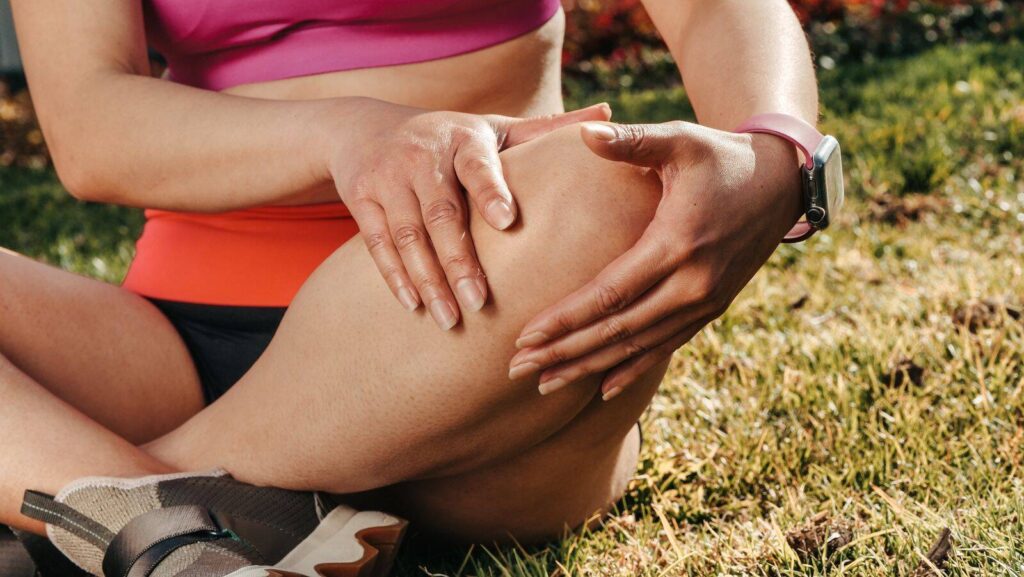
Iliotibial band syndrome (ITBS) is an overuse problem that causes sharp or aching pain on the outside of the knee, most often in runners and cyclists. It usually settles with load management, hip strengthening and a gradual return to running. Physiotherapy may help you find the cause and build a safe plan.
Key Takeaway: Iliotibial band syndrome is outer knee pain from overload, and it usually improves with less irritating load, hip strengthening and a staged return to running. Keep pain mild, at about 3 out of 10 or lower and settled by the next morning, and see a clinician if the knee locks, swells or gives way.
What is iliotibial band syndrome?
Iliotibial band syndrome is an overuse problem that causes pain on the outside of the knee, where the iliotibial band (IT band), a thick strip of connective tissue along the outside of the thigh, passes over the joint. It is one of the more common reasons for knee pain in people who run regularly.
Where the IT band runs
The band starts near the hip, where it connects with muscles in the buttock and the side of the hip. It runs down the outside of the thigh and attaches just below the knee joint on the shin bone.
Because it crosses the knee, it moves a little forward and back each time you bend and straighten the leg. That is normal and happens with every step.
Why the outer knee becomes painful
Researchers still debate exactly why the area hurts. Older explanations blamed friction, while newer ideas point to compression of sensitive tissue under the band or to an overloaded tissue that has not adapted to training demands.
For you, the practical message is the same. The outer knee has been asked to do more than it was ready for, and the pain is a signal to adjust the load and build capacity.
What are the symptoms of IT band syndrome and where does it hurt?
The main symptom is pain on the outside of the knee that builds during activity. It often starts after a certain distance or time, eases when you stop, and returns when you start again.
Typical signs
- Sharp or burning pain over the outer knee, about a thumb-width above the joint line
- Pain that appears at a similar point in most runs, then forces you to slow down or stop
- Worse pain going downhill, down stairs or when the knee is bent about 30 degrees
- Tenderness when you press on the outer knee, and sometimes mild swelling
- Tightness or an ache along the outside of the thigh or hip
Some people also notice a snapping or clicking feeling on the outer knee. This is not a reason for alarm on its own, but pain with it is worth having assessed.
How it differs from other knee pain
Outer knee pain has several possible sources. Pain at the front of the knee around the kneecap usually points to patellofemoral pain, while pain along the inner or outer joint line with locking or giving way may point to a meniscus problem.
A physiotherapist can sort these apart with a hands-on assessment, which matters because the treatment plans differ. If you want a broader look at lingering knee symptoms, our guide to persistent knee pain treatment explains common causes.
How long symptoms usually last
Timelines vary. Mild cases that are caught early may settle within a few weeks of adjusted training, while longer-standing pain can take 6 to 12 weeks or more to ease as strength builds.
Getting help sooner tends to shorten the process, because small changes made early are easier than rebuilding after weeks of pushing through pain.
What causes IT band syndrome in runners and cyclists?
ITBS rarely has one cause. It usually appears when training load rises faster than the tissues can adapt, often combined with how the hip and trunk control the leg.
Changes in training load
A quick jump in weekly distance, a sudden increase in hill work, or a return to running after a break are the most common triggers. Races and training blocks that add speed work can also tip the balance.
Our article on how to increase running mileage without injury lays out a sensible way to build week by week.
Strength and movement patterns
Weak hip muscles, especially those on the side of the hip that stabilize the pelvis, are often found in runners with ITBS. When these muscles tire, the knee may drift inward and the outer knee takes more strain.
Other factors that may contribute include limited hip or ankle movement, a very narrow running stance and worn shoes. None of these is a certain cause, which is why an individual assessment is more useful than a general rule.
Cycling, hills and other triggers
Cyclists can develop ITBS when a saddle sits too high or too far back, or when cleats turn the foot in a way that changes the knee path. Running on a banked path, always in the same direction, can also load one leg more than the other.
Long downhill sections, whether running or hiking near the Niagara Escarpment around Milton, can bring symptoms on sooner because the knee works harder to slow your body.
How is IT band syndrome treated?
Most people improve with a plan that reduces irritating load, builds hip and thigh strength, and returns to running in stages. Evidence for any single treatment is limited, so a combined approach that fits your situation makes sense.
Load management and relative rest
Relative rest means reducing the activity that triggers pain, not stopping everything. Many people can keep walking, cycling on a low saddle height or swimming while the knee settles.
A useful guide is to keep pain mild, at about 3 out of 10 or lower, and settled by the next morning. If a run pushes you past that, shorten the next one or swap it for cross-training.
Good cross-training options include swimming with a pull buoy, pool running and cycling at a saddle height that keeps the knee comfortable. Choose what you can do without outer knee pain, so you keep your fitness while the area settles.
Hands-on care, foam rolling and other options
A 2024 systematic review of conservative treatment found that hip abductor strengthening was the most common strategy in studies of runners with ITBS, sometimes combined with shockwave therapy or manual therapy. The studies were small and varied.
A 2026 systematic review noted that treatments and diagnoses differ so widely between studies that firm conclusions about any one option are hard to draw. In clinic, we use that honesty to guide choices, favouring exercise and load changes first and adding other tools only where they help you move or train more comfortably.
Rolling the outside of the thigh may feel relieving for a short time, and some people find it helps them warm up. It is unlikely to lengthen the band itself, which is very stiff tissue.
If rolling hurts directly over the outer knee, ease off and roll the muscles higher up, such as the buttock and the front and side of the thigh. Consider it a comfort tool, not the core of your recovery.
Footwear, surfaces and everyday habits
Shoes that have lost their cushioning or support may add load, so many runners replace them after several hundred kilometres. Switching between a flat trail, a track and the road can also spread the strain across different tissues.
Day to day, avoid sitting for long periods with the knee crossed tightly, and take short walking breaks at work. Small habits like these will not fix ITBS alone, but they reduce how often the outer knee is irritated.
Sleep and recovery matter as well. Many runners improve faster when they keep easy days truly easy, sleep regularly and avoid stacking hard runs on back-to-back days. Recovery is when your tissues adapt to the training you have done.
Which hip strength exercises help with iliotibial band syndrome?
Exercises that train the muscles at the side and back of the hip are the backbone of most ITBS programs. They aim to help the hip control the leg so the outer knee is not overloaded.
Starting exercises
- Side-lying leg raise: lie on your side, lift the top leg slightly behind you, and lower slowly, 2 to 3 sets of 10 to 15 per leg
- Side plank from the knees or feet: hold for 20 to 40 seconds, 2 to 3 times each side
- Glute bridge: lift your hips from the floor and squeeze the buttocks, 2 to 3 sets of 10 to 15
These ranges are a general starting point, not a prescription. Your physiotherapist can adjust them to how your hip and knee feel.
Progressing the program
- Lateral step-ups onto a low step, keeping the knee in line with the second toe
- Single-leg balance with a small knee bend, building to a hip hinge
- Banded side steps and single-leg deadlifts as strength improves
Move to the next level when the current one feels easy and does not bring on outer knee pain. If you are unsure about form, a few supervised sessions can make the home program safer and more effective.
How do you return to running after IT band syndrome?
A staged return lets the knee tolerate impact again without flaring up. Most plans start with walking and short run segments, then build time before speed or hills.
A sample staged return
One common structure begins with brisk walking for 30 minutes without pain. Next come intervals such as 1 minute of jogging and 2 minutes of walking, repeated for 20 to 30 minutes, every second day.
If those intervals stay comfortable, increase the jogging portion in small steps, then move to continuous running on flat ground. Add hills, downhill sections and speed work last, once flat running feels easy for a couple of weeks.
Our post on return to sport testing criteria explains how we judge when you are ready to push harder.
The table below sets out the four stages of a typical return.
| Stage | What you do | Move on when |
|---|---|---|
| 1. Walking | Brisk walking for 30 minutes | It is pain free |
| 2. Run-walk intervals | 1 minute of jogging and 2 minutes of walking for 20 to 30 minutes, every second day | The knee stays comfortable the next morning |
| 3. Continuous flat running | Lengthen the jogging portion in small steps, then run continuously | Flat running feels easy for a couple of weeks |
| 4. Hills and speed | Add hills, downhill sections and speed work one at a time | Pain stays mild and settles by the next morning |
When to pause the plan
Stop and rest if pain climbs above mild levels during a session, or if the knee is more sore the next morning. Drop back one step and stay there for a few days before trying again.
A running gait check can show whether cadence, stride width or foot strike are adding to the load. Our running gait assessment article describes what that involves.
When should you see a doctor or go to emergency?
Most outer knee pain is not dangerous, but some signs point to a different problem that needs medical attention. Do not wait if you notice any of the signs below.
Signs that need urgent care
Go to the nearest emergency department or call 911 if you have severe pain after a fall or twist, cannot put weight on the leg, or the knee looks clearly deformed. The same applies if the calf becomes swollen, hot and tender, or if you have a fever with a hot, swollen joint.
Signs to see a doctor or physiotherapist soon
Book an assessment if pain has lasted more than 2 weeks despite lower training, if the knee locks or gives way, or if pain wakes you at night. You can reach Health811 by dialling 8-1-1 for free nursing advice if you are unsure how urgent your symptoms are.
The College of Physiotherapists of Ontario regulates physiotherapists in the province, and in Ontario you can book physiotherapy without a physician referral.
How can physiotherapy in Milton help with IT band pain?
A physiotherapist looks at the whole chain from foot to hip, not only the sore spot. That helps explain why your knee is overloaded and what to change first.
What an assessment involves
At Tonic Physio in Milton, an assessment for a runner usually includes your training history, hip and ankle movement, strength testing and a look at how you run. You leave with a plan covering load changes, exercises and a timeline for returning to running.
Bring your current running shoes, a copy of your recent training log and any race dates to the visit. Knowing your goal helps your physiotherapist set milestones that fit your calendar instead of a generic plan.
Our running injury assessment brings these checks together, and extended health benefits or WSIB may apply depending on your situation.
Booking
If outer knee pain is keeping you from running, you can book an assessment online to see whether a structured plan fits your goals.