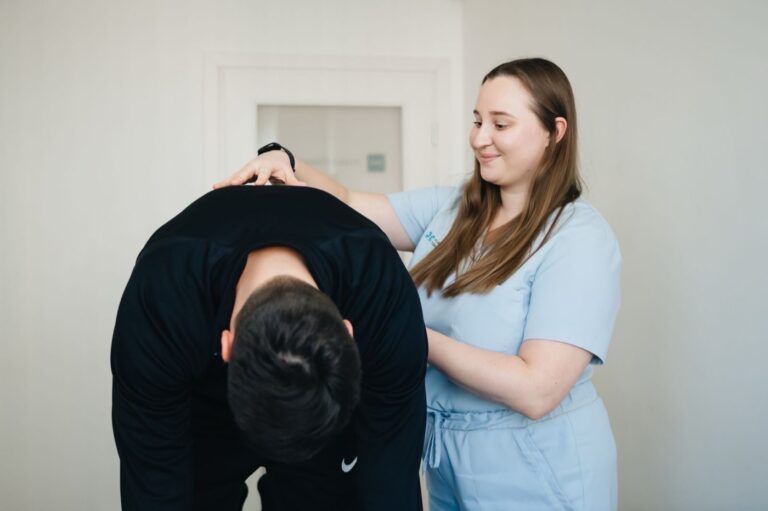
The modern workday is a slow-cooked recipe for neck, shoulder, and back trouble: eight hours of sitting, a commute layered on each side, and shoulders that creep toward the ears by Tuesday. Massage therapy is one of the few interventions that addresses the whole pattern at once, and desk workers are its most consistent beneficiaries.
Key Takeaway: Desk work loads specific tissues predictably: the neck and shoulder girdle, the forearms, the hip flexors, and the low back. Massage therapy relieves the accumulated tension, restores movement between the stiff segments, and gives you a weekly reset that desk stretches alone cannot match. Most desk workers do best with a 4 to 6 week rhythm, adjusted for flare-ups.
What the desk day actually does to your body
The desk posture is not one problem; it is a stack of them, each with its own tissue signature.
Tech neck: the forward head load
Every inch your head drifts forward multiplies the effective weight your neck muscles support. At a laptop screen set too low, the drift is constant, and the muscles at the base of the skull and along the shoulder blades hold the bill. By late afternoon, that load reads as the familiar band of pressure across the shoulders and the ache at the skull base.
The hip flexor shortening
Hips spend the workday in a shortened position, and they adapt to it. Tight hip flexors tilt the pelvis, the low back compensates, and standing up after a long sit produces the stiffness that feels like aging but is actually adaptation.
Forearm and wrist load
Typing and mousing are light loads repeated thousands of times. The forearm extensors and flexors accumulate that repetition into genuine tension, and the elbows start complaining, the pattern behind much of what gets called tennis elbow in office workers.
The mid-back that stops moving
The thoracic spine, designed to rotate and extend, spends workdays frozen in a slight forward curve. Its neighbors, the neck and low back, take the movement debt, which is why desk backs complain in the wrong places.
How massage therapy addresses each piece
Massage works the pattern from several directions at once, which is why it outperforms single-tool approaches for the desk-body profile.
Our article on deep tissue massage benefits for athletes goes into more detail.
Releasing the shoulder girdle
Targeted work through the trapezius, levator scapulae, and rhomboids dissolves the accumulated guarding that stretches alone cannot reach. The relief after a session that addresses these specifically is the reason desk workers rebook.
Restoring forearm comfort
Deep work through the forearm extensors and flexors, plus cross-fiber techniques at the elbow, addresses the typing load directly. Combined with grip and position changes, it resolves the early-stage elbow complaints before they harden into tendinopathy.
Opening the hips and unloading the low back
Work through the hip flexors, glutes, and low back paraspinals restores the mobility that eight hours of sitting steals. Patients notice the standing-up-easier feeling within one to two sessions.
The nervous-system effect nobody prices in
Massage shifts the body out of its low-grade stress state, and stress is a genuine amplifier of desk pain: the shoulders climb with every deadline. The relaxation response is not a luxury add-on; it is half of why the physical relief lasts.
Which massage style fits your desk problem
| Complaint | Best fit | Why |
|---|---|---|
| Shoulder and neck band tension | Deep tissue or therapeutic massage | Reaches the chronic guarding under the shoulder blades |
| Stress-driven tightness, poor sleep | Relaxation (Swedish) massage | Calms the nervous system driving the guarding |
| Forearm and elbow ache | Focused deep tissue with stretching | Addresses the specific overworked muscle groups |
| Hip and low back stiffness | Therapeutic massage with mobility work | Restores the movement sitting steals |
Registered massage therapists blend approaches within a session; the table describes emphasis, not exclusive categories. Tell your RMT what your workday looks like, hours, setup, and commute, because the treatment plan should match the actual load.
Our team has also written about hot stone massage versus Swedish massage.
The desk worker’s maintenance rhythm
How often should a desk worker book? The honest answer depends on what else you are doing, but the pattern from thousands of Milton and Halton patients is consistent.
- Prevention mode: every 4 to 6 weeks keeps the accumulation from rebuilding
- Flare mode: weekly for 2 to 3 sessions settles an active episode faster
- High-stress seasons: tighten the interval temporarily; the calendar loads the shoulders whether you notice or not
Maintenance works because tension accumulates on a curve. One session does not fix a year of desk posture; a rhythm keeps the curve flat, and each session starts from a better place than the last.
What massage cannot fix alone
Honesty makes the massage plan work better. Three pieces need companionship:
- The workstation setup: if the monitor sits at lap height, the neck rebuilds its complaint weekly. Fix the setup or book more sessions
- Movement frequency: no massage survives eight motionless hours. The 2-minute stand rule is the multiplier
- Strength: the deep neck flexors and shoulder blade muscles need load, not just release. A physiotherapy assessment adds that layer when the tension keeps returning
Massage and physiotherapy pair deliberately for stubborn desk patterns: the RMT releases what has knotted, the physiotherapist strengthens what keeps failing. At our Milton clinic the two services share notes, which is why the pairing works.
What a desk-focused session actually feels like
First sessions begin with a short intake: hours at the desk, setup, symptom map, stress load. The treatment concentrates on the shoulders, neck, forearms, and hips, with pressure checked honestly along the way. Deep tissue work should feel like productive intensity, never like enduring.
Afterwards, expect looser shoulders, easier rotation, and occasionally a day of pleasant soreness in the worked areas. Hydrate, move gently that evening, and let the next workday test the difference.
The desk stretches that hold the gains
- Chin nods: 10 slow reps, twice daily, resets the forward head drift
- Doorway chest stretch: 30 seconds each side, undoes the rounded-shoulder curve
- Hip flexor stretch: 45 seconds per side after long sitting days
- The 2-minute stand rule: every 30 to 40 minutes, no exceptions worth breaking
The stretches maintain between sessions; the massage removes what stretching cannot reach. Together they keep the desk body ahead of its own accumulation.
The desk setup fixes that multiply every massage
Massage removes the accumulated load; the setup decides how fast it rebuilds. These four changes cost almost nothing and extend every session’s life.
Monitor height: the single highest-leverage fix
Raise the screen so the top third sits at eye height. Laptops need stands or book stacks plus a separate keyboard. The neck’s daily load drops immediately, and every massage holds longer.
The chair basics that matter
- Hips level with or slightly above knees
- Feet flat, or a footrest if they dangle
- Elbows supported near 90 degrees so shoulders stop hanging
- Lumbar support that fills the gap without pushing
Peripheral hygiene
An external mouse and keyboard, positioned so elbows stay at your sides, halves the forearm reach that builds the typing tension. Wrist rests position hands; they do not replace forearm care.
The meeting rule
Phone calls and one-on-ones that do not need screens are walking meetings. Movement during the workday is the cheapest physiotherapy that exists, and the habit carries more load off your shoulders than any single chair feature.
Remote workers: the second-desk problem
Hybrid workers live in two setups, and the home one is usually the worse one. Kitchen tables, dining chairs, and lap-height screens rebuild in two home days what the office fix removed. The home setup deserves the same three fixes: raise the screen, support the elbows, and keep the movement timer running. Patients who fix both setups report fewer flares than anyone with one perfect desk.
When massage should hand off to physiotherapy
Some desk complaints have moved past the muscle-tension stage, and massage alone stops making progress. The handoff signals:
There is more detail in our post on how often to book a massage.
- Numbness or tingling into the arm or hand
- Pain that persists past a week despite regular massage
- Weakness: losing grip strength, dropping objects
- Pain that wakes you at night
Those presentations need assessment, not another session of the same. Physiotherapy evaluates the nerve, joint, and strength layers, and the two disciplines continue in parallel from there. The clinic’s RMTs and physiotherapists share notes, so the handoff is a conversation, not a referral maze.
Answers to the questions desk workers ask most
Will one massage fix my neck?
One session changes the week, not the pattern. The desk rebuilds load daily, so the relief is real and temporary until the rhythm, setup fixes, and stretches hold the line. Most patients feel the difference immediately and rebook on that evidence.
Deep tissue or relaxation: which for desk tension?
Both work, on different layers. If your tension is mechanical, hours of posture, deep tissue reaches it. If it is stress-driven, the relaxation style often outperforms, because the nervous system is the actual patient. Many sessions blend the two.
How long before I feel normal again?
First sessions typically deliver 3 to 7 days of noticeable relief. The rhythm builds from there: each session starts from a better baseline, and by the third, most desk workers report their workday no longer produces the Tuesday-shoulders pattern.
Should I book before or after a big work deadline?
After, for the deep sessions; before, for a lighter relaxation session. Deep tissue work leaves some short-term soreness, which pairs poorly with a deadline that will also load the same tissues.
Does insurance cover massage therapy?
Almost all extended health plans cover registered massage therapy, usually with its own annual maximum. Direct billing covers most major insurers, which makes the maintenance rhythm affordable as a habit rather than an occasional splurge.
The desk setup fixes that multiply every massage
Massage removes the accumulated load; the setup decides how fast it rebuilds. These four changes cost almost nothing and extend every session’s life.
Monitor height: the single highest-leverage fix
Raise the screen so the top third sits at eye height. Laptops need stands or book stacks plus a separate keyboard. The neck’s daily load drops immediately, and every massage holds longer.
The chair basics that matter
- Hips level with or slightly above knees
- Feet flat, or a footrest if they dangle
- Elbows supported near 90 degrees so shoulders stop hanging
- Lumbar support that fills the gap without pushing
Peripheral hygiene
An external mouse and keyboard, positioned so elbows stay at your sides, halves the forearm reach that builds the typing tension. Wrist rests position hands; they do not replace forearm care.
The meeting rule
Phone calls and one-on-ones that do not need screens are walking meetings. Movement during the workday is the cheapest physiotherapy that exists, and the habit carries more load off your shoulders than any single chair feature.
Remote workers: the second-desk problem
Hybrid workers live in two setups, and the home one is usually the worse one. Kitchen tables, dining chairs, and lap-height screens rebuild in two home days what the office fix removed. The home setup deserves the same three fixes: raise the screen, support the elbows, and keep the movement timer running. Patients who fix both setups report fewer flares than anyone with one perfect desk.
When massage should hand off to physiotherapy
Some desk complaints have moved past the muscle-tension stage, and massage alone stops making progress. The handoff signals:
- Numbness or tingling into the arm or hand
- Pain that persists past a week despite regular massage
- Weakness: losing grip strength, dropping objects
- Pain that wakes you at night
Those presentations need assessment, not another session of the same. Physiotherapy evaluates the nerve, joint, and strength layers, and the two disciplines continue in parallel from there. The clinic’s RMTs and physiotherapists share notes, so the handoff is a conversation, not a referral maze.
Answers to the questions desk workers ask most
Will one massage fix my neck?
One session changes the week, not the pattern. The desk rebuilds load daily, so the relief is real and temporary until the rhythm, setup fixes, and stretches hold the line. Most patients feel the difference immediately and rebook on that evidence.
Deep tissue or relaxation: which for desk tension?
Both work, on different layers. If your tension is mechanical, hours of posture, deep tissue reaches it. If it is stress-driven, the relaxation style often outperforms, because the nervous system is the actual patient. Many sessions blend the two.
How long before I feel normal again?
First sessions typically deliver 3 to 7 days of noticeable relief. The rhythm builds from there: each session starts from a better baseline, and by the third, most desk workers report their workday no longer produces the Tuesday-shoulders pattern.
Should I book before or after a big work deadline?
After, for the deep sessions; before, for a lighter relaxation session. Deep tissue work leaves some short-term soreness, which pairs poorly with a deadline that will also load the same tissues.
Does insurance cover massage therapy?
Almost all extended health plans cover registered massage therapy, usually with its own annual maximum. Direct billing covers most major insurers, which makes the maintenance rhythm affordable as a habit rather than an occasional splurge.
Booking desk-worker massage in Milton
The massage therapy in Milton team at Tonic Physio treats the desk-body profile daily for Milton, Oakville, and Halton workers, with direct billing to most extended plans. Book the 4 to 6 week rhythm, tell your RMT about your actual workday, and let the first session map your specific tension geography.
If your shoulders have been creeping for months, one session shows you the baseline you forgot you had. The rhythm from there is what keeps it.