Pelvic floor exercises are small, controlled squeezes and releases of the muscles that support your bladder, bowel and, in women, your uterus. You can learn the basics at home in a few minutes a day. They may help with leakage, pressure and core support, and a physiotherapist can check you are using the right muscles.
Key Takeaway: Pelvic floor exercises are small, controlled squeezes and full releases that may help with leakage, pressure and core support. Learn the right muscles first, build up slowly over 8 to 12 weeks, and see a physiotherapist if exercises cause pain or your symptoms are not changing.
What are pelvic floor exercises and who are they for?
Pelvic floor exercises are controlled squeezes and full releases that train the sling of muscles at the base of your pelvis to contract, hold and fully relax, much like you would train any other muscle group. That sling is called the pelvic floor.
What the pelvic floor does
These muscles help you hold in urine and stool, support your pelvic organs, and work with your deep core and breathing muscles. They also play a role in sexual function and in stabilizing your hips and spine.
When they are weak, too tight or poorly coordinated, you may notice leakage, urgency, pelvic pressure or pain.
Who may benefit
- Women during and after pregnancy and birth
- People who leak urine when they cough, sneeze, lift or run
- Adults going through menopause or ageing changes
- Men recovering from prostate surgery or with pelvic pain
- Anyone who lifts heavy weights, runs or plays high-impact sport
Our guide on men’s pelvic floor physiotherapy explains why this is not only a women’s topic.
What the research says
A Cochrane review of pelvic floor muscle training for urinary incontinence in women concluded that training may improve, and for some women resolve, symptoms of stress and other types of urinary incontinence. The authors also noted that the best long-term approach needs more research.
That supports trying exercises as a first step for many people, ideally with guidance on technique.
How do you find the right muscles?
Many people squeeze the wrong muscles at first, such as the buttocks, thighs or abdomen. Taking a few minutes to find the right muscles makes every later exercise more useful.
Finding the contraction
Sit or lie comfortably. Imagine you are trying to stop yourself from passing gas, then lift that feeling gently up and inward, as if drawing a straw up with those muscles.
You should feel a subtle lift or squeeze, not a big movement. Your stomach, buttocks and thighs should stay fairly relaxed.
A note about stopping the urine stream
You may have heard that stopping your urine midstream is a way to find the muscles. It can be used once to check you have found them, but it should not become a regular exercise.
Repeatedly interrupting urine flow can interfere with normal bladder emptying. Practise with the bladder empty instead.
Check your breathing and posture
Breathe normally while you squeeze. Holding your breath or bracing your stomach often means the wrong muscles are doing the work.
Lying on your back with knees bent is the easiest position to start in. Later you can progress to sitting, standing and moving.
What are the best pelvic floor exercises to do at home?
Start with the basics and build slowly. The number of repeats below is a common starting point, and your physiotherapist can adjust it for you.
The table summarises the main exercises, and each one is explained below it.
| Exercise | What it trains | Starting point |
|---|---|---|
| Slow holds | Endurance and control | 8 to 10 repeats, holding 3 to 5 seconds |
| Quick squeezes | Fast reaction to cough or sneeze | 8 to 10 repeats of about 1 second |
| Glute bridge with a gentle squeeze | Links the floor with the hips | 2 sets of 8 to 10 |
| Seated squeeze | Easy practice between tasks | 5 to 8 repeats |
Slow holds
Squeeze and lift the muscles gently, hold for 3 to 5 seconds, then relax fully for the same time. Aim for 8 to 10 repeats, and work up to holding for 10 seconds as you get stronger.
The release matters as much as the squeeze. If you cannot feel the muscles let go, shorten the hold.
Quick squeezes
Squeeze and release quickly, about one second each, for 8 to 10 repeats. These train the muscles to react fast when you cough, sneeze or step down from a curb.
Glute bridge with a gentle squeeze
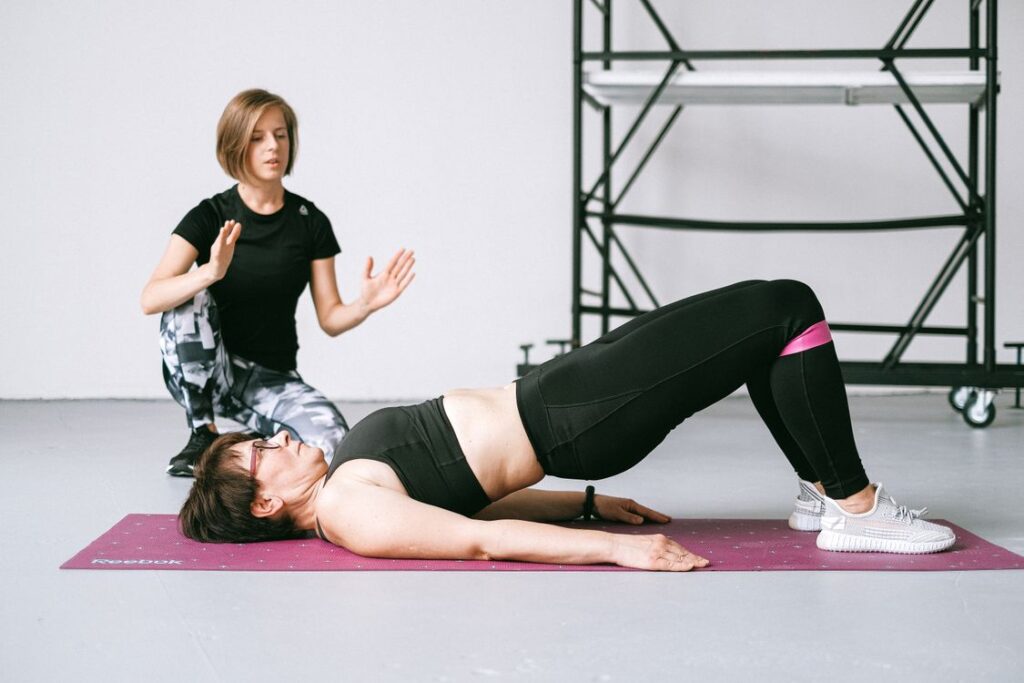
Lie on your back with knees bent, exhale and lift your hips while gently drawing up the pelvic floor, then lower slowly. Do 2 sets of 8 to 10.
How do the exercises fit into daily movement?
Once the basic squeeze feels familiar, you can link it to movements you already do during the day.
Squat with an exhale
Stand with feet shoulder-width apart and sit back into a squat while breathing in. As you stand, breathe out and gently lift the pelvic floor.
This links the muscles with a real-life movement, such as standing up from a chair.
Breathing and relaxation
Lie on your back and breathe into your lower ribs and belly. As you breathe in, allow the pelvic floor to soften and drop slightly, and as you breathe out, let it return.
Gentle stretches such as a child’s pose or happy baby can also help you feel the muscles relax.
Seated squeeze at your desk
Sit tall with your feet on the floor and breathe out as you gently lift the pelvic floor. Hold for a few seconds, release fully, and repeat 5 to 8 times.
Because nobody can see it, this is an easy way to practise between tasks or during a commute.
Pair the squeeze with something you already do, such as waiting for the kettle or for a video call to start, so you do not need to remember a separate time.
How can you work the pelvic floor with the deep core?
The deep abdominal muscles and hips work alongside the pelvic floor, so some people add simple core exercises to the routine.
Bird dog and dead bug for the deep core
These two moves link the pelvic floor with the deep abdominal muscles and the hips. In bird dog, you reach one arm and the opposite leg out slowly while keeping the back still, for 2 sets of 6 on each side.
In dead bug, you lie on your back and lower one arm and the opposite leg while breathing out. Add a gentle pelvic floor lift on the exhale if it feels natural, and stop if you feel pressure or pain.
How often should you do them and when will you notice a change?
Consistency matters more than intensity. A short routine that you can keep up beats an ambitious one you drop after a week.
A simple routine
Many people start with a set of slow holds and a set of quick squeezes, once or twice a day. You can link it to a daily habit, such as brushing your teeth, so it becomes automatic.
How long it can take
Muscles take time to change. Studies often run programs over several weeks to a few months, so give a routine at least 8 to 12 weeks before judging it.
Tracking progress
Note how often you leak, how strong the urge feels and how long you can hold a squeeze. A weekly check gives you a clear picture of whether things are moving.
A phone note is enough. Record the date, how many leaks you had that week and the longest hold you managed. Review the notes every four weeks rather than every day, because small daily swings are normal.
If nothing changes after a couple of months, a hands-on assessment can show whether the issue is weakness, tightness or something else.
How do pelvic floor exercises fit into daily life and sport?
Strength built in a quiet room is useful, but real life asks more. The aim is for the muscles to respond automatically when you lift, cough, run or laugh.
Using the exhale when you lift
Breathe out and gently lift the pelvic floor just before the effort, such as lifting a grocery bag, a child or a weight at the gym. Avoid holding your breath and bearing down, because that increases pressure on the pelvic floor.
With practice, this can become an automatic part of how you lift and move.
Running, jumping and high-impact activity
If you leak when running or jumping, you may need to build up the strength and the reaction time of the muscles, not only the hold. Your physiotherapist may suggest starting with lower-impact options and building up as symptoms improve.
You do not need to stop exercise altogether in most cases. Adjusting load and building strength often allows a gradual return.
Menopause and later life
Changes in hormones and tissue support may bring more urgency or leakage. Regular pelvic floor exercises, general strength training and walking may help maintain function as you age.
If symptoms are bothersome, talk to your doctor, because there are several options and you do not have to simply put up with them.
What mistakes should you avoid?
A few common errors can slow progress or even increase discomfort. Knowing them helps you adjust early.
Overtightening and skipping the release
Not every pelvic problem is a weak pelvic floor. Pain with sex, constant pelvic tension, or difficulty emptying the bladder can mean muscles are too tight, and strengthening could make that worse.
If exercises increase pain, stop and have the muscles assessed.
A muscle that never fully lets go cannot work well. Always finish each squeeze with a complete release and a breath.
Using the wrong muscles
If you feel your buttocks clenching, your thighs squeezing or your stomach pushing out, you may be working the wrong group. A physiotherapist can check using a gentle assessment, with your consent.
Straining on the toilet
Regular straining puts repeated pressure on the pelvic floor. Fibre, fluids, a footstool to raise your knees and an unhurried routine may help, and persistent constipation is worth raising with your doctor.
Good toilet posture helps. Lean forward with your forearms on your thighs, keep your feet raised on a small stool and let your belly relax. Breathe out gently rather than holding your breath and pushing.
What about pregnancy and after birth?
Pelvic floor exercises are widely recommended around pregnancy, though advice should fit your situation.
During pregnancy
A Cochrane review of pelvic floor muscle training in antenatal and postnatal women found that early, structured training in pregnancy may help prevent leakage in late pregnancy and after birth. Ask your midwife, doctor or physiotherapist about the best plan for you.
After birth
Gentle activation can often begin in the days after birth once you feel ready, though your care team may give specific advice after a tear, caesarean birth or other complications. Our article on postpartum pelvic floor recovery covers a gradual return.
When should you see a doctor or go to emergency?
Most pelvic floor symptoms are not emergencies, but some need prompt care.
Go to emergency or call 911
Seek emergency care if you suddenly cannot pass urine, have heavy vaginal bleeding, lose bladder or bowel control together with numbness in the groin or legs, or have severe pelvic pain with fever.
See a doctor or physiotherapist soon
Book an assessment if you see blood in your urine, feel a bulge or heaviness in the vagina, have pain with sex or urination, or leakage that is getting worse. Health811, at 8-1-1, can give free nursing advice in Ontario if you are unsure what to do.
The College of Physiotherapists of Ontario regulates the profession, and you can book physiotherapy without a doctor’s referral.
How can pelvic floor physiotherapy in Milton help?
Home exercises are a good start, but guidance helps you target the right problem. A physiotherapist can tell whether you need strengthening, relaxation or both.
What an assessment involves
A visit begins with a conversation about your symptoms, history and goals, in a private room. With your consent, the physiotherapist may check muscle function using an internal or external assessment, and you are free to decline or pause at any time.
Many people feel nervous before a first pelvic floor visit. You can ask what will happen at each step, bring a support person if you wish, and stop at any point. The therapist explains the options before anything starts.
Our pelvic floor physiotherapy service in Milton also uses the B-Pulse chair for some clients, alongside exercise. Read about leaking urine when running if that is your main concern.
Booking
If you would like help getting started, you can book an assessment online and build a plan that fits your needs.