A cortisone shot can ease tendon pain quickly, but the relief often fades, and research suggests it may be followed by worse results later. Shockwave therapy works more slowly and aims to stimulate the tendon itself. Neither is right for everyone, and both are best chosen alongside a loading exercise plan and your doctor’s advice.
Key Takeaway: A cortisone shot often eases tendon pain within days, but research suggests the benefit may fade and may be followed by worse results later. Shockwave therapy works more slowly and may help some stubborn tendon problems, and both are best paired with a loading exercise plan chosen with your doctor.
What is a cortisone shot and what does it do?
A cortisone shot is an injection of a corticosteroid medicine, usually given by a doctor, near the painful tendon or joint. Corticosteroids reduce inflammation and can quiet pain for a time. People often ask for one because they want fast relief so they can work, train or sleep.
Why relief can fade
Long-standing tendon pain is often a problem with how the tendon handles load, not just inflammation. Cortisone calms the irritated tissue, but it does not rebuild tendon strength or change the load that caused the problem. When the medicine wears off, the tendon may be no better prepared than before.
Our article on tendinopathy versus tendonitis explains why many chronic tendon problems are not simply inflamed.
Possible side effects
Common effects include a temporary pain flare for a day or two after the injection. Skin colour or thickness around the injection site can also change. Rarely, infection occurs.
Doctors are generally careful about injecting into or near large weight-bearing tendons, such as the Achilles, because of concern about weakening the tendon. Ask your doctor about the risks that apply to your tendon.
What is shockwave therapy and how does it work?
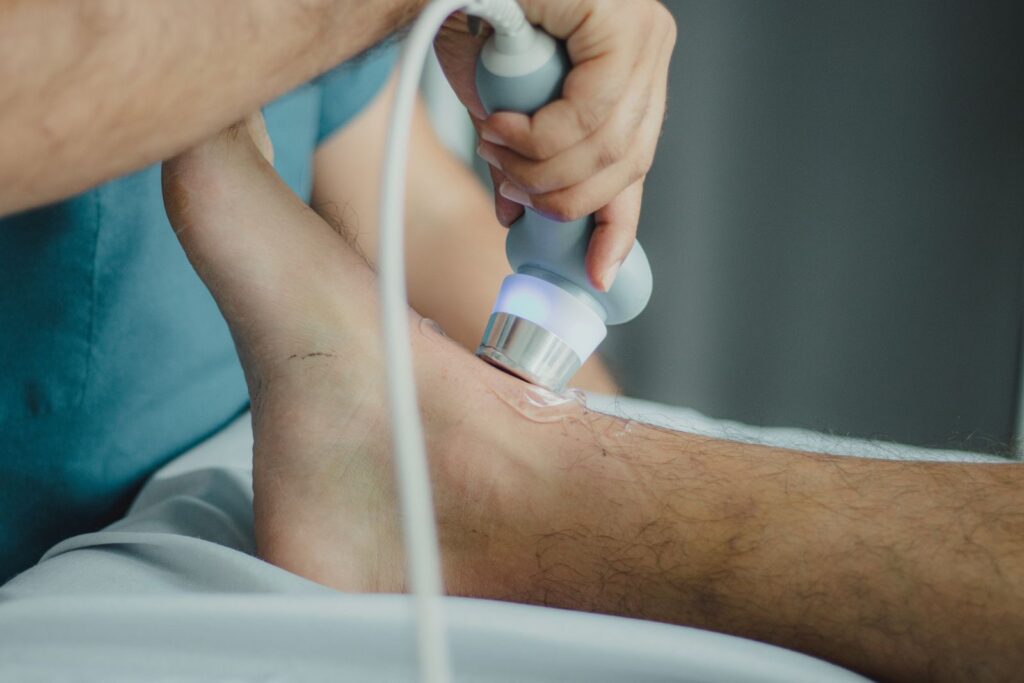
Shockwave therapy, also called extracorporeal shockwave therapy (ESWT), delivers short acoustic pressure waves through the skin to a painful area. It is usually applied with a handheld applicator and gel. The exact mechanisms are still studied, and treatment is often combined with exercise.
What a session feels like
Most people describe a tapping or pulsing sensation that can be uncomfortable over a tender tendon. A session usually lasts only several minutes.
A course of several sessions is common, and your clinician can adjust the intensity to what you tolerate. Learn more in our guide to what shockwave therapy is.
After a session, mild soreness or redness over the treated area is common and usually settles within a day or two. Tell your clinician if the pain is sharp or lasts longer, because the intensity can be reduced. Your clinician will also advise on activity straight after treatment.
Who should avoid this treatment
Shockwave is not suitable for everyone. Your clinician will screen you before treatment and may avoid it in these situations.
- Pregnancy, or treatment near the abdomen or lower back
- Bleeding disorders or blood-thinning medicines, unless cleared by your doctor
- Infection, tumour or open wounds over the treatment area
- Growth plates in children and teenagers
Shockwave vs cortisone shot: what does the research say?
Research does not give a single winner. It does show a pattern: injections tend to help sooner, while the benefit may not last.
Evidence for shockwave is more mixed and depends on the condition. Here are the main studies in plain language.
Short term versus longer term
A systematic review in The Lancet pooled 41 randomised trials of injections for tendinopathy. It found corticosteroid injections reduced pain in the short term compared with other treatments, but this effect was reversed at intermediate and long-term follow-up. You can read the abstract on PubMed.
The tennis elbow trial
In a 2013 trial of 165 adults with tennis elbow lasting more than six weeks, people given a cortisone injection had lower rates of complete recovery or major improvement at one year than those given a placebo injection (83% versus 96%). Recurrence was also higher after cortisone (54% versus 12%). The full results are on PubMed.
This is one condition and one trial, so it does not describe every tendon. It does explain why many clinicians pause before offering repeated injections for tennis elbow.
What the shockwave evidence shows
A 2024 systematic review in the British Journal of Sports Medicine looked at shockwave in athletes and active people. Based on the higher-quality trials, shockwave may be effective alone for plantar fasciitis, tennis elbow and proximal hamstring tendinopathy. The authors also called for more high-level research.
See the abstract on PubMed.
Which tendon problems are shockwave and cortisone used for?
Both treatments are used for long-standing tendon and fascia pain, but the best choice depends on the site and how long you have had symptoms. Your doctor and physiotherapist can help match the option to your condition.
Tennis elbow and golfer’s elbow
Tennis elbow is the condition with the clearest research on both options. Cortisone may relieve pain sooner, and the trial above raised concerns about longer-term results. A physiotherapist can also build a loading plan for the forearm muscles.
Heel pain and plantar fasciitis
Shockwave is commonly offered for stubborn plantar fasciitis. Read more in our article on shockwave therapy for plantar fasciitis. Injections near the heel are used less often and require a careful medical discussion.
Hamstring, shoulder and Achilles tendons
The shockwave review above also found support for proximal hamstring tendinopathy, which causes deep pain near the sit bone. This pain is often worse with sitting and sprinting. A diagnosis matters, because the same area can be affected by back and nerve problems.
Evidence also varies by site elsewhere. Some shoulder conditions respond differently to shockwave than others, and the Achilles needs extra caution with injections. Your clinician should explain the reasoning for your tendon.
Why does chronic tendon pain last so long?
Tendons have a limited blood supply and adapt slowly, so a tendon that has become painful under load can take months to settle. Pain that has lasted more than a few weeks is usually a load problem, not a one-off injury. That is why quick fixes often disappoint.
How tendons respond to load
Tendons like steady, repeated load. Too much, too soon, or too little for too long, can leave them sensitive. A sudden jump in running, a new job task or a return to sport after a break are common triggers.
Other factors worth mentioning to your doctor
Age, body weight, diabetes and some medicines can affect tendon health. Certain antibiotics, such as fluoroquinolones, are linked to tendon problems, so tell your doctor if tendon pain began during or after a course. Do not stop a prescribed medicine without medical advice.
How long do cortisone and shockwave take to work?
The timing is different. Cortisone is usually felt within days when it works, while shockwave benefits tend to build gradually over several weeks after a course. Neither works for everyone, and some people notice little change.
Cortisone timeline
Relief often begins within days and, as the Lancet review found, tends to fade over the following weeks to months. A pain flare in the first day or two is possible.
Shockwave timeline
Many clinicians review progress a few weeks after the last session, not after each one. Exercise continues throughout. If you notice no change after the planned course, your therapist should discuss other options with you.
What about exercise?
Exercise is the part of tendon care that both options often leave out. Tendons usually respond to gradual, progressive loading, which means heavier or slower work over weeks to months. A shot or a shockwave session may reduce pain enough to make that work easier.
Why loading matters
A tendon that hurts under load needs to become tougher under load. A therapist builds a plan that starts at a level you can manage, then increases it over time. Pain that settles within a day is usually acceptable.
Judge progress by function more than by pain scores. Can you climb stairs, grip a mug, walk or run for longer, or lift a heavier load than a month ago? Those milestones show the tendon is adapting, even when some discomfort remains.
What a loading program can look like
Your therapist may start with gentle holds that tense the muscle without moving the joint, because many people find these easier on a sore tendon. Next come slow, controlled lifting and lowering movements with light weight.
Over several weeks the weight, speed and range increase, and sport or work tasks are added back. Each step should feel manageable the next morning.
Combining treatments
Some people use shockwave together with a loading program. If your doctor offers a cortisone shot, ask how it will fit with exercise and what activities to avoid afterward. Our shockwave therapy service in Milton is usually paired with an exercise plan.
How do you choose between them?
Start with a clear diagnosis, because the right treatment depends on what is actually wrong. Then weigh how long you can wait for relief, your medical history and your goals. This is a decision to make with your doctor, not from a website.
The table compares the two options on the points that usually matter most.
| Point | Cortisone shot | Shockwave therapy |
|---|---|---|
| Who provides it | A doctor | A trained clinician, often a physiotherapist |
| How fast it works | Relief often begins within days | Benefit tends to build over several weeks |
| What the research suggests | Short-term pain relief that was reversed at longer follow-up in a major review | Mixed, with some support for plantar fasciitis, tennis elbow and proximal hamstring tendinopathy |
| Main cautions | A pain flare, skin changes and, rarely, infection, with extra care near the Achilles | Not suitable in pregnancy, over infection or open wounds, or at growth plates, with caution for bleeding risks |
| Role of exercise | Pair it with a loading plan | Pair it with a loading plan |
Questions to ask your doctor
- How many injections would be reasonable for my tendon, and how far apart?
- What risks apply to me, given my medicines and health conditions?
- What should I avoid doing in the days after an injection?
- What will we try if the shot does not last?
Bring a list of your medicines and any past injections to the appointment. Mention if you are pregnant or planning to be, if you take blood thinners, or if you have diabetes. These details change which options are safe.
Write down your goals as well, such as returning to a sport, lifting a toddler or finishing a work shift without pain. Your goals help your clinician and doctor weigh the speed of relief against the chance of a lasting result.
If one option does not work
A treatment that does not help is useful information. It may mean the diagnosis needs a second look, the loading plan needs adjusting, or another cause such as the neck or back is involved. Go back to your clinician rather than repeating the same treatment.
Cost and coverage
A cortisone injection is a medical service, so ask your doctor about coverage.
OHIP does not usually cover shockwave therapy at a private clinic. Some extended health plans cover physiotherapy sessions that include shockwave, so check your plan. Work injuries may fall under WSIB.
Ask for the cost per session and the planned number of sessions up front, along with how progress will be reviewed. A clear plan lets you judge value and decide when to move on if you have not seen change.
When should you see a doctor or go to emergency?
Tendon pain is often slow and stable. Some changes need prompt care. Do not wait if the pain pattern suddenly changes.
See a doctor soon if
- You felt a pop or snap, then lost strength or could not push off
- Bruising or a visible gap appears along the tendon
- Pain is getting worse over days despite rest and a gentle program
- Pain is constant or wakes you at night
Go to emergency or call 911 if
Go to the nearest emergency department if a joint becomes hot, red and swollen, especially with a fever, after any injection. Seek urgent care for a calf that is suddenly swollen, tender and warm. Chest pain or shortness of breath always needs a 911 call.
How can physiotherapy in Milton help?
You do not need a doctor’s referral to see a physiotherapist in Ontario. At Tonic Physio, a physiotherapist can assess your tendon, explain which options make sense and build a loading plan. Physiotherapists in Ontario are regulated by the College of Physiotherapists of Ontario.
Your assessment and plan
We review your history, test strength and movement, and decide whether shockwave is a good fit. You leave with an exercise plan and clear advice on activity. If you are weighing an injection, we encourage you to speak with your doctor as well.
If chronic tendon pain is holding you back, you can book a physiotherapy visit online to talk through your options.