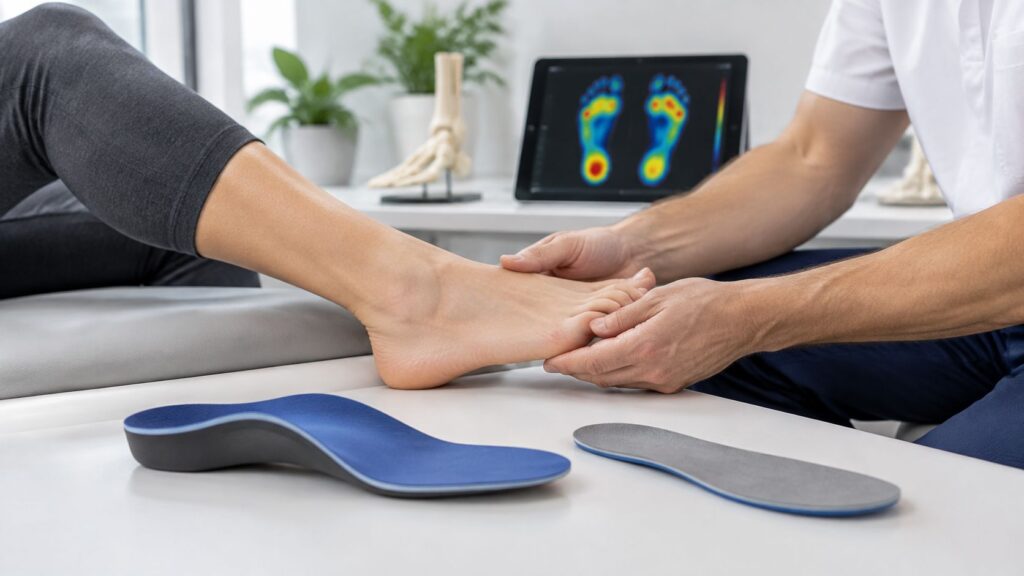
Custom didn’t mean better pain relief across five randomized controlled trials summarized in three systematic reviews in a Canadian Agency for Drugs and Technologies in Health review. For adults with plantar heel pain, the reviewers found no statistically significant difference between custom-made and prefabricated orthotics. That finding changes the buying question: not whether custom orthotics can help, but whether a custom device offers something your diagnosis, footwear and activities require.
Table of Contents
- Where Custom Orthotics Help and Where They Fall Short
- How Custom Orthotics Change the Way Your Foot Loads
- Custom Versus Prefabricated Inserts Compared
- How Practitioners Assess and Fit Custom Orthotics
- Which Conditions and People Gain the Most
- What to Expect Over the Coming Weeks
- Costs, Coverage and a Pre-Order Checklist
Where Custom Orthotics Help and Where They Fall Short
Custom orthotics benefits are measurable for selected conditions, not universal. The strongest practical distinction is between improvement compared with receiving no orthotic and improvement compared with another insert. Those aren’t interchangeable tests.
For plantar fasciitis, the Canadian review found statistically significant short-term improvements in pain and health-related quality of life compared with no orthotic treatment, but not foot function. Someone might therefore feel more comfortable without becoming measurably better at the activities used to assess function.
Reported benefit of custom orthotics by condition
The earlier CADTH clinical effectiveness review identified supporting evidence for painful high arches, plantar fasciitis function and bunion-related pain, but also mixed or negative findings for other diagnoses. In a plantar fasciitis trial it summarized, function favoured custom devices over sham devices at 3 and 12 months, with a number needed to treat of 4 at 3 months and 5 at 12 months; the respective confidence intervals were 2 to 19 and 3 to more than 215, indicating substantial uncertainty, particularly over the longer term.
| Condition | Reported benefit | Strength of evidence | Key caveat |
|---|---|---|---|
| Plantar fasciitis, short term | Less foot pain and better quality of life than no orthotic | Statistically significant, short term | Foot function didn’t improve in that comparison |
| Plantar fasciitis, function | Function favoured over sham devices at short- and longer-term follow-up | Some supporting evidence | Long-term confidence interval is wide |
| Painful high-arched feet, or pes cavus | Improvement in pain, function and quality of life | Some supporting evidence | Requires the relevant diagnosis |
| Painful bunion, or hallux valgus | Pain relief | Some supporting evidence | Benefit wasn’t maintained at longer-term follow-up |
| Metatarsalgia | Symptom improvement and reduced pain in a Canadian patient study | Observational only | Doesn’t prove the device caused every gain |
| Rheumatoid arthritis | Inconsistent benefits across assessed outcomes | Mixed | Results differ between studies |
| Diabetic peripheral arterial disease | No improvement in pain, function or quality of life in a trial | Limited | Single-trial finding |
Some supporting evidence doesn’t mean everyone with that diagnosis should buy a device. It means there’s a reason to consider treatment after checking whether the patient resembles the people studied and wants the outcome measured.
Pain relief, improved function and better quality of life are separate outcomes. Ask which one the proposed device is intended to change.
Start with the diagnosis, not the appearance of your arch. If heel pain hasn’t been assessed, understanding plantar fasciitis causes, symptoms and treatment options can help you describe the problem, but it can’t replace an examination.
How Custom Orthotics Change the Way Your Foot Loads
An off-the-shelf insert is a little like reading glasses from a rack: a standard design may suit many people. A custom orthotic resembles a prescription lens because its shape and modifications are specified for an individual. The analogy describes manufacturing, not guaranteed superiority.
The physical differences are easier to recognise side by side.
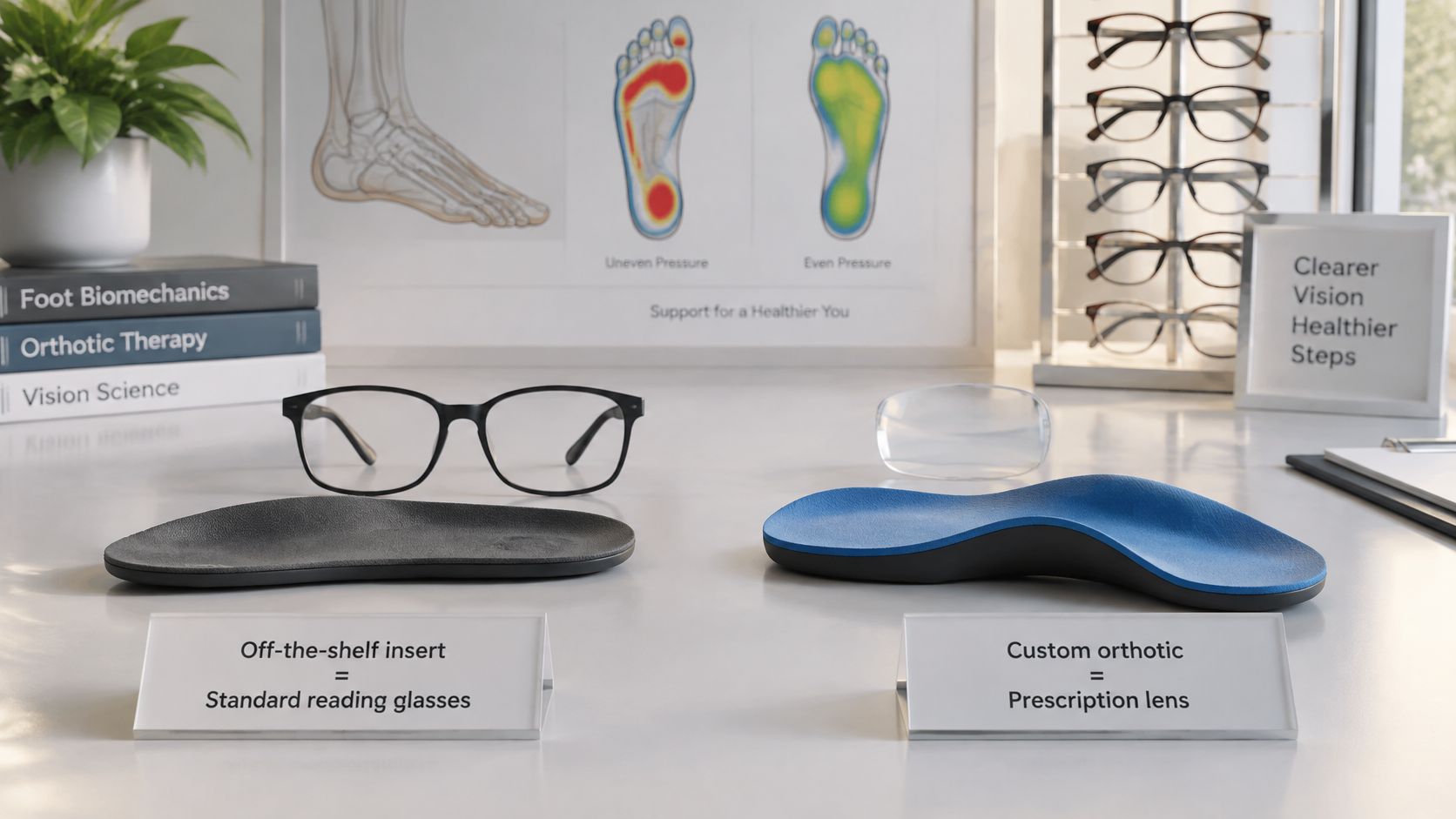
Say a worker feels pain beneath the ball of the foot during a shift. Each step transfers load through the heel, the inner and outer arch regions, and the metatarsal heads beneath the forefoot. The clinical question is whether changing that contact pattern could make the painful task more tolerable.
Changing pressure rather than simply adding cushioning
A practitioner can specify different features for different purposes:
- Arch contour: Increase contact along the medial or lateral column of the foot.
- Heel cup: Help position the heel within the device.
- Metatarsal relief: Use a pad or cut-out to redistribute pressure around a sensitive forefoot region.
- Posting: Add an angled modification to change how the device supports the foot.
A Canadian study of patients with metatarsalgia reported symptom improvement in 81% of participants and average pain reduction of 58.55% after individualized footwear recommendations and bilateral custom orthoses. Follow-up comfort was rated 7.7 ± 2.2 out of 10.
Those results are encouraging, but the study was observational and included footwear advice alongside orthoses. It can’t establish how much improvement came from the device alone.
For the worker, useful foot and ankle assessment therefore connects the painful location with standing demands and the shoes worn. A beautifully contoured device isn’t useful if it crowds the toes, lifts the heel out of the shoe or creates a new pressure point. Footwear compatibility is part of the treatment, not an afterthought.
Custom Versus Prefabricated Inserts Compared
The evidence doesn’t establish superior pain relief from custom devices for adult plantar heel pain. The CADTH custom foot orthotics review also found custom orthotics less cost-effective than prefabricated orthotics, usual care or placebo in the short and medium term.
That doesn’t make all inserts interchangeable. It means a more elaborate manufacturing process needs an individual clinical justification rather than an assumption that higher cost produces better results.
Custom versus prefabricated orthotics on key criteria
| Criterion | Custom orthotics | Prefabricated inserts |
|---|---|---|
| Foot pain compared with each other | No statistically significant advantage demonstrated | No statistically significant disadvantage demonstrated |
| Short-term pain compared with no orthotic | Statistically significant reduction for plantar fasciitis | Not the comparator in that particular comparison |
| Cost-effectiveness, short and medium term | Less cost-effective in the review | More cost-effective than custom in the review |
| How the device is made and adjusted | Built to an individual scan or impression with a prescription | Ready-made in standard shapes and sizes, often trimmed to fit |
| Best suited when | A documented clinical requirement calls for individual accommodation or modification | A standard contour fits comfortably and a first trial is appropriate |
The sensible first choice is often the least complicated option that addresses the problem. For plantar heel pain, a well-fitted prefabricated device may be a reasonable trial when it accommodates the foot and footwear comfortably.
Custom fabrication becomes more defensible when the practitioner can identify something a standard insert can’t adequately accommodate. That might be an unusual foot shape, a localized area requiring relief, or a previous insert that couldn’t be adjusted satisfactorily. These are reasons to consider customization, not proof that it will work.
A verdict based on the situation
- No previous insert trial: Discuss whether a prefabricated option can meet the treatment goal.
- Previous insert failed: Establish why it failed. An uncomfortable shoe or incorrect diagnosis won’t necessarily be solved by customization.
- Specific accommodation needed: Ask which prescription feature addresses it and how its effect will be tested.
- High activity demands: Assess the actual task and shoe. Being a runner alone doesn’t establish a need for custom equipment.
Buying rule: A useful recommendation explains what the custom device will do that a suitable prefabricated insert cannot.
An abnormal-looking gait scan or flat arch isn’t a complete answer. The justification should connect a clinical finding to a design choice and a meaningful activity.
How Practitioners Assess and Fit Custom Orthotics
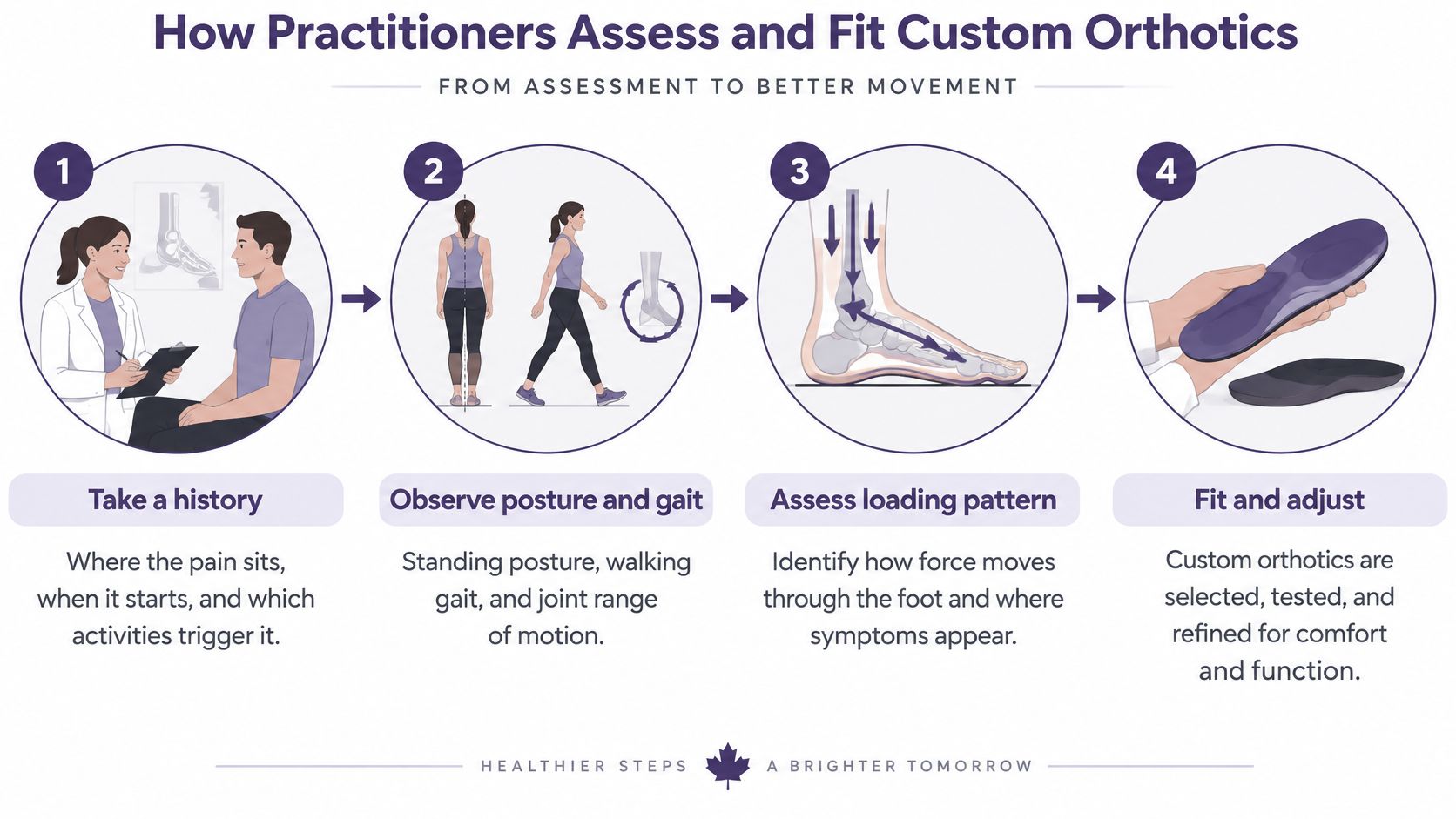
A useful assessment produces more than a foot shape. It establishes a working diagnosis, identifies the task that causes difficulty and determines whether an orthotic is an appropriate way to address it.
This process overview shows the main stages.
From symptoms to a prescription
Describe the pain precisely. Point to its location, explain when it starts and identify what brings it on. Distinguish discomfort during the activity from pain afterwards. Avoid describing every symptom as arch pain if the painful area is the heel or forefoot.
Examine movement and capacity. The practitioner observes standing posture and walking, then checks relevant joint movement and strength through the foot, ankle and, where indicated, the knee and hip. The common mistake is treating an unusual movement pattern as the diagnosis without checking whether it relates to symptoms.
Capture shape and assess loading. A three-dimensional scan records foot geometry, while GaitScan technology assesses pressure patterns during walking. These provide different information. Neither replaces the history or physical examination.
Inspect the footwear. Bring work shoes, everyday footwear and the shoes used for the activity you want to resume. Check available depth, removable liners and heel security before choosing the device profile. Designing for a shoe you don’t wear creates an avoidable fitting problem.
Write a targeted prescription. Arch contour, heel cup, metatarsal relief, posting, top cover and material should each have a purpose. A firmer or more prominent support isn’t automatically better. The prescription should accommodate the diagnosed problem without creating another uncomfortable contact area.
Fitting is a clinical check
Test the finished device in the shoe. Stand and walk with it rather than judging it only while seated. Check for heel slippage, toe crowding and focal pressure. The goal isn’t just to confirm that the insert fits inside the shoe.
Arrange review and adjustments. Agree on the activity to reassess and record how it feels before treatment. At review, examine both the patient and the device rather than relying only on a general impression of comfort.
At our first physiotherapy visit, we assess movement, strength and posture before creating a personalized treatment plan that includes exercises, manual therapy and goal-setting. Our custom orthotics use 3D scanning or GaitScan technology to provide foot support, reduce strain and improve alignment.
For runners, a running gait assessment in Milton can help connect symptoms with the demands of running rather than relying solely on a walking observation. Keep clinical findings, scan records and prescription information together so they’re available if required for reimbursement.
Which Conditions and People Gain the Most
The best candidate isn’t defined by age, occupation or arch height alone. It’s someone with a diagnosed problem, a plausible reason to modify foot support and a specific activity that can be reassessed.
A pressure scan can support that discussion, provided the practitioner explains how it relates to the symptoms.
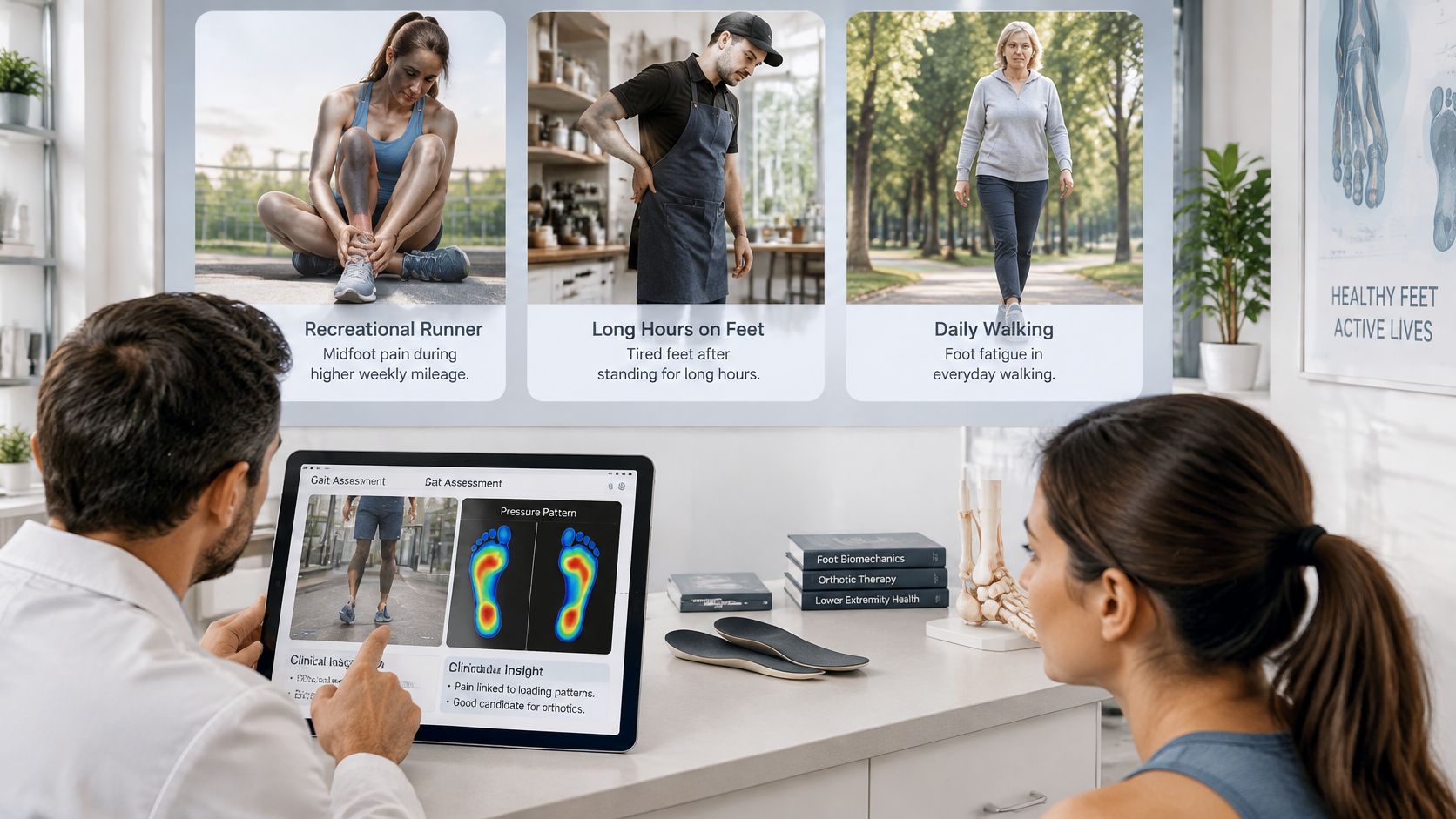
Different people need different treatment targets
The recreational runner. Say midfoot pain appears as training increases. Before prescribing an insert, examine the painful structure, recent training changes and footwear. If an orthotic trial is appropriate, judge it against a defined running task, not a promise of faster times or injury prevention.
The standing worker. A worker whose foot pain interrupts a shift needs an assessment that accounts for work footwear and standing conditions. The useful outcome is whether the worker can complete the relevant task more comfortably, not whether the scan looks more symmetrical.
The older adult with instability. Separate foot discomfort from weakness, dizziness and other contributors to unsteadiness. If support is trialled, assess walking security alongside strength and balance needs. Don’t assume an orthotic alone will prevent falls.
The accompanying video provides another way to consider foot support and assessment.
Emerging applications need cautious expectations
Pregnancy-related foot pain affects up to 40% of pregnant individuals, according to the Pedorthic Association of Canada’s 2024 research project description, which describes an investigation into customized 3D-printed orthoses. An investigation isn’t a positive treatment result, so this application should be treated as emerging rather than established.
People with painless flat feet shouldn’t assume they need treatment because of their foot shape. Likewise, an insert isn’t a substitute for identifying pain referred from elsewhere or a condition that requires different care. A guide to signs that may warrant an orthotics assessment can help frame questions, but symptoms still need interpretation.
A person can have an unusual-looking foot without needing a device, and significant pain without needing a custom one.
Diabetes, reduced sensation or circulation concerns require clinical assessment before an insert trial. Seek prompt medical review for new numbness, open sores or sudden swelling rather than trying to solve them by changing arch support. A hot, swollen foot, a wound or rapidly worsening symptoms shouldn’t wait for a routine fitting appointment.
What to Expect Over the Coming Weeks
A new orthotic may feel unfamiliar. Follow the wearing schedule given at fitting rather than immediately using it through a full work shift or demanding training session. A change in contact under the arch is different from sharp pain or a new pressure injury.
Don’t push through new numbness, worsening focal pain or rubbing that breaks the skin. Stop the activity that provokes it and contact the treating clinician; skin damage or concerning neurological symptoms may need medical review.
Agree on a review rule
Keep brief notes that distinguish comfort from actual functional change:
- Defined walk: Record symptoms during the same route or comparable walking task.
- Standing tolerance: Note when discomfort begins under similar working conditions.
- Chosen activity: Record whether the task is completed, modified or stopped.
Book follow-up rather than waiting indefinitely for discomfort to disappear. If the agreed outcome hasn’t improved by the planned review, the clinician should reconsider the diagnosis, shoe compatibility and prescription, then discuss whether adjustment or a different approach is warranted.
Reassessment trigger: No meaningful improvement should prompt a clinical decision, not an automatic instruction to keep wearing the device.
Persistent tendon symptoms also need their own assessment and rehabilitation strategy. Information on Achilles tendonitis treatment in Milton can help distinguish a broader rehabilitation discussion from changing inserts.
Orthotic materials can deteriorate with use. Arrange review when the device loses its shape, develops damage or no longer feels suitable, rather than replacing it solely because a calendar date has passed. The expectation is a testable improvement, not guaranteed resolution.
Costs, Coverage and a Pre-Order Checklist
A 2025 Canadian estimate published by MYOMED places the average price of custom orthotics at C$400–C$600 per pair. Treat that as a budgeting reference, not a quote for your prescription or an assurance that assessment and follow-up are included.
The financial question is what you’ll pay for the complete episode of care. Obtain a written breakdown of assessment, fabrication, fitting and adjustment charges, and compare the proposed approach with an appropriate prefabricated trial.
Coverage must be confirmed before payment
Ontario public health coverage generally doesn’t pay for routine orthotics, and workplace or extended-health reimbursement may require a prescription or diagnosis, biomechanical examination, gait analysis, manufacturing details and proof of purchase, as outlined in OTIP’s guidance on buying custom-made orthotics. Annual limits and provider restrictions can make reimbursement conditional.
Don’t confuse physiotherapy coverage with orthotic coverage. Public plans such as OHIP, seniors coverage and post-discharge coverage may cover physiotherapy, while private insurance often supplements this. That doesn’t establish eligibility for a device.
Digital scanning also needs to be evaluated separately from reimbursement. A scan is a fitting or manufacturing tool, not proof that the resulting treatment will produce a better clinical outcome. Ask for an explanation of the prescription rather than treating the technology’s name as the reason to buy.
Check these points before ordering
Confirm the diagnosis and the custom requirement. Write down the condition being treated and the finding that calls for an individualized device. Flat feet or an unusual scan alone don’t explain the expected benefit.
Discuss the alternative first. Establish whether a prefabricated trial is reasonable and, if it isn’t, why not. If you’ve tried inserts already, bring them so the clinician can examine the fit and modifications rather than relying on the word failed.
Get the insurer’s requirements in writing. Confirm the eligible prescriber and dispensing provider, necessary documents, claim limits and any approval requirements. Ask the insurer whether the proposed assessment and manufacturing method meet your particular plan’s definition.
Clarify adjustment arrangements. Before authorizing fabrication, establish whether follow-up adjustments are included, what they cover and whether shoe changes could require further work. Don’t assume every fitting issue is covered by the initial payment.
Bring a baseline rather than a general complaint. Prepare notes about the activity you can’t comfortably complete, the footwear involved and what makes symptoms better or worse. This gives the clinician something concrete to evaluate.
Agree on the next decision. Specify what improvement would justify continued use and what would prompt modification or another treatment approach. A purchase shouldn’t commit you to repeating the same strategy without evidence that it helps.
Keep copies of the prescription, assessment documentation, manufacturing description and receipt. If a claim is declined, request the reason in writing before paying for additional documentation or another device.
Your next step this week is an assessment, not necessarily an order. Bring your usual shoes, previous inserts, symptom notes and written benefit requirements to the appointment so the clinical and financial decisions can be made together.
Tonic Physio offers custom orthotics in Milton, assessed using 3D scanning or GaitScan technology. Visit Tonic Physio to book a detailed assessment, and bring your footwear and baseline notes so we can discuss whether a custom device fits your condition and goals.